Mongolian Defense Diplomacy

Over the last few months, Mongolia has hosted or taken part in several multi-national military exercises with the aim to develop the Mongolian army’s peacekeeping abilities, as well as a way to leverage military-to-military ties as a tool of diplomacy.

Khaan Quest

On August 10–13, Mongolia held the annual peacekeeping exercise, Khaan Quest, which opened in the presence of Admiral Samuel Locklear, Commander of the United States Pacific Command. Khaan Quest 2013 adjourned on August 14 with remarks from another high-ranking military official—Lieutenant General Terry G. Robling, the commander of the US Marine Forces in the Pacific. About 1,000 troops from Australia, Canada, France, Germany, Japan, India, Nepal, South Korea, Tajikistan, the United Kingdom, the United States and Vietnam took part in this peacekeeping field training exercise, while China, Russia, Turkey and Kazakhstan sent observers. The importance of Khaan Quest goes beyond the direct military training it provides for Mongolia’s soldiers. At the request of the Mongolian government, the US has provided the country assistance in transforming its former Soviet-style military training field (known as the Five Hills Training Center) into a regional peacekeeping training center. And in addition to having been the site of this year’s Khaan Quest exercise, Five Hills also hosts bilateral training exercises with major powers like the US, China, India, Germany as well as minor powers such as Belgium and Qatar. Today, Mongolia’s Five Hills is the only multi-national peacekeeping training center in Northeast and Central Asia.

Military Exercises with China and Russia

The following month, on September 16 and 17, the Mongolian military began two separate exercises with the Russian and Chinese armed forces, respectively. About 300 military personnel of the Russian Eastern Military District, along with 800 Mongolian troops participated jointly in the Selenge 2013 counter-terrorism tactical exercise (Press Release, Ministry of Defense of Mongolia, September 16). Annual Russian-Mongolian exercises, which had resumed in 2008, are not confined to a single training center, but rather are held in different locations to support the Mongolian military’s efforts at boosting its armed forces’ maintenance and readiness. For instance, the 2009 exercise, Darkhan-2, was focused on rehearsing the repair and maintenance of military equipment for peacekeeping deployments (RIA Novosti, August 18, 2009; EurasiaNet, August 26, 2009).

In contrast, the next day’s military exercise with the Chinese People’s Liberation Army (PLA) has occurred for the first time in Mongolia. The first bilateral exercise was conducted in China in 2009. This year, 70 PLA military engineering units shared their disaster-relief expertise with their Mongolian counterparts at the Five Hills Peacekeeping Training Center (Xinhua, September 17). Interestingly, as the joint exercise was occurring, the Mongolian defense minister concluded the first-ever agreement with the PLA to develop joint military-technical cooperation in Beijing (Press Release, Ministry of Defense of Mongolia, September 19).

Defense Diplomacy – Global Peacekeeping

Rather than being signs of geostrategic competition over Mongolia by Washington, Moscow and Beijing, the three recent exercises demonstrated Ulaanbaatar’s active defense diplomacy strategy. All three major powers with which Mongolia held its military drills—the US, Russia and China—are actively supporting Mongolian military’s participation in global peacekeeping operations. Moreover, the recent exercises all contributed to regional confidence building measures.

Years of holding such bilateral and multilateral exercises have helped the Mongolian armed forces to modernize, raise their operational capabilities, and develop the skills necessary to deploy its peacekeepers to foreign theaters. Within just a short period of time (2003–present), Mongolia has become the second largest troop contributor from Northeast and Central Asia to United Nations peacekeeping missions, with 927 soldiers stationed abroad as of August 2013. And over time, Mongolia has deployed over 800 (two rotations per year) military personnel to the International Security Assistance Force (ISAF) operation in Afghanistan. Given Mongolia’s small population size, military, and relatively low GDP per capita, its contributions are impressive.

In return for Mongolia’s previous troop deployments to the war in Iraq and the ongoing mission in Afghanistan, the US provided the country with substantial military training, education and assistance to develop a sizable (2,500 personnel) peacekeeping force, to establish the regional peacekeeping training center, and to build niche capabilities like a field hospital, military police as well as engineering capacities. As a result, the Peacekeeping Training Center is in year-round use by Mongolia in pre-deployment training, as well as for bilateral and multilateral peacekeeping training. Furthermore, a Mongolian-run field hospital (Level II) has been operating in Darfur since November 2010. The Mongolian military now has enough cadre and equipment to run its own self-sufficient peacekeeping-related training. Meanwhile, Mongolia’s steadfast deployments to Afghanistan with German, US, and Belgium militaries contributed to Ulaanbaatar’s new membership status in the Organization for Security and Cooperation in Europe (OSCE) as well as partnership with the North Atlantic Treaty Organization (NATO) (see EDM, May 9).

Gradually overcoming its suspicions over the regularly held Mongolian-US military exercises, the PLA has itself begun to support Mongolia’s peacekeeping ambitions. In November 2011, the PLA constructed the recreational facility, “Complex for Peacekeeping.” The facility is used for Mongolian peacekeepers to overcome post-deployment stress after returning home (Press Release of the Government of Mongolia, November 15, 2011). The Mongolian military also receives military engineering equipment from China for its newly established peacekeeping-designated construction-engineering battalions. Similarly, Mongolia obtained diesel armored vehicles and equipment through Russian military assistance (RIA Novosti, February 17). This cooperation is reflected in Mongolia’s strategic partnership declarations with Russia and also China (People’s Daily Online, June 17, 2011).

Mongolia’s defense and security policies are not being driven in response to the geostrategic interests of its neighbors or international great powers. Rather, the US, Russia and China are attracted to Mongolia’s non-threatening, sustained interest in taking part in global peacekeeping efforts. And developing those skills is helping Mongolia to modernize its armed forces, raise its international profile and increase the country’s importance in the eyes of foreign powers and institutions. US cooperation with the Mongolian military seems to be limited to developing Mongolia’s peacekeeping capabilities for taking part in UN- and coalition-led missions abroad. China and Russia are also responding favorably to Mongolia’s defense diplomacy, though respectfully of each other’s concern for maintaining this country’s continued neutrality. Nevertheless, Russia has resumed intense bilateral military interactions, including high-level talks, military assistance (e.g., education, training, hardware), and annual military exercises that stress interoperability and readiness. On the other hand, Mongolia’s approach to cooperation with China is more cautious and gradual in order to overcome their decades-long history of hostility. Overall, Mongolia’s defense diplomacy, whose stated aim is developing Mongolia’s international peacekeeping capabilities, has contributed to positive, balanced relations with the major powers and gained support from each of them.

Note: re-posted with the permission of the Eurasia Daily Monitor of the Jamestown Foundation, for the original news, Eurasia Daily Monitor (October 9, 2013)

Posted in China, Eurasia Daily Monitor, Foreign Policy, Military, Russia, United States | Tagged | Leave a comment

Solutions to the Current Economic Crisis?

Previously, I have written about economic and political aspects of the challenges currently facing Mongolia.

Right now, the economic situation seems a bit like a “wicked problem” or a quagmire, and I see relatively little cause for short-term optimism, but the Government of Mongolia and Rio Tinto especially in the long run have too much at stake in the Oyu Tolgoi project not to come to some solution…

In my mind, progress and a re-start of Phase II of Oyu Tolgoi is the surest and most expedient route to addressing the current economic challenges. While construction would not start up overnight, it would rev up somewhat quickly, especially for the predominantly underground elements of Phase II. This would provide jobs, taxes, and multiple spin-off effects that would maintain Mongolia’s growth rate. This in turn would address some of the budgetary challenges and most likely also the current account deficit, at least to some extent. Finally, a re-start of OT construction would be a powerful signal to any potential other investments.

Solutions

From my perspective, the most urgent challenge to Mongolia’s prosperity and development is the lack of progress on Oyu Tolgoi. Given the enormous size of this project, an accelerated development of the project would carry the Mongolian economy at rates that might not set records or send the world’s capital flocking to gleaming Ulaanbaatar office towers, but does have the potential to bring significant employment and other financial benefits to Mongolians. A collapse or much further delay of this project is bound to have a significant impact on other foreign investment and any attempts at economic diversification. Conversely, further delays will certainly dampen the enthusiasm of potential investors no matter whatcurrent legislative initiatives might bring.

To work out such differences, it appear that both partners need to take a less adversarial attitude. Ivanhoe Mines’ and Rio Tinto’s reputation has always been that they are not willing or able to fully engage the local political context and thus continue to run into difficulties with the GoM. As I am not privy to any such discussions directly, I have no direct knowledge of such attitudes, but even if these impressions are unfair, the fact that they keep getting repeated in Ulaanbaatar and elsewhere suggests a difficult-at-best relationship between the partners.

Perhaps recent changes in Oyu Tolgoi management and the replacement of the three GoM-appointed directors will bring about a change in attitude.

Beyond such a shift in attitudes some hard thinking among Mongolian policy-makers is very necessary.

Owning OT?

Is an ownership stake in OT really the best way to proceed? I have long been of a view that this ownership raises massive governance challenges surrounding the regulation (environment, taxation, employment, etc.) of an entity that the GoM co-owns.

A further clear risk in ownership is that it magnifies dependence on a single sector as any downturn in OT’s fortunes would bring immediate demands for state support and thus exacerbate such a downturn.

In contrast, a well-regulated (an ambitious notion in itself) privately-held entity could produce highly liquid revenue streams that are then available for investment towards diversification abroad, and savings.

Therefore, some kind of floating of the GoM’s share in OT or distribution of these shares would seem to be a viable alternative. business-mongolia recently looked at a variant of this proposal that would see equity swapped for a higher royalty rate.

Owning OT!

If the GoM remains committed to an ownership stake, there are many puzzles to be resolved. Currently, there are calls for demands of proportional representation not just on the BoD but across management ranks as well. The recent record of state-managed entities such as TT suggest that this might not be a very good deal for the Mongolian people.

Whether there is active and direct participation in management is something to be pursued or not, the fundamental mandate of such participation needs to be clarified as it does for the role of the members of the BoD. Do they represent the Ministry of Finance and thus aim to maximize financial shareholder value? Do they present the Ministry of Environment and should thus force environment ambition on the company? Is there main task to ensure employment gains? While these are not always conflicting objectives, they certainly can be. If priorities are set, they should be communicated very clearly to the Mongolian public as well.

Posted in Business, Development, Economics, Foreign Investment, Governance, Inflation, JD Mining Governance, Mining, Policy, Politics | Tagged | 2 Comments

Summer 2014 History Events with Mongolia Focus

A 5-week faculty summer institute on “The Mongols and the Eurasian Nexus of Global History” and a conference on “Changing Patterns of Power in Historical and Modern Central and Inner Asia” have been announced recently. While these include a focus on transnational history, they certainly also include a focus on Mongolia.

The Mongols and the Eurasian Nexus of Global History

Aimed at undergraduate teaching faculty to help them develop curriculum content that focuses on Mongolia and cultural interactions throughout Inner Asia.

Funding: National Endowment for the Humanities
Location: East-West Center, Honolulu, HI, USA
Dates: May 26 – June 27, 2014

Information

Changing Patterns of Power in Historical and Modern Central and Inner Asia

The conference will focus on the role and position of Central and Inner Asia from the 12th century until today by tracing socio-historical systems and long-term historical legacies. Understanding various patterns of power in an historical context, including their meanings, concepts and semantics, their competition, appropriation and exchange, as well as institutions and schemes of redistribution, is vital in this respect.

This Forum stresses the transregional character of communication and exchange of the socio-political concepts and cultures between Central and Inner Asia and other world regions.

Location: Ulaanbaatar, MGL
Dates: August 7-9 , 2014
Information

Posted in Conferences, History, Inner Asia, Research on Mongolia, Teaching in Mongolian Studies | Tagged | Leave a comment

Study in Canada Education Fair, Oct 27-29, Ulaanbaatar

The Canadian embassy in Ulaanbaatar is hosting its first Canadian Education Fair later this month.

Over 20 education institutions from Canada will be represented at the fair, reflecting a commitment to education as a key to success and prosperity of any nation.

Educational programs that will be highlighted include higher education, English and French foundation programs, technical and vocational education, as well as programs for secondary students.

There should be lots of information available for students, parents, and educators on October 27 from 11:30-18h at the Blue Sky Tower.

The University of British Columbia will be represented at the fair as well, so I hope that many Mongolians will make use of this opportunity.

Posted in Canada, Education, Higher Education | Tagged | Leave a comment

Foreign Policy Roundup #7: September 16-29, 2013

It was a busy week in the world of Mongolian diplomacy with both President Elbegdorj and Minister of Foreign Affairs L. Bold attending the 68th Session of the United Nations this past week. I have provided a break down of their activities below. As always, if I have missed anything please do let me know.


——-

At the 68th Session of the UN: 

While attending the UN General meeting, Mongolian President Elbegdorj:


Minster of Foreign Affairs, L. Bold:

Mongolia announced the establishment of diplomatic relations with Sierra Leone.


Europe

The OSCE Institute at the University of Hamburg and the Mongolian Institute for Strategic Studies conducted an open training session for civil servants, NGOs, and researchers

Mongolia’s new ambassador to San Marino presented his credentials to the San Marino government.


North America

The Mongolian Consul-General in San Francisco, California met with the state assembly member, Tom Ammiano, to discuss Mongolian social and economic topics.

Mongolian Minister of Development, N. Batbayar, and the U.S. Ambassador to Mongolia, Piper Campbell, signed an agreement, which authorized a financial package of $5.1 USD to the Mongolian government. This additional funding was the direct result of the newly signed US-Mongolia Transparency Agreement.

Leader of the Mongolian Parliament, Z. Enkhbold, met with the Director of the Mongolian-North American Business Council to discuss foreign direct investment, future mining plans, environmental issues, and green development strategies.


Asia

Several Mongolian Parliament members met with Singaporean representatives of the international financial consulting firm, KPMG.

The Mongolian-North Korean Consultation Commission met in Pyongyang.


Neighbors (China and Russia)

L. Bold met with the Russian Ambassador to Mongolia to discuss the Russian-Mongolian strategic partnership.

Mongolia’s Minster of Defense, D. Bat-Erdene, traveled to China to conduct official negotiations on military and technical cooperation. During the negotiations, they discussed Asia-Pacific security issues more broadly, and North Korean issues specifically. The visit ended with the signing of a MoU on the future of their cooperation and strategic partnership.

On the invitation of Ts. Oyungerel, China’s Minister of Culture made an official visit to Mongolia. After meeting with a delegation from Mongolia’s Sport, Culture, and Tourism Ministry, he met with the Chinese ambassador to Mongolia. Before leaving he and Oyungerel signed a protocol on “Organizing 2014 Cultural Relations Days.”

Posted in 2013, Foreign Policy Roundup, Mongolia and ... | Tagged | Leave a comment

Politics During the Current Economic Crisis

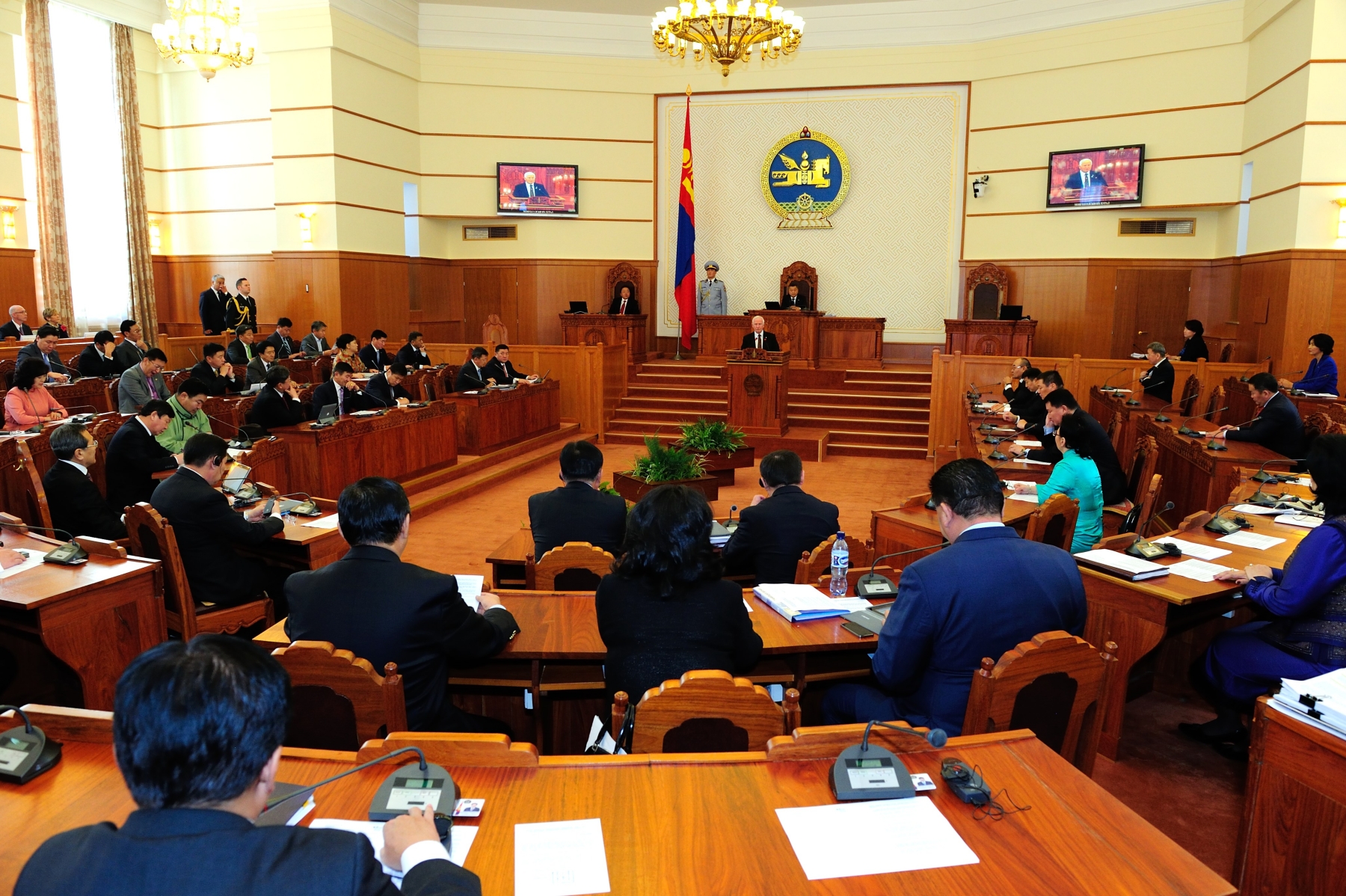
There is no political crisis in the sense of any conflict within parliament or between parliament and the president. Nor are there major scandals at the moment. However, there does appear to be a crisis in the sense of the lack of ability of policy makers to address the current economic challenges and to move toward immediate and long-term solutions.

This is also somewhat ironic, of course, as the re-election of President Elbegdorj seemed like a triumph for the Democratic Party and its occupation of the three highest constitutional offices (president, prime minister, chairman of the Ikh Khural) at the same time as having a DP mayor in place for Ulaanbaatar.

PM Altankhuyag has been – perhaps surprisingly – successful in keeping his coalition of the DP, MPRP and Civil Will Green Party together for over a year now. Factions and disputes between factions often bubble to the surface within the DP and while a replacement of Altankhuyag as prime minister does not seem imminent, it would also not come as a major surprise. Few would place a lot of money on the likelihood that Altankhuyag will be able to serve out an entire term until the 2016 election. The current rumours seem to point to Minister of Defence D Bat-Erdene (no relation to former MPP presidential candidate, B Bat-Erdene) as a possible replacement.

For the moment, there does not appear to be a viable alternative to the current coalition of DP, MPRP, and CWGP as the MPP seems unlikely to want to enter into any coalition, especially since it is facing an on-going leadership crisis of its own. On the questions surrounding the economic crisis none of the parties offer a particularly different vision of how to tackle the current challenges, nor on the direction to pursue in the long run.

On the policy-making side, the government’s contrition over last year’s foreign investment law – once again – seems largely reactive, not the result of strategic considerations that have led the government to pursue a particular course of action. Acting primarily in a reactive fashion is obviously not unique to the Mongolian government, but it has been a pattern in the country when it comes to investment and mining regulations. The pendulum swinging from the initial welcoming of foreign investment around the turn of the millennium to the Windfall Profits Tax in 2006 and back to a more welcoming stance in the negotiations for the OT Investment Agreement charts the reactive nature that legislation on foreign investment has exhibited.

Elbegdorj has announced that he has withdrawn the much-aligned (at least by foreign and business observers) draft Mining Law, and has even recused himself from further deliberations.

This lack of strategic planning is yet another piece of evidence for my on-going argument that one of the crucial roadblocks to Mongolia’s economic, political and social development continues to lie in its lack of policy-analysis and policy-making capacity.

The greatest fear regarding the political reaction to the current crisis is thus that reactive policies represent yet another swing of the policy pendulum toward investor friendliness which might be followed again at some point in the medium-term future by a swing in the opposite direction and to opposite extremes.

In his recent statements, Elbegdorj has made it clear that he feels a profound responsibility for the fate of Mongolia for the remainder of his term. He has pointed this out in light of the fact that this will be his final term as president and that he thus is not acting out of personal ambition. Some argue, on the other, hand that he may be driven precisely by personal ambition, given his rumoured ambition for a position with an internal organizations, perhaps the UN.

Posted in Business, Development, Economics, Foreign Investment, Governance, Inflation, Mining, Oyu Tolgoi, Party Politics, Policy, Politics | Tagged | Leave a comment

Anatomy of the Current Economic Crisis

Having spent last week in Ulaanbaatar, it is clear to me that the current crisis is a) more severe than I had thought, and b) more real/less perceived than I had thought.

Below, I try to list elements in this economic crisis. I will follow this up with another post that focuses on the political context to the crisis.

Elements in the Economic Crisis

These are the main elements in this crisis:

  • the massive decline of foreign investment
  • a softening of economic growth in China
  • on-going uncertainty around Oyu Tolgoi
  • a current account deficit, inflation and the depreciation of the tugrik

2012: Foreign Investment

A number of the elements in the current economic crisis date to 2012, the decline of foreign investment and the decline of coal exports to China.

In May 2012, parliament hastily approved a foreign investment law to prevent the takeover of South Gobi Sands by Chinese aluminum giant Chalco. The law initially seemed to be focused fairly narrowly on establishing a review procedure by the government and parliament for foreign investments of a certain size and involving state-owned enterprises. In this, the law was not dissimilar to similar measures in countries like Canada or Australia (see my “Mongolia’s Evolving Foreign Investment Regime“, January 9 2013, East Asia Forum; also two posts on this blog: “FDI to Mongolia: Restrictions, China, and Comparisons with Canada“, Dec 5 2012, and “Foreign Investment to Mongolia: Restrictions, China, and Comparisons with Canada II“, Feb 1 2013). While the law was promoted as much by anti-Chinese sentiment as by a desire to control mining assets in Mongolia, it was poorly drafted and contained provisions that created a great deal of uncertainty among foreign investors regarding their ability to sell assets and thus cash in on investments (see for example a legal analysis provided by Hogan Lovells in the context of proposed amendments to the law, “The Proposed Amendment to the Strategic Foreign Investment Law of Mongolia: Not the cure-all as advertised” (Apr 15, 2013, PDF).

This uncertainty has lingered and has led to the shelving of exploration activities by many foreign investors, primarily from Australia, Europe, and North America. The uncertainty was confounded by proposed amendments to the mining law (see for example Mendee’s blog post, “Major Revision of Mongolian Mining Regulations is Under Way” May 11, 2013).

The result of this uncertainty has been a decline of foreign investment that some peg around 50% though it’s unclear how much of that is due to decisions not to invest further, as opposed to decisions to actually withdraw investments.

Some portion of this drop is also attributable to the conclusion of Phase I of Oyu Tolgoi construction. Since Phase II is currently on hold, this has reduced foreign investment into the OT project.

One of the ironic aspects of this decline in foreign investment from OECD countries is that apparently (no confirmable numbers on this, merely something that is talked about in Ulaanbaatar) many of the assets that may have been abandoned in the context of investment reviews by OECD foreign investors (primarily Canadian and Australian) have been snapped up by Chinese investors. The same may also hold for Mongolian projects that have faced financing challenges as the current crisis has worsened. So while the foreign investment law may have prevented the sale of South Gobi to Chalco, it may have created opportunities for the sale of smaller and medium-sized projects to Chinese investors as an unintended consequence.

It should also be noted that 2012 was a year when a number of prominent foreign companies came under investigation by Mongolia’s authority for a number of alleged violations against mining regulations and tax evasion (apparently). The prosecution of these offences – whether it may have been justified by malfeasance or not – added to the perception of embattled foreign investment.

The Mongolian government was not too bothered by howls of protest coming from investors last year. Some of this lack of concern was rooted in a sense of optimism about Mongolia’s economic development that was rooted in the high growth rates of previous years and expectations tied to what seemed like the imminent beginning of production at Oyu Tolgoi. The sense of economic (over)self-confidence that was so palatable in Ulaanbaatar was reinforced even more by the success of the launching of the Chinggis Bond in November 2012 that was oversubscribed and netted the government US$1.5b. Oddly, this capital was raised without a clear sense of what the funds might be spent on leading to a pointed line of questioning of the government’s plans from the opposition. Regardless, the oversubscription was taken to be an endorsement of the Mongolian economic and economic policy, and concerns about foreign investment were brushed aside.

I should note in this context, that some of these developments did not seem entirely pernicious to me last year. I have been of a view that Oyu Tolgoi may be all that the government of Mongolia can and should handle for some time, so that the decline in the number of other active projects seemed like a development that would allow political and regulatory energy to focus on “getting OT right”. Other projects could then be re-activated in later years when the regulatory environment was settled in the context of development of OT, and some infrastructure and training needs would also have been addressed at that point.

I am still fundamentally of this view, i.e that OT on its own is “large enough” for significant growth and so large that regulatory and development efforts will already be stretched very thin by a focus on OT. I do recognize in the current context, however, that the slowdown and uncertainty around OT (see the discussion below about how the government is not “getting OT right” in 2013) has led to an economic crisis that I had not anticipated in part because I continue to believe that OT is too big to fail for the government as well as for Rio Tinto.

2012: Softening of Exports to China

In terms of the active selling and buying of goods (not investment), the Mongolian economy is dominated entirely by its trade with China of course. China continues to be the main source of imports of all manner of consumer and many industrial goods, and it is the destination of the large majority Mongolian exports, whether that is raw or processed materials, or any products.

As China’s rapid growth has slowed to be merely fast growth, the exports of coking coal from Mongolia to China have halved over the past year or so. Frik Els has collected some of the numbers of this shift for mining.com. In addition to the slowdown in China, there have also been a number of managerial challenges in that some of the contracts that Mongolian firms had entered into turned out not to be very advantageous and allowed Chinese buyers to back out when prices started sinking.

2013: Grappling with OT Ownership

Earlier this year, President Elbgdorj opened a large can of worms when he outlined a detailed list of questions he had about the construction of OT (see my “Giving Power to the People of Mongolia“, beyond BRICS, Financial Times, Mar 19 2013, for example.

While many of the points that Elbegdorj has raised are legitimate areas of questioning and should also prompt some very serious thinking in the Mongolian government, none of this thinking has led to any solutions. The start of production and delivery of copper concentrate was delayed several times earlier this year and recently, further construction of Phase 2 and the associated underground operations has been suspended. Not to be outdone in a sulking contest with the Government of Mongolia, Oyu Tolgoi (i.e. Rio Tinto) fired 1,700 workers in August.

While the middle of September has brought many statements from the government indicating contrition over economic policy for the past year or so, mention of Oyu Tolgoi was conspicuously absent from all these statements.

They only good news regarding the project recently has been the appointment of three new members of the board of directors of Oyu Tolgoi by the Mongolian government according to its 1/3 ownership stake. These directors are surely politically connected to the DP and the president, but they have worked in the mining industry or on mining regulation for some time, bringing a different level of competence to their appointments.

2013: From Cushioning a Softening of Growth to Inflation and Currency Depreciation or The Budget

There have been significant infrastructure investments by the Mongolian state this year that have cushioned the blow of the withdrawal of foreign, non-Chinese investment, and the slow-down of coal exports. These investments and injections into the economy have maintained growth rates for the first half of the year. They are also putting pressure on the state budget. While this pressure has been curbed somewhat by a slowdown in expenditures, the government is facing a deficit on the order of US$100m. This is a comfortable distance from the stability-law-imposed ceiling of 2% of GDP somewhere near US$100m. The Chinggis Bond of last November clearly provided some of the cash for these investments and one can only suspect that the ¥-denominated Sumo Bond announced for later this year will be used to similar purposes. Another aim in raising funds through the Sumo Bond may be to build up foreign currency reserves given the current account deficit. It is also important, of course, to note that these are bonds so that they will ultimately represent a draw on the state budget for interest and repayment. A budget update is due on Oct 1 that will clarify some of the expenditure and likely deficit levels.

2013: A new focus on State-Owned Companies

Over the past several months, there has been increasing scrutiny of Mongolian state-owned companies and their (lack of) profitability. This may have started with some scandals surrounding MIAT, the national airline, that brought more attention to the large state-owned sector that continues to exist. Now, estimates that only 25% of state-owned companies are profitable are even being disputed by some commentators. While the impact this lack of profitability may have on the government budget is not clear to me, it certainly does have an impact.

Clearly such state-owned companies are a mix of some holdings that are meant to be subsidized (utilities, for example), some that provide much needed employment (manufacturing) and others that are more of an investment (Erdenet/OT). The fact that utility companies are operating at a deficit even when plans are progressing for the Central Heating and Power Plant 5 in Mongolia may not be surprising and should probably be evaluated differently that the losses running up at MIAT.

2012-13: The Depreciation of the Tugrik

The Tugrik has declined around 20% since the Chinggis Bond was issued (no direct and singular causal link implied here). This obviously makes all imports more expensive and is thus quite noticeable in Mongolia. Over the course of the summer, a kg of rice has thus gone from T1,600 to T2,000 a change that is representative of the price change of ordinary goods and is obviously very noticeable for shoppers. Likewise, many restaurants had stickers on their menus with new prices during my mid-September visit.

The Bank of Mongolia appears to have been intervening to support the tugrik all year and that has led to a decline of foreign currency reserves given the current account deficit that is due to the decline in exports.

Note that while there has been some discussion of manipulation of the tugrik by currency speculation, this seems somewhat unlikely. For currency speculators outside of Mongolia, the tugrik is not an attractive target as it only clears in Mongolia itself. I.e., it is very complicated (or impossible, at least directly) to hold a tugrik account abroad which means that speculation is not only complicated, but even riskier. Surely some people are speculating on the movement of the tugrik domestically, but this is probably not of a volume to really move the currency around massively.

Comments/corrections Please!

Note that I am not an economist, so if I have misportrayed anything in the above summary of the economic crisis, please comment on the post to offer corrections or further information.

The Mongolia page of the International Monetary Fund (IMF) is always a good source of macro-eonomic indicators that are updated every month.

Posted in Business, China, Corruption, Development, Economics, Foreign Investment, Governance, Inflation, JD Mining Governance, Mining, Oyu Tolgoi, Policy, Politics | Tagged | 3 Comments

Moving with the Seasons: A Photography book on Mongolian Nomads

Liza F. Carter traveled five times to Mongolia over four years to document the daily life of a modern nomadic family and to photograph a way of life that is fast disappearing. Moving with the Seasons: Portrait of a Mongolian Family is a stunning book is filled with photographs and information on the lives of Mongolian nomads.   The books draws on the author’s experience with a single family to revel the unique culture of Mongolian nomads and their remarkable capacity to thrive in one of the world’s harshest environments. The family blends ancient ways of living that have survived since the time of Chinggis Khaan in AD 1200 with elements of the modern world.

The family’s willingness to share with the rest of the world the annual cycle of nomadic life on the Mongolian steppe makes for an unusually intimate portrait. Much of the information found in the test and photographs comes directly from time spent with this family, and is not available in print elsewhere. Moving with the Seasons is both timely in its appeal to the growing awareness in the West that we have a lot to learn from traditional peoples before their ways of life disappear, and timeless in its representation of the humanity of the nomadic family profiled in the book.

A reader on Amazon wrote “This is the book I would have liked to read before I went.. (to Mongolia). It’s about the people themselves, not about the experiences of a westerner observing the people. It takes you through all four seasons with a nomad family, reporting on events that befall us all, from everyday chores to special occasions, even hospitalization and death. In words, the author fills in background, but the pictures really carry the story. A wonderful account of a very special people, modern-day Mongolians.”

Buy a signed copy direct from the author: www.lizacarterart.com

“In an age when most travellers whiz about the globe at light speed, Liza Carter prefers a slower pace that has given her a rare and in-depth look at the fast-disappearing nomadic culture of Mongolia. Her timely book displays extraordinary passion and sensitivity for the people she meets and with a careful eye she brings her reader into the cozy felt gers that the Mongols have called home for centuries. The news cycle in Mongolia tends to focus on the country’s mining boom, evolving business culture, and political tumult in the capital, but Liza Carter instead paints a portrait of a traditional nomad family as they struggle to survive the harsh  landscape and unforgiving climate in a land once considered the greatest empire on Earth.”

Michael Kohn, Author of Lonely Planet’s Guide to Mongolia


“This beautifully illustrated and well-researched story is a tribute to the life of a typical Mongolian herding family. We are given a glimpse into just how close many people live to the edge of survival. Their environment is becoming harsher with the impacts of climate change––raising the question of how much longer they can remain nomadic herders. This book is timely and important.”

Clyde E. Goulden, Ph.D., Director, Institute for Mongolian Biodiversity and Ecological Studies, Academy of Natural Sciences


“In this well-written and engaging volume, Liza Carter offers a vivid view of the Mongolian nomadic pastoral lifestyle in modern times. Readers will enjoy her descriptions of the herders’ shelter, food, customs, and beliefs. Ms. Carter portrays both the joys and difficulties the herders face in a difficult and often inhospitable environment and political landscape. Her anecdotes about the Mongolian families she visited provides the reader with insights into their demanding lifestyle.”

Morris Rossabi, Distinguished Professor of History, City University of New York. Author, Modern Mongolia and Khubilai Khan


“An illuminating look at Mongolian life… charming….even long-time visitors will find fascinating new facets of Mongolian herders’ life here.”

Christopher P. Atwood, professor of Mongolian studies at Indiana University


Posted in Countryside, Nomadism | Leave a comment

ACMS Scholar’s Corner Sept 19 2013

Last night I was very pleased to join the American Center for Mongolian Studies “Scholar’s Corner” at the Blue Sky Hotel.

The events are intended as an informal way for scholars and others interested in research on Mongolia to gather on a monthly basis.

We had a crowd of about 20-25, I think. I am told that it was a slightly more formal session than usual.

I opened up the discussion by saying a little bit about two projects that I’m starting: a census of private primary and secondary schools in Ulaanbaatar, and the role of soum citizens halls in budget decisions and democratization.

Scholar’s Corner at the Blue Sky Hotel Lounge

I also couldn’t resist some musings about what I see as a big dynamic in current Mongolia (or certainly central Ulaanbaatar), namely the extent to which Mongolians now seem to be internalizing rules and regulations and how I see that as a sign of the rationalization of contemporary life and social relations. Examples that I mentioned or that others contributed include: obedience to bus lane regulations, even-odd license plate driving restrictions, and the smoking ban. Some participants agreed with the general gist of this view.

The discussion then veered towards politics, voting, party democracy and other political developments. One of the questions that came up was whether there are generational cleavages among voters and their support for particular parties. Some observed that the DP used to be attractive to younger voters because they were seen as the reforming party, but as their leadership maintains its hold on party power, there may be opportunities for the MPP to reform itself first with younger cadres, to then be perceived as a more business-friendly party.

The sense that Mongolian political parties continue to lack an ideological foundation/definition was also discussed with some views on the pragmatist preferences of Mongolian voters.

Fortunately, the Blue Sky Lounge also serves a nice cold beer so that the discussion wasn’t quite as serious at all times as it may sound here.

It was a delight to meet a number of foreign and Mongolian students and researchers, and it is very clear to me that lots of interesting research is being done in Mongolia where the pace of social change is such that there is lots of room for more research!

If you’re interested in these meetings, be sure to check on the ACMS webpages or like/follow on Facebook or Twitter.

Posted in American Center for Mongolian Studies, Research on Mongolia, Social Change, Ulaanbaatar | Tagged | Leave a comment

Let’s Call them Sumo Bonds

In a great conversation with a fellow long-time Mongolia watcher, we were contemplating what to call a ¥-denominated Mongolian bond.

This follows Prime Minister Altankhuyag’s trip to Japan last week. It appears that a ¥-denominated Mongolian bond with a volume of around US$1b will be issued later this year. Press reports are referring to this as a samurai bond, thus using the term that is generally applied to non-Japanese  debt issued in Yen. This is in contrast to a sushi bond, for example, which is issued by a Japanese borrower in a currency other than the Yen outside of Japan. So, by common usage, the Mongolian bond would be known as a samurai bond.

In our conversation we were pretty sure, however, that this bond ought to have a special name, just like last year’s US$-denominated Mongolian bond that came to be known as a Chinggis Bond.

Some of the options we considered:

Continuing the Chinggis theme: Kublai Bond. Giving more attention to Kublai Khaan would have the additional advantage of reminding Chinese investors that the Yuan Dynasty was founded by this Mongolian. But, there’s no link to Japan in this name – other than via the attempted invasions (see below) – which seems like a missed opportunity. Also, if Mongolia were to ever issue a RMB-denominated bond, this should really be known as Kublai Bond.

Emphasizing the Japan link: Kamikaze Bond. 神風 was the ‘divine wind’ that saved Japan from Mongol invasions (under Kublai Khaan) in 1274 and 1281. But, these bonds are intended to save Mongolia from its budget crisis (more on that and the wisdom of this bond issue in future posts), not Japan, so that’s not quite right either. Also, the obvious association with the ‘special attack units’ of the Asia Pacific war makes this unattractive as a name.

So, the clear solution came to us:

Yen-denominated Mongolian bonds henceforth shall be known as Sumo Bonds. Sumo here stands for Japanese-Mongolian ties, of course and carries a notion of Mongolian strength when wrestlers arrive in Japan. All recent top wresters have been Mongolian of course. Sumo bond is easily pronounced and will mean something to bond traders in far-flung places as well.

Since sending the first tweet about this proposal, I’ve had two nominations for Yokozuna Bond instead of Sumo Bond. That suits me in principle, but “Sumo” as a term is much more well-known around the world then Yokozuna. [横綱 being the title for the highest rank in Sumo of which there are a maximum of four at a time, but haven’t been more than two in some time, I think. The two current Yokozuna, Hakuho and Harumafuji (both currently fighting in the September tournament) are both Mongolian and were immediately preceded by Asashoryu, also Mongolian. The last Japanese yokozuna was Takanohana who retired in 2003.]

Work with me here on establishing “sumo bond”, use the term, first in quotation marks than without if you are a financial reporter or analyst.

If the term catches, I will trademark it and donate the receipts from my trademark income to a Mongolia-focused charity.

For some notes about sumo wrestlers’ role in Mongolian politics, see my post for the FT’s beyond BRICS blog, “Mongolian Politics – A Wrestling Match

Posted in Curios | Tagged | 3 Comments

Foreign Policy Roundup #6: Sept. 2-15, 2013

Missed something in Mongolian foreign policy news over the past two weeks or just need to review the headlines? Below you will find brief summaries of news in foreign affairs, translated from Mongolian-language news sources, and organized by region.


Central Asia

The Director of the Mongolian Parliament, Z. Enkhbold, received Kazakhstan’s Ambassador to Mongolia, K. I. Koblandin. The ambassador noted Kazakhstan’s intention to further engage with Mongolia and that he hoped both countries would support each other in international organizations, ahead of Kazakhstan’s membership on the UN Security Council in 2017-2018.

President Elbegdorj attended the meeting of the Shanghai Cooperation Organization in Bishkek, Kyrgyzstan.


Europe

Z. Enkhbold met with the President of the European Development Bank, on his official visit to Ulaanbaatar. Since joining the organization in 2006, the Bank has arranged over $1 billion in direct investment and loans to the country.

The first meeting of the French-Mongolian Governmental Cooperation Group was declared a success. Among other things, they discussed the fact that a French company had won the contract for the development of a new power station.

The Prime Minister of Belarus made an official visit to Mongolia. Mongolia’s relations with Belarus have been making headlines lately with visa liberalization and a technology agreement between the two countries coming to light recently. During the visit a new agreement on cooperation on military-technology was signed.

Mongolian diplomatic passport holders will now be allowed to stay in Italy up to 90 days without a visa.

Tony Blair visited Mongolia to consult with government on policy issues ranging from education and health to foreign direct investment.

G. Tsogtsaihan, of the Ministry of Foreign Affairs, met with Spain’s Minster of Foreign Affairs in Madrid, where they discussed their bilateral relations in the context of Mongolia’s security cooperation with the European Union.

Mongolia’s Ambassador to Serbia presented her credentials to the Serbian President. During the meeting, she expressed Mongolia’s wish for increased societal and economic relations with the country.

A meeting on EU-Mongolian cooperation was held in the Government Palace.


Asia-Pacific

PM N. Altanhuyag began his first official international tour in Japan. During his trip, he met with representatives of the Mongolian-Japanese Economic Commission. Following the meeting, the Japanese Cooperation Bank announced that it would be extending an 8 billion yen loan to Mongolia. In the final days of the visit, he met with representatives of the Japanese Parliament, and the Japanese Emperor. He also met with Mongolian citizens working and studying in Japan. Finally, he signed a new official agreement between the countries outlining their strategic partnership for the next five years.


Middle East and Africa

The Ministry of Foreign Affairs circulated an internal memo condemning the use of chemical weapons in Syria, and expressed a hope that fighting would be stopped and solution between all sides be found.

As part of Mongolia’s goal to establish diplomatic relations with all members of the UN, relations with Togo were formally established on September 6 in New York.


Multinational/Multiregional

Minister of Foreign Affairs, L. Bold, met with a series of new ambassadors, including those from Spain, Argentina, Greece, Brazil, Australia, Pakistan, Bangladesh, and Columbia.

Director of Parliament, Z. Enkhbold, met with representatives from 14 countries to exchange opinions on various facets of Mongolian policy, including domestic matters.

The World Economic Forum hosted a Strategic Dialogue on the Future of Mongolia in Ulaanbaatar on Sept 15.

Posted in 2013, Foreign Policy, Foreign Policy Roundup, Mongolia and ... | Tagged | 3 Comments

Back in the UB

By Julian Dierkes

It’s become a bit of a tradition for me to post about my first impressions back in Ulaanbaatar after an absence.

This time, my absence was not very long, i.e. from the presidential election in late June until mid-September.

First impressions have recently been a mix of exhaustion as transfer through Beijing are NEVER smooth [this time I ended up waiting for a hotel shuttle bus for 1 3/4 hrs missing a meeting], and elation at being back in Mongolia.

The flight from PEK was the emptiest flight I’ve ever been on into ULN, and that includes several trips in the winter. Only about 25 people on the plane I would guess. I am not sure whether that means anything, but it was especially surprising to see so few Mongolians travelling on the plane. I don’t think I’ve been to Mongolia in mid-September before, so perhaps it was just a matter of the time of year.

The only disappointment about the small crowd was that there was a reception committee from the Ministry of Foreign Affairs for visitors who were coming for the World Economic Forum Strategic Dialogue on the Future of Mongolia – like myself. There offer of VIP (me, hah!) treatment through immigration was somewhat less useful given that it took longer to check my name on their list than for the other passengers to clear through immigration. Also, I had arranged a pick-up through ACMS, so didn’t need a ride.

One of the great joys of my arrival this time (in addition to that, ah, I’m back in Mongolia feeling) was that as of Sept 1 Germans no longer need a visa to travel to Mongolia. It was with great delight that I presented my visa-less passport, received a smallish stamp, and went on my way.

Were the five huge apartment blocks right next to the airport already under construction in June? I can’t recall.

The airport road close to the airport has disintegrated into a sandy mess. Fortunately, I didn’t care at all as the driver started singing along to radio folksongs which always makes me very happy.

The airport road has now disappeared and been replace by a temporary road that lies to the right (heading into town) which the real new airport highway is being constructed in place of the old road. Anyone who has arrived into Ulaanbaatar especially late at night will have a definite image in front of their eyes, of the bumpy road into town where drivers were especially fond of passing on the right, i.e. on the gravely shoulder of the road.

Just before you cross the Tuul, the “Hunnu Mall” is being constructed. It advertises 50,000sqm of retail space. Is that big for a mall? It certainly looks awful with some gaudy neo-classical elements.

Tragically, the police booth that oversaw the intersection just past power plant #3 on the other side of the Tuul seems to have fallen victim to the construction. For me, this police booth was always the clear marker that a) I was in a post-socialist country, and b) we were almost in town. Is this a metaphor signalling the end of the post-socialist period?


Posted in Change, Curios, Ulaanbaatar | Tagged | Leave a comment

Mongolia Buffeted by Global Winds

[For another version of  observations of the current situation in Mongolia, see my piece in the Wall Street Journal Asia on September 13. This piece has been  posted on the World Economic Forum blog as well.]

For most of the past 100 years, Mongolia has existed in somewhat splendid isolation from global forces of politics and capitalism. Over the past two years it has been buffeted by the winds of global capitalism, jumping from the triumph of the issuance of oversubscribed Chinggis Bonds in late 2012 to its current crisis of a sputtering mining project that growth is almost entirely dependent on. More than ever before, Mongolia’s development path will depend on its decision-makers’ understanding of global dynamics and reaction to these dynamics.

Since gaining independence from Qing China in 1911 and then carrying out the world’s second socialist revolution in 1921, Mongolia existed under the Soviet Union’s economic and political wing until 1990. Even after its democratic revolution in that year and an increasing focus on its “third neighbours” beyond Russia and China, the world found little reason to take notice of Mongolia until 2011. Yes, well-connected Tibetan politicians and activities introduced their Mongolian co-religionists to policy-makers around the world in the 1990s and Mongolia’s success in establishing itself as Asia’s only post-state socialist democracy caught the attention of some international relations officials, but this attention remained quite limited in scope. The 2000s were a decade of mineral exploration in Mongolia that culminated in an Investment Agreement between Anglo-Australian mining giant Rio Tinto and the government of Mongolia in 2009 as a framework for production at the immense Oyu Tolgoi gold and copper deposit in the Gobi desert. Construction investment related to that and other mines pushed economic activities to such heights in 2011 that the country was declared the fastest-growing economy in the world. And the world took notice!

In 2012, as Oyu Tolgoi construction was fueling this rapid economic growth, Mongolian coal exports were generating income, tax revenue and employment. In the Fall, the issue of a first US$-dominated sovereign “Chinggis Bond” was massively oversubscribed. All this good economic news gave a boomtown feel to Ulaanbaatar. Riding on the elevators of new commercial buildings were 20-something Mongolians oozing confidence. Mongolia seemed poised to conquer the world – once again.

Then China’s manufacturing industry sneezed and Moncoalia caught a major cold. Just before catching this cold defenses were already weakened by the hasty passage of a foreign investment law that clarified little and created a lot uncertainty. Now, coal sales to China have tumbled, the giant Tavan Tolgoi coal project is no longer the object of transnational investment desires, and direct investment in Mongolian ventures other than Oyu Tolgoi seems to have evaporated. To add to these woes, Mongolian politicians have been wrestling with cost-overruns in the construction of Oyu Tolgoi and how they are to understand themselves as ⅓ part owners of that mine.These doubts have cast a pallor over this mighty project and financing for its on-going construction. Construction of underground portions of the mine has been suspended and at the end of August 1,700 workers were let go. The Tugrik lost approximately 10% of its value against major currencies in August. Confidence has been shattered and parliament will be meeting in an emergency session in the coming week.

While the government budget has expanded to a volume where such a downturn can be buffered, these measures require the mortgaging of future mining revenues. Mongolia’s ability to rely on foreign donors is disappearing quickly. As the country transitions from a developing country to an emergent resource nation numerous donors will reduce their activities or shift gears from grants to long-term loans.

International investment interest has been a boon to Mongolia’s aspirations and economic development. But it is also introducing pressures and an urgency that decision-makers and the public have been challenged by. Policy analysis capacity in government, but also in civil society, remains low. The press is free and active, but has struggled in adopting professional practices that inform public debates rather than fanning flames, all in the context of widespread political ownership of media.

Rather than developing long-term strategic visions Mongolian political leaders have been reacting to developments outside their own control. The recent presidential election campaign that saw the current president, Ts Elbegdorj, win re-election in late June, was devoid of alternative conceptualizations of Mongolia’s economic development and the impact this will have on social and political development.

The choices that Mongolia faces require much more domestic research and policy analysis capacity. Ideally, this could be built in a non-partisan fashion over the coming decade, possibly in lockstep with the need for capacity building in such areas as financial administration, mining regulation, and vocational education.

But Mongolia’s integration into regional and global dynamics of investment and economic integration also necessitate the consideration of scenarios for the country’s future. Next week, World Economic Forum Strategic Foresight will host a discussion of such scenarios just before parliament convenes in an extraordinary session to consider responses to the current crisis. Discussions of scenarios as well as consideration of changes to investment laws might lay the groundwork for less tumultuous development in coming years that could bring equitable and sustainable growth to this landlocked nation with its extraordinary nature and people.

Posted in Democracy, Development, Foreign Investment, Governance, JD Mining Governance, Mining, Oyu Tolgoi, Policy | Tagged | Leave a comment

UBC Job in Asian Public Policy

The Institute of Asian Research is hiring an assistant professor (tenure-track) in Asian Public Policy. I would personally be thrilled to see applications of junior scholars who focus some or all of their work on Mongolia.

Here’s the job ad:

New Position in Public Policy / Asia at Assistant Professor level 

The Institute of Asian Research (IAR) and the Department of Political Science, University of British Columbia (Vancouver campus), invite applications for a tenure-track appointment at the assistant professor level, effective July 1, 2014, in Asian public policy.  All policy specializations will be considered relevant (for example, governance and policy-making, economic policy, environmental policy, social and gender policy, urban policy, transportation, water, development).

The appointment is a joint position between IAR (75%) and Political Science (25%). Candidates must have a Ph.D. or be nearing completion.  Experience in teaching public policy related to Asia will be an asset. The successful candidate will be expected to maintain a program of scholarly research leading to publication, effective teaching, graduate supervision, and service.

The successful candidate will teach and supervise at the graduate and undergraduate levels in the area of public policy in Asia at the IAR and in Political Science. In addition, the successful candidate will be expected to play a role in the ongoing development of a public policy degree program focused on Asia at the IAR.

The programs, faculty research interests, and general activities of the Institute of Asian Research are found at www.iar.ubc.ca and those of the Department of Political Science are found at www.politics.ubc.ca.

Applicants should apply through the UBC faculty careers website,  and be prepared to upload a C.V., a description of current and future research interests, evidence of teaching effectiveness, and a sample of their ongoing research, preferably in the form of published material. Applicants should also arrange to have three confidential letters of reference sent by email to m.lao@ubc.ca.  Materials should be received by October 15, 2013.

The position is subject to final budgetary approval.  Salary will be commensurate with qualifications and experience.

UBC hires on the basis of merit and is strongly committed to equity and diversity within its community.  We especially welcome applications from visible minority group members, women, Aboriginal persons, persons with disabilities, persons of minority sexual orientations and gender identities, and others with the skills and knowledge to productively engage with diverse communities.  All qualified candidates are encouraged to apply; however Canadians and permanent residents will be given priority.

Posted in Politics, Research on Mongolia | Tagged | Leave a comment

Review of “Mongolia’s State Policy on the Minerals Sector (2013-2024)”

State Policy on the Minerals Sector (2013-2024),” a document defining the policy framework for the Mongolian minerals sector in the next decade is expected to be discussed at the upcoming autumn session of the State Great Khural. President Elbegdorj decided earlier this year that Mongolia needs a comprehensive policy framework that would define the country’s priorities and strategies in the minerals sector before discussing a new Minerals Law. The decision was a result of the discussion on the proposed law held at the Citizen’s Hall in February 2013. Mining Minister Gankhuyag introduced a draft of the document to parliament in July 2013. At present, a working group that is preparing the document for parliamentary discussion is receiving comments from interested Parties. The following is a short review of the policy document.

The document has four main sections: rationale, key principles, policy priorities and implementation. In brief, the rationale is defined as developing a mutually beneficial, transparent and responsible mining and mineral processing industry that supports Mongolia’s sustainable economic growth.

The main principles in developing the Mongolian minerals sector are defined as:

  • open and responsible government;
  • rule of law and transparent corporate governance;
  • non-discrimination of investors;
  • open access to geology and geo-science information;
  • better operational and health safety regulations;
  • research and stakeholder consultation based decision-making;

The document defines the main priorities of different phases or segments of the mining industry: legal and policy framework, geological research and geo-science information, mineral extraction, mineral processing, environmental protection and rehabilitation, and mineral resources management.

In the legal and policy framework section two priorities are particularly notable:

  • Supporting artisanal and small-scale miners’ efforts to work legally under cooperative work arrangements;
  • Supporting Extractive Industries Transparency Initiative (EITI) and Responsible Mining Initiative, and improving regulations on social, economic and environmental assessment.

According to the document, developing a national system of comprehensive and up-do-date geological and geo-scientific information and resources that is capable to provide the opportunity to systematically assess and increase Mongolia’s mineral reserve is a top priority. Private sector-led geological surveys and investment will be encouraged along with government-funded geological surveys and exploration.

As for the extractive sector, the following priorities can be highlighted among others:

  • Incorporation of radioactive elements (U, Th), rare earth elements, underground water, and some large deposits of gold, coal, iron and copper that have the potential to compete in the global and regional markets into the Strategically Important Deposits and government involvement in exploration, extraction and processing of such deposits;
  • Supporting companies that use technologies not harmful to the environment and human health, operate in accordance with the principles of transparent and responsible mining, and pay a significant amount of tax to national and local governments;
  • Development of large-scale mineral deposits by creating investor-friendly regulations and infrastructures.

Regarding mineral processing, government will promote mineral processing through tax and fiscal policies and directly supporting enterprises producing value-added products such copper cathode, ironwork, uranium concentrate powder, distilled gold and rare earth concentrations. Projects on coal enriching, coking and chemical plants, power plants at coking coal deposits, Eco-fuel from brown coal, liquefied fuel from coal and shale, and gaseous fuel from coal are also defined as key priorities.

Regarding environmental protection and rehabilitation, among other priorities, Mongolia will change standards for mine development, rehabilitation and closure, and will create mechanisms for engaging local community representatives in mine closure control and monitoring activities.

On the mineral resources management, a number of specific priorities were stated:

  • Selecting managers of state-owned and state-shared mining companies with the involvement of professional associations and civil society;
  • Supporting domestic businesses in the supply chains and procurement of large-scale projects;
  • Establishing “Wealth Fund” as a fiscal stabilization fund and a sovereign wealth fund;
  • Establishing the Mongolian Minerals Exchange;
  • Promoting civil society monitoring;
  • Establishing a national geological agency;
  • Increasing national human resource for the minerals sector;
  • Creating a unified registration directory of entrepreneurs in the mineral sector.

The policy document explains the structure and institutions for its implementation along with potential risks. It mentions the following national programs to be developed as part of policy implementation: “Geological Mapping,” “Coal,” “Iron,” “Fluorspar,” Rare Earth Elements,” “Copper,” “Construction Minerals” and “Legal Framework for the Minerals Sector.”

The document defines the following as the policy outcomes which can be interpreted as a broad projection of the development of the minerals sector:

  • Geological survey and exploration will be conducted in accordance with the policy priorities, increasing the country’s mineral reserves;
  • Mineral reserves will be extracted in a complex and environment-friendly ways
  • The amount and types of value-added, internationally competitive mineral products will be increased;
  • Mineral revenue will be invested in the non-minerals sectors, minimizing Mongolia’s dependence on the minerals sector;
  • Occupational and technological accidents will be decreased;
  • Opportunities for infrastructure development (road networks, power plants, city, and settlements) will be expanded, allowing long-term development planning;
  • As a result of the development of large-scale industrial centres, population migration will be stabilized;
  • An adequate number of professional personnel of the minerals sector will be prepared;
  • Environmental protection, land rehabilitation and long-term monitoring will be implemented in a responsible and planned way;
  • Mineral extraction and processing will be restricted in water catchment areas, river basins, forest zones, agricultural lands, highly nutritious pastures, Gobi oases, and areas near lakes and ponds;
  • A legal framework for ensuring transparency in the mineral sector, and public consultation in developing laws, regulations and large-scale projects will be developed;
  • Minerals will be traded at the Mongolian Minerals Exchange.

In sum, the document provides a broader understanding of the key priorities of the Mongolian minerals sector. It also clarifies some specific priority areas of mineral development and strategies aimed at consolidating and reforming existing policies and regulations. There are, however, several important issues that are not adequately addressed in the document such as ensuring policy stability, clarifying deposits or minerals of strategic importance and the role of government, understanding the cumulative environmental and social impact of mines on mining zones, developing measures to prevent land use or water-related conflicts between formal and informal mining, promoting non-judicial grievance mechanisms in the minerals sector, and requiring the social and economic empowerment of local communities affected by mining. Especially, the document does not mention about prior consultation with and consent from local communities in the area of mineral exploration and extraction, and agreements and formal negotiations with local communities and their representatives. A clear commitment on ensuring community consultation and broad support for any exploration and mining projects needs to be included in the document.

Posted in Democracy, Development, Governance, Mining, Policy, Sovereign Wealth Fund | Tagged | Leave a comment