In the talk, Julian posed the question of how the presence of “natural resources” influence the shape and course of democratization and economic development in countries like Mongolia.
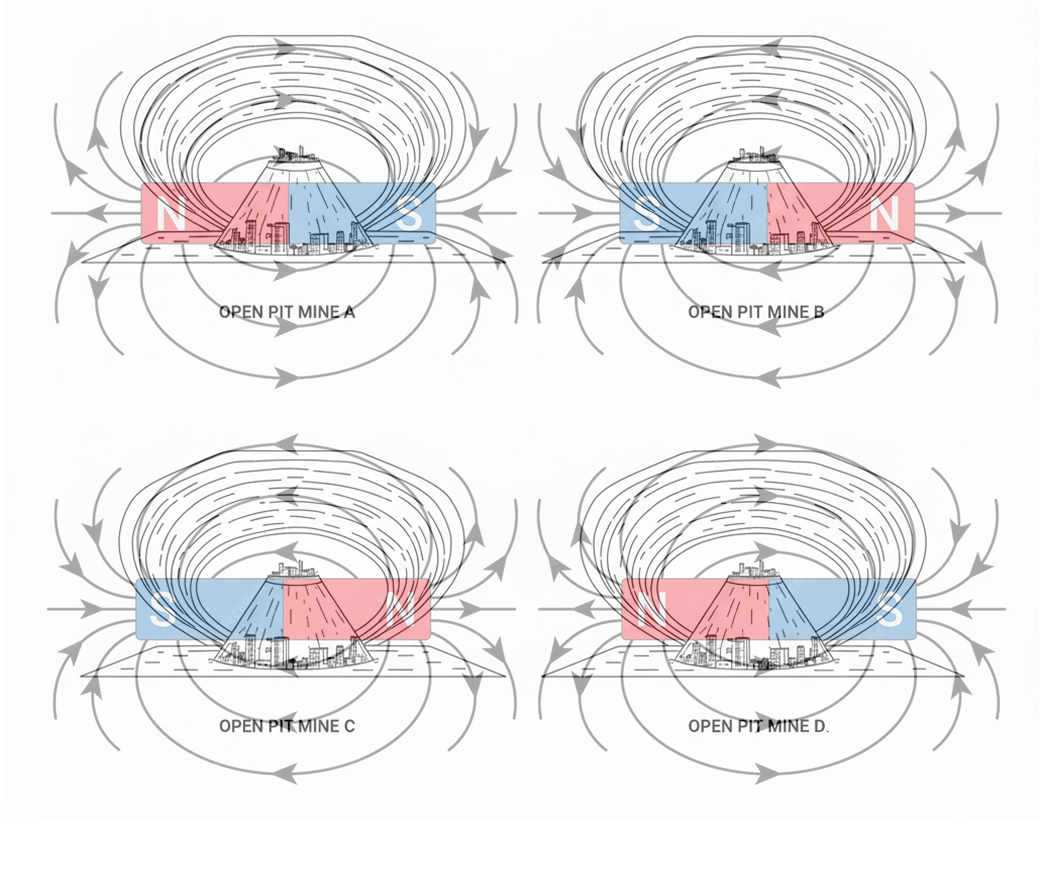
The concept that Julian created, that “natural resources” generate “magnetic fields,” sparked my imagination right away. In his talk, Julian gave a comprehensive review of mining projects in Mongolia and their place in the Mongolian imaginary of national development: Nalaikh as the foundation pit of the Mongolian working class, Erdenet as the modernist “milk cow,” and Oyu Tolgoi as the uncertain and contested present and future. As he demonstrated, the “magnetism” of natural resource projects has profoundly shaped Mongolia’s historical path, making it anything but a linear course of prosperous ascendance.
While the primary association with magnets might be “attraction” (in the case of Mongolian mining, international investors, researchers, bilateral and multilateral agreements, and infrastructure projects), the “magnetism of mining” concept provoked me to consider how magnets and magnetic fields also produce “repulsion” (specialization, geopolitical pressure, and infrastructural restraints).
Fields of Mining Magnetic Repulsion (Created using Gemini 3 and Freepik)
As Julian invited me to reflect on after his talk, the long-term data from Erdenet provides a direct illustration of this magnetism in action. However, looking through the lens Julian has provided, I began to see not just the “attraction” of the modernist “milk cow,” but also the “repulsion” — the specialization and geopolitical pressures — that his framework brings into focus. Acknowledging the “repulsion fields” of mining projects makes possible a particular vision as to how they can drive development gains, at both the local or regional level as well as the national level. While Erdenet functions as the national “milk cow” Julian described, his magnetism framework helps me illuminate how that wealth is not just an input for the national budget, but the regenerative source of a multiplicity of networks maintaining the prosperity of certain groups while repelling “outsiders” who are not “attracted” in by particular types of social physics, at least some of which are particular to the Mongolian context (including the deliberate pacing of more “federalist” reforms in Mongolian governance that Julian noted in his talk).
In the past months, Julian and I have focused on the Prime Minister, the Parliament, and mining in Mongolia as “national” dynamics. We have also documented, however, how as the Prime Minister and the Party have narrativized crises that have (for now at least) “unhappened” as issues of central control in the present to direct development by investigating corruption, collecting revenue from mining projects, and attracting foreign investors, Mongolia’s present problems are also deeply historical and remain caught up in long-standing “force fields.”
I have encountered Mongolia-watchers scratching their heads. The case concerns a collapsed joint project in Australia. But could it have to do with Oyu Tolgoi? Is the event’s alignment with the Oyu Tolgoi Hearings significant?
The elephant (or perhaps, Siberian Brown Bear) in the room is Russia’s aggressively leaning into the geopolitical reordering that has followed the COVID-19 crisis. The “aggressive lean in,” of course, is most obvious in the form of Russia’s invasion of Ukraine. However, from the perspective of Mongolia, recent events including:
continuing fuel shortages due to Ukrainian attacks on Russian refineries,
conversations around outfitting Ulaanbaatar’s ger districts with fixtures for Russian gas,
and a “pilot plan” with the Eurasian Economic Union that exempts almost 90% of Russian exports to Mongolia from duties that was “silently” approved by the Ikh Khural in mid-December
all demonstrate that Russia is keeping Mongolia in its fold. Isee.mn reports that the EAEU deal may reduce Mongolia’s GDP growth by about 6.1 percent and, according to a study by the National University of Mongolia, Mongolian domestic production could decrease by 18 percent due to increased industrial imports.
As reported by Reuters, the case was a re-litigation by a Russian court after a decision had been made by an Australian court. As I have heard others point out, it seems unlikely that the Russian side will be able to collect their claim. I concur, but would emphasize that collecting damages from Rio Tinto is not the point. The point is Russian state entities reinforcing and “claiming” deepening divides with (so-called) “Western” countries like Australia. As the Reuters article notes, initially Rusal was sanctioned by Australia after the 2022 Invasion of Ukraine, and additionally, the “re-litigation” (redefinition of who is calling it quits upon whom) coincides with Rusal acquiring stakes in alumina refineries in China and Russia since 2023. It is significant that at least one Mongolian commentator is concerned that Russia might continue by pressing countries with stake in Rio projects, including Mongolia, to provide “compensation” for the loss in Queensland.
(And, a shout out to Robert Ritz’s Lexica News service for helping me stay up-to-date on Mongolian reporting!)
It was a big year for the blog because we moved from the original home at the Univ of British Columbia to our own domain as I moved from UBC to the University of Mannheim.
This move has disrupted traffic flows somewhat as search engines make the adjustment to the new location because we have not wanted to take down the old site entirely since there will be many readers who will have been used to the old URL. Judging by the analytics, it seem that traffic really started picking up to the new URLs late in the Fall to reach levels that are comparable to those before the move (but after the evil Twitter takeover that might me quit that platform)
As a reminder to readers, you can fine me on Mastodon and Bluesky where I regularly post, including posts about new blog posts. Mongolia Focus is also on LinkedIn and we send notifications about new posts out via a WhatsApp channel.
Posts
We published 33 posts in the past year, Marissa and I wrote the majority of them, but this also included 10 guest posts. These posts brought us up to 892 posts in total since we started publishing in the summer of 2021. Extrapolation would point to 2027 with its presidential election as the year that we pass the 1,000-post milestone, since we are typically more active during election years.
Among the posts have been some “service posts” like our bios of Zandanshatar cabinet members. Marissa also wrote a really handy glossary of the MPP that helped us (and hopefully readers) analyze several (near)crises of government.
In the long run, I imagine that my attempts to understand changing V-Dem scores on academic freedom may prove to be the most significant to inform future analyses (mine, but hopefully also others). V-Dem also spurred me to write on self-censorship which also seems like it is a lasting feature of Mongolian democracy, if difficult to grasp empirically. Prior to these posts I also published a somewhat frustrated observation about all the things that I have seen repeating in Mongolian politics over the past 20 years without substantive change. I also could not help myself but note the display of toxic masculinity in much of Mongolian political imagery.
The post I probably enjoyed writing most was my musings about the origin of wooden fences.
You know those ubiquitous wooden board fences in urban areas of #Mongolia, right? How can they be so common?
mongoliafocus.com/2025/08/orig…
Marissa also followed this up with her thoughts on egg cartons. Of course, these posts are more musings than analyses, but our position as regular, but intermittent visitors to Mongolia allows us to share some such observations on occasion. In this vein, a Spring visit also allowed me to continue my observations of changes in Ulaanbaatar and in the countryside.
Oh, and no LLM models have been used in the writing of any of my posts, neither for content nor for style!
Readership
Assessing readership has been complicated somewhat by the migration of Google Analytics to a new format, a migration that I have not – honestly – fully understood. For my lack of understanding, the pre-migration and post-migration numbers are not added up, so everything has gone a little wonky.
New Analytics
Using the system that will supply analytics going forward (in operation since Apr 2025), I see a total of 14,000 pageviews (as of Dec 30 2025).
The root page is always the most visited, followed this past year by:
Zandanshatar cabinet (235)
Helsinki Mongolian democracy photo exhibit (191)
PM Zandanshatar (181)
Oyun-Erdene Era (175)
Mongolia Economic Forum (172).
What is very noticeable in this listing is that some of our older posts that have always received strong readership are not included which is probably due to the fact that they are enjoying a zombie existence on the UBC site.
Top ten origin countries of readers (well, there IP address anyway, I imagine) were:
China (60%)
U.S. (14.7%)
Singapore (14.1%)
Mongolia (8%)
Germany (2.6%)
Canada (2.3%)
UK (2.1%)
Australia (1.2%)
Japan (1.1%)
Netherlands (1%)
There are some significant changes from previous statistics in this. The share of pageviews from China is huge. As recently as 2022, this was 4%! Singapore has never featured in this listing before. I cannot help but wonder whether the site migration and analytics shift does not have something to do with this. Seems more plausible to me than a real shift in readership.
Old Analytics
The older tracking logged over 20,000 pageviews. That implies a total of over 34,000 pageviews which is in line with previous, non-election years.
In the most visited pages, some of our “evergreen” posts are making a stronger appearance here:
An ad hoc committee established by the Mongolian Parliament recently held hearings on the Oyu Tolgoi (OT) Investment Agreement, bringing together nearly 300 participants. Attendees included former presidents and prime ministers, current and former ministers and lawmakers, OT board members, executives, and mining-sector experts, all invited to share their perspectives and concerns.
Across several days of testimony, a consistent theme emerged: some frustration with how the agreement was negotiated and how key decisions have been made over the past 16 years. Particular concerns were raised regarding the “Dubai Agreement,” license transfers, high financing costs, governance and transparency shortcomings, elevated management expenditures, and – most prominently – the long delay in dividend revenues. Dividends were initially expected to be distributed starting in 2019, but now are projected to begin in 2041, contingent upon the full repayment of Mongolia’s project-related debt.
This debate carries national significance, as OT is one of the world’s largest copper deposits. The mine is currently ranked 12th globally and is projected to become the fourth-largest copper producer once underground operations reach full production, with annual output expected to reach approximately 500,000 tonnes starting in 2028, according to mining.com. Therefore, decisions made today regarding OT will shape Mongolia’s economic trajectory for decades, either expanding or constraining future opportunities. This underscores the importance of careful, professional, and technically informed renegotiation efforts.
One notable observation from the hearings was the heavy focus on the delay in dividend payments, with comparatively limited attention given to OT’s ongoing economic contributions. Dividends represent only one dimension of how value is generated and distributed in a large-scale mining project. A comprehensive assessment therefore requires a broader understanding of how Mongolia has already been – and continues to be economically impacted by the project. As noted by Julian Dierkes, sustained and iterative renegotiation efforts in key areas remain essential, as meaningful improvements could strengthen the overall agreement and potentially accelerate future revenues.
Importantly, large mining projects often generate substantial economic benefits before shareholder distributions begin—through employment, domestic procurement, tax and royalty payments, infrastructure investment, and long-term skills development. Recognizing these contributions alongside dividend expectations is essential for fostering a balanced, informed national discussion and helping the public understand the full potential of mining projects, thereby reducing the risk of similar challenges in future developments.
Understanding Dividends
Delayed dividends are not unique to Oyu Tolgoi (OT) or to Mongolia. In OT’s case, both the open-pit and underground developments were financed through loans raised by Rio Tinto from approximately 15 international banks and financial institutions. As with many large, capital-intensive mining projects, particularly block-caving operations, substantial upfront capital investment is required. Cost overruns during development are common and the results extended the debt-repayment period and, in turn, delayed the projected dividend timeline. However, the trade-off inherent in this mining method is that, once development and construction are complete, block caving delivers comparatively low operating costs over the life of the mine.
This financing structure is standard in global mining, where multi-billion-dollar underground projects often operate for decades before dividends are distributed. In this context, feasibility studies are not one-time blueprints but living documents that require periodic updates to reflect evolving technical, geological, and cost realities. In the case of Oyu Tolgoi, the feasibility study (Техник эдийн засгийн үндэслэл – ТЭЗҮ) is to be reviewed on five-year cycles, providing formal opportunities for the parties to reassess assumptions, address concerns, and negotiate necessary updates; however, it is not always clear whether comprehensive reviews and updates are consistently undertaken at each cycle by all parties.
What Is a Dividend?
A dividend is a distribution to shareholders that can occur only after a company has fully met its financial obligations, including:
operating and labour costs
taxes and royalties
debt service
capital expenditure
ongoing reinvestment requirements
Dividends vs. Broader Economic Benefits
During the hearings, dividends were frequently treated as the sole indicator of national benefit. In reality, OT has been delivering substantial economic value well before dividends became available. According to Rio Tinto, between 2010 and 2021, the OT project spent approximately USD 13.4 billionin-country spending, including wages, payments to domestic suppliers and contractors, taxes, and community contributions.
Employment
OT reports employment of over 20,000 workers, with 97% being Mongolian nationals. This provides immediate and stable household income and creates strong local and national economic multiplier effects.
Procurement and Local Business Development
Approximately 1,000 national and local suppliers and contractors provide goods and services to OT, making the project one of Mongolia’s largest drivers of domestic procurement and private-sector growth, where local economy has been diversified.
Taxes and Royalties
OT contributed USD 482 million only in 2024 and USD 371 million in 2023, and billions of dollars since 2010 through various taxes and royalties, forming a significant portion of Mongolia’s government revenue base and supporting essential government services.
OT has been training thousands of Mongolian professional and tradespeople while also building capacity within local contractors and suppliers. These skills remain in Mongolia regardless of ownership structure and represent a lasting national asset.
Comparing these benefits to dividends
Type
When earned
Who Benefits
Scale Compared to Dividends
Employment
Immediate & ongoing
Households & national workforce, their families
Larger in early years, and continued and stable employment opportunities
Procurement
Immediate
Mongolian domestic and local businesses
Very large, diverse impact
Taxes & Royalties
Immediate & recurring
Government & public services
Often exceeds early dividends
Skills Development
Long-term
National human capital
Strategic national benefit
Dividends
Long-term, after debt repayment
Government (34%)
Small compared to other direct benefits
Conclusion: Moving Beyond Criticism and Blame
Mongolia should not ignore dividend timelines or accept current terms without renegotiation. Strengthening key provisions, improving cost controls and financing structures, and safeguarding national interests remain legitimate priorities. At the same time, dividends represent only one element of the broader economic value generated by large-scale mining projects.
Reducing OT to a narrative of “fraud” oversimplifies a complex reality and risks obscuring both the benefits already delivered and the structural issues that genuinely require reform. Employment, domestic procurement, tax and royalty contributions, skills development, and community investments have generated substantial national value, even in the absence of dividend distributions to date.
Governance also matters. If Mongolia seeks greater influence at the executive level, it must first strengthen its representation at the board level by appointing qualified, experienced, and technically capable individuals rather than political or personal appointees to represent national interests.
With several major resource projects ahead, the lessons from OT, both successes and shortcomings must inform future negotiations. Criticism and blame alone will not improve outcomes; a balanced, informed understanding of how value is created and constrained in complex mining investments is essential to building stronger, more resilient agreements for future generations.
About Zorigtkhuu (Zorig) Bat-Erdene
Zorig Bat-Erdene is a mining procurement and supply chain professional. He holds a Master of Applied Science degree in Mining Engineering from the University of British Columbia, where his research focused on Mining Local Procurement (Local Content) in Mongolia. He continues to be passionate about finding sustainable solutions for the mining industry and improving the lives of local communities affected by mining.
Seemingly, Mongolian democracy has been backsliding since 2019.
Post by @jdierkes@sciences.social
View on Mastodon
Shifts in the V-Dem indices are not huge, but noticeable and consistent. Mongolia now ranks as an “electoral autocracy” not a democracy. These shifts appear to be roughly in line with a degrading academic freedom index which I have discussed in more detail before. As I do with academic freedom, I have some doubts about what fellow experts are measuring with regard to democracy. But, I will shelve that question for another time.
Here, I want to to think about the corrosive impact that perceived repression may be having.
The Appearance of Self-Censorship
The complete freedom to ask and say what I want has been one of the aspects that I have really appreciated about Mongolia. I try to recognize the responsibility that comes with that freedom, for example by offering a discussion of transparency and independence to help readers develop criteria for their trust in my analyses. While I am free to research and write, I do try to offer some accountability to readers. But, I offer no accountability to corporate or government organizations.
I cannot reconstruct when it was mentioned to me for the first time that I should or should not talk about a particular issue in a public presentation, but I remember that I was shocked.
When I spoke to others who are watching the state of democracy closely in April 2025, for example, self-censorship has become a big topic. Yes, everyone is free to say what they want, but some choose not to say some things that they would like to say for fear of repercussions.
Feared Repercussions
My immediate question to mentions of self-censorship is: “but, what are you afraid of?” The most common answers I receive to this is “online trolls” and arrest.
By comparison to all truly repressive regimes (including Mongolia’s immediate neighbours, obviously) those appear to be relatively mild sanctions, esp. when mention of arrest is almost always coupled with an expectation that arrest would only be brief. Yet, that does not mean that these are not sanctions that are driving behavior.
I also acknowledge that my surprise about the fear of speaking out comes on the backdrop of significant privilege in this context. I am neither a Mongolian citizen, nor do I live in Mongolia. I am employed at a German public university that offers very strong protection regarding academic freedom. The greatest risk I face is thus some kind of restriction on travel to Mongolia or activities in Mongolia, but those kind of restrictions seem quite far-fetched at this time.
Troll Armies
Yes, colleagues and acquaintances in Mongolia are actually afraid of online trolls. I am not questioning their fear, but rather expressing my surprise that online trollery has taken on such dimensions that it induces fear. The actions that people are afraid of include direct threatening language in posts and messages, and especially the spreading of false rumors that are disparaging or defamatory about a person, i.e. what I would call Rufmord – reputation murder – in German. This may well be the flipside of the observation that Mongolians are very much online, especially on Facebook, but large parts of the NGO, academic and policy world also remains active on what once was Twitter.
As an aside, I can only continue to urge Mongolians to abandon Twitter and move over to BlueSky, the most Mongolian-named social network imagineable, and a place where discourse remains civilized and safeguards for respect are stronger. Find me there at Mongolia Focus.
In this online world, several acquaintances have assured me that “troll armies” are regularly deployed in a targeted manner against particular individuals.
While many used to be concerned about foreign interference via social media, the present concern is much more focused on domestic political actors. It appears (from the patterns of targeting of individuals and particular issues/topics) that these kind of attacks are coordinated by political actors.
Note my very guarded language here. Because of the nature of fears of these actions, no one seems to be eager to publish evidence of such troll armies and their connection to particular political actors. I have not been subject to any such attacks, so I cannot directly speak to this issue, but the fears that are reported to me in this regard certainly seem very credible.
Vision 2050
I was even more surprised to hear from academics that they have been given the impression that they need to be extolling the virtues of PM Oyun-Erdene’s Vision 2050, though here as well, the nature of any sanctions is unclear to me. I can’t help but be reminded of the inane mentions of Xi Jiping I heard in “academic” presentations at the last Congress of Mongolists. Perhaps those activities will decline in salience now, half a year after the end of Oyun-Erdene’s time in office.
Arrests
There have been several instances of arrests at demonstrations and arrests of journalists (like the recent Noorog case) where the reasons for arrest have been very unclear, prosecution was either vague (“breaking national unity”) or did not result, making these arrests very much look like deliberate harassment. Yes, if no prosecution results, there is no direct harm, though I cannot imagine that remand cells are a joy to spend the night in, such arrests make for a lot of mental anguish, and they also do taint the person somewhat as subsequent non-prosecution is clearly not as noticeable as initial arrest is.
Why?
In considering reports of what seems like harassment, I do have to wonder what would prompt actors to pursue these kind of threats.
I have no insights into whether it is political leaders themselves who are initiating threats. But, if these threats are made (more obvious as in the cases of arrests), they are surely made with the knowledge of some such actors. What democratic political actor would consider threatening critical voices? None! I am left to conclude that those who are shown to be involved in such activities (again, most obviously in the case of arrests, those in charge, whether they have ordered actions directly or not) are not committed democrats and therefore should not hold public office in a democracy.
Implications
There are some catchy phrases that come to mind in considering the implications that self-censorship might hold for democracy.
“Democracy requires democrats” This phrase is generally attributed to Friedrich Ebert, Social Democrat and first president of the Weimar Republic until his death a hundred years ago this year. He is also namesake of the Friedrich Ebert Foundation which has been active in Mongolia for many years and with whom I have collaborated on a number of occasions. Or, reversing this phrase, “no democrats, no democracy”. If critical voices are driven toward self-censorship, that means that democrats are falling silent which does pose a threat to democracy.
“Democracy dies in darkness” This is attributed to Bob Woodward, legendary journalist at the Washington Post which adopted the phrase as its slogan in 2017. What this phrase is often interpreted to mean is a plea for transparency and public examination to safeguard democracy. Again, if self-censorship becomes widespread, this safeguard deteriorates and threatens democracy itself.
As the sense of rising self-censorship is murky and anecdotal, it is not clear to me how I would recognize a turnaround in this regard, other than through reports of contacts. Various indices struggle with measuring the sense of oppression that comes through online attacks and even if the situation were to improve in this regard, it would take some rounds of scoring for the large indices to shift. As is the case with many democracies that are facing a populist right that is threatening some of the underpinnings of democracy, this is a time for Mongolian democrats to mobilize to protect what has been won.
Just a month ago, we thought we might have to revise our post with short bios of the current cabinet members in PM Zandanshatar’s cabinet. That still might happen with ongoing speculation about new individual appointments or even a shuffle, but the strong possibility of a new PM that loomed a month ago after Zandanshatar had only been in office for four months, seems to have passed … for now.
As so often, the circumstances that led to the resignation of D Amarbayasgalan as speaker, no-confidence motion against Zandanshatar, presidential veto, decision by constitutional court to overturn the no-confidence vote, remain somewhat opaque. And with the MPP General Assembly meeting happening at the end of this week, events are surely taking place to fill the now empty Speaker position, among others.
Somewhat unusually, however, there was less discussion, nay speculation on the alliances between individual politicians that may have been behind the events, more thinking about factionalism in the MPP more generally. Since this speculation has annoyed Julian in the past, perhaps good news if our perception is right.
Sequence of Events
To review, what happened?:
MPP Chairman Election, Amarbayasgalan elected over Zandanshatar (September 27-28)
Zandanshatar announces replacement of Minister of Justice
Signatures to remove Zandanshatar presented in Parliament
Standing Committee on State Structure recommends not removing Zandanshatar
Amarbayasgalan and Zandanshatar submit resignations (October 17)
Parliament votes to remove Zandanshatar (October 16- October 17)
Complaint submitted to Constitutional Court against process removing Zandanshatar
Khurelsukh vetoes Parliamentary decision to remove Zandanshatar (October 20)
Constitutional Court rules that removal was unconstitutional
Khurelsukh rescinds veto
B. Enkhbayar presented again as Minister of Justice (October 24)
Demonstrations on square of doctors, бэрхшилтэй (recipients of disability payments) ongoing
Current state: Zandanshatar is PM, Kh. Bulgantuya (former deputy Speaker) and Amarbayasgalan (former Speaker) are now “rank and file” MPs, the sole deputy Speaker of Khural is Purevdorj (of the Democratic Party), the Speaker role is empty, and the new Minister of Justice is B. Enkhbayar, replacing Munkhbaatar.
Upcoming: While Amarbayasgalan had been elected as Party Chairman and was expected to be confirmed at the MPP General Assembly this week (November 15-16), he has now stated that he is withdrawing.
What Does it Mean
With his co-hosts, Julian also commented on the events as they unfolded on the “Great State Mural – Mongolia Portrayed” podcast, and Marissa co-authored a piece for The Diplomat.
Through the June replacement of Oyun-Erdene and the crisis that wasn’t, a couple of MPP actors have clearly lost some clout, most obviously Amarbayasgalan, but perhaps Bulgantuya as well. Not to say that either are out entirely, especially in a context where it seems to be factions rather that allegiance to individuals that is splitting the MPP, but they have been removed from symbolically at least important positions.
It is not clear that Zandanshatar’s position has really been strengthened. Yes, he was saved by the Constitutional Court and would have been saved by Khurelsukh’s veto, but that is unlikely to quiet the voices who were pushing for his dismissal. His announcement that he would not be seeking the party chairmanship is another signal that he remains in a relatively weak position within the party but perhaps also vis-a-vis parliament.
As has been the case in tumultuous situations in the past, it should be noted, that no specific substantive disagreements have emerged to fuel divisions. Yes, the teachers’ strike has been ended, but doctors are still striking. While a budget has just been passed, it includes substantial cuts (According to Montsame, “To offset the impact of increased spending, the 2026 budget introduces expenditure rationalization measures, including a reduction of MNT 990.17 billion in current expenditures and MNT 361.14 billion in capital outlays. Specifically, allocations for new equipment have been reduced by 50 percent, with resources redirected toward priority road transport and investment projects consistent with the objectives of the 2026 Development Plan of Mongolia.”). No faction has staked out a substantive position on any of these issues. Even corruption which has been a constant undercurrent from Oyun-Erdene’s dismissal through the current crisis, is not an area where factions or individuals are offering a different approach.
All that points toward overall policy stability which may well serve many people well, while in fact the MPP is still working to shore up divisions among its powerful members as the roles of Speaker and Party Chairman are to be filled. Stay tuned to Mongolia Focus for updates!
In this short post, I aim to explore potential legal bases of current efforts to unseat Zandanshatar (and that might be used to unseat Amarbayasgalan; the attempt from last week when signatures were gathered appears to have fizzled out for now at least). The current state of events as of October 15, 2025 is described in more detail in the latest The State Great Mural podcast episode here.
Removing a Prime Minister
According to The Law On The State Great Khural, Article 9, MPs may “propose the dismissal of the Prime Minister of Mongolia (hereinafter referred to as the “Prime Minister”) jointly with other members in accordance with Article 43, Part 1 of the Constitution of Mongolia” (8.1.11), i.e. if a majority of members support a proposal submitted by one-quarter of all members. According to news.mn, a third law stipulates that the Standing Committee on State Structure discuss and make recommendations before the final vote.
Removing A Speaker Of Parliament (Or An MP)
Additionally, according to The Law On The State Great Khural, Article 12, the Speaker may be removed if they are removed as an MP (according to Article 9), by a proposal submitted by a majority of MPs, or by the Constitutional Court. The removal is to be discussed by the Standing Committee on State Structure (Төрийн байгуулалтын байнгын хороо) and decided by an open vote. It is worth noting here that PM Zandanshatar is not an elected member of Parliament.
The Standing Committee On State Structure
The above mentioned article of the Constitution states:
“If at least one-fourth of the members of the State Great Khural formally submit a proposal to dismiss the Prime Minister, the State Great Khural shall begin deliberations within three days and make a decision within ten days.If a majority of all members of the State Great Khural support the proposal, the resolution of the State Great Khural on the dismissal of the Prime Minister shall be deemed adopted, and a new Prime Minister shall be appointed within thirty days.” (34.1)
A third law has been brought into play, The Law on the Rules of Procedure of the Session of the Parliament: “The Standing Committee on State Structure shall discuss the proposal to dismiss the Prime Minister at its session, issue opinions and conclusions, and present them to the plenary session” (101.2) before the final vote. A complete list of the 32 members of the Standing Committee on State Structure has been published by news.mn.
Zooming out, it is worth noting that, also according to The Law On The State Great Khural (Article 23), the jurisdiction of The Standing Committee on State Structure was expanded this past summer to include: “members’ declaration of assets and income,” “Order and maintenance of order in the session” and “Ethics, discipline and responsibility policy of civil servants.” (23.8.18-21) The law was also amended at this time to add subcommittees on Ethics and on the Immunity of Members of Parliament (27.3.3).
Pres. Khurelsukh’s speeches at the UN General Assembly have caught my eyes in recent years, in part because the UN has been the site of an at least symbolic battle between Russian President V Putin and the world over his aggression against Ukraine. Mongolia is caught up in that via its relations with Russia and China.
Pres Khurelsukh has continued his attendance streak to participate in the 80th general assembly, delivering his speech on Sept 23. A full text (“check against delivery”) is also available as a PDF.
Themes
The UN
Obviously, the UN has featured prominently in all of Khurelsukh’s speeches, as it did in Pres. Elbegdorj’ speeches, while Pres. Battulga was not so keen on attending/speaking.
And, on the 80th anniversary of the UN, how appropriate that Mongolia’s role in and connection to the UN featured prominently.
Following the historical introduction to the speech, Khurelsukh moved directly to Mongolia’s UN links, emphasizing peacekeeping in particular, as he should. He emphasized Mongolia’s efforts regarding the incorporation of women into peacekeeping troops pointing to their proportion in Mongolian forces as 14%.
The SDGs were the next item to be emphasized, including a reference to the Awaza Program of Action which I was not aware of. As this Program is focused on Landlocked Developing Countries (LLDCs), Khurelsukh returned to a focus that also appeared in his 2024 speech. The Think Tank for Landlocked Developing Countries had been set up in Ulaanbaatar more than 15 years ago as one of the most tangible links to the UN, but my sense is that there has not been a lot of action around the cooperation between landlocked countries recently.
The next UN touchpoint was the 17th session of the Conference of the Parties (COP) of the Convention to Combat Desertification which Mongolia will be hosting next August.
Mongolian Culture
Of course, the Great Khaan cannot be missing from a speech like this. Here, he shows up right in the second full paragraph, as does the pax mongolica as a quasi-prototype. I am not a historian, but some of this language here, including “a period of remarkable progress and flourishing for humankind”, seems a bit hagiographic, but perhaps that is just sour European/conquered grapes…
Mongolian culture and heritage was generally a strong theme. The section that followed mention of Landlocked Developing Countries thus referred to that particular relationship with nature that Mongolians have and explicitly referred to the adoption of July 11 as World Horse Day by the UN in the context of the mid-summer celebration of Naadam.
Whereas previous speeches by Khurelsukh had contained oblique references to Russian aggression or at least elements that could be read as such, there did not seem any kind of specific reference to the Ukraine conflict even in phrases surrounding the multilateral cooperation that the UN is focused on.
With the end of summer and the opening of the State Khural on September 15, the past few weeks have seen statements about economic policy coalescing into patterns.
These culminated this past week in still-new Prime Minister Zandanshatar‘s unveiling of his budget proposal, currently under discussion in the State Khural. A pitch to the public is exemplified in a Facebook post, stating that the budget includes “investment in the EDUCATION SECTOR to be increased by 2 times and the HEALTH SECTOR by 5.5 times,” specifying the construction of schools, kindergartens, dormitories, a cancer research center, and a cardiovascular center. (Meanwhile, a recent podcast episode by The Great State Mural highlights teacher shortages and low teacher pay as major concerns among the Mongolian population.)
However, at the same time, the Mongolian economy faces some major challenges and is being forced to attempt major pivots. As noted by over at Mongolia Weekly, the government is shifting focus from coal to copper. The Mongolian government’s revenues have been bolstered for several years (roughly since around the transition of power from Battulga’s to Khurelsukh’s administrations) on revenues from coal exports to China. As reported by Mining Insight Magazine, prices for Mongolian coal paid by China had fallen off by as much 30% as of fall 2024, and according to a summary presented with the 2026 budget proposal itself, prices had fallen by 40% in the first half of 2025, to the lowest price in the last 15 years.
Recent announcements by the government signaling attempts to increase gains from copper include:
Like fences, chickens (and their eggs) are seemingly “unnomadic” products. Also like fences, eggs are hardly unavailable in Mongolia, at least in urbanized areas and provincial centers.
A food shop, Egg Mart, with airag ger and khushuur shop in Erdenet, 2012.
A main course dish with eggs (өндөгтэй хуурга) in Erdenet, 2012.
“Fowl or fish they [Mongols] consider unclean, and their dislike to them is so great that one of our guides nearly turned sick on seeing us eat boiled duck at Koko-nor” (p. 57).
Nonetheless, according to figures from 1990, “The total population of farm birds is 376,000, 73 percent of which are found on state farms and 18 per cent on co-operative farms; 9.6 per cent are raised on subsidiary farms and by individuals.” (Information Mongolia, pg. 196). This may refer to egg-layers, with egg consumption being well established in northern Mongolian population centers, at least, by the early 2000s. As indicated by the messaging on the egg carton pictured below, eggs are considered healthy and nutritious (“For a healthy family,” эрүүл гэр бүлийн төлөө).
Mongolian egg carton, as shared in Facebook group for “Expats in Mongolia”
Comment about use and reuse of Mongolian egg cartons, as shared in Facebook group for “Expats in Mongolia” by a user with a Mongolian forename
As indicated by this comment, in Mongolia eggs can also be purchased by the unit. I have been provided in this case with a small plastic bag, as also can be the case with yogurt, when it is distributed for sale, for transport by the consumer from the point of sale.
Below I am trying to muse out loud about some of the origins of the specific version of the xashaa fence. If anyone has any different ideas or perhaps even more well-grounded information, I would absolutely welcome that. This is a little bit like my orange-turquoise puzzle that I thought about with NUM’s Munkh-Erdene, but that we did not really reach a conclusion on. Therefore, it might even be an idea for a dissertation topic!
Two obvious purposes come to mind for these fences: keeping animals in, and keeping the elements and, perhaps, people and animals, out.
The counter-arguments are relatively clear, however. Obviously, Mongolian herders generally do not corral their animals except, for example, to sheer them or to catch horses to train them. So the idea of the wooden fence to contain animals seems to run somewhat counter to usual practice. However, perhaps it is the quasi-urban context where we see the fences that changes that practice? For example, in a soum centre, is a fence useful to keep animals that are about to be sold or moved somewhere else?
The one animal that might be kept in more obviously by a fence could be a dog. But there is little attention paid to dogs, their whereabouts and their well-being in the countryside, so this seems somewhat unlikely.
What about keeping animals out then? Again, when gers are sitting on the steppe somewhere, there is no obvious concern with animals coming close to the ger itself or to the cooking or slaughter areas that might be nearby. In an urban context, perhaps there is some utility in keeping herds out that are passing through, but is that enough of a need for one type of wooden fence to dominate across the whole country?
Maybe urban social distrust is at the root of the fence? These fences are not all that solid, so they would not really keep a determined animal or human out, but as gates typically have some kind of locking mechanism, there is some attention that is paid to the capacity of a fence to keep a property private and perhaps somewhat secure. If families might be leaving a property for months at a time as they are migrating, perhaps this modicum of security is enough to motivate some fences initially and they are subsequently copied by others?
In April 2025, I had a chance to meet up with National University’s Bayartsengel B who introduced me to the lovely new café at Dashchoilin Monastery near the university.
This conversation pointed me in two directions for possible explanations. The first might be that the fences might be intended to keep someone out. But, Bayar countered that hospitality norms in the countryside are so strong, that gers would generally be left open for travellers to visit, so fences to keep travellers out or prevent theft would be an unlikely explanation. This might be different for nobles, however, where a fence might signal status. Monasteries may also have had enclosures initially as my check on Erdene Zuu photographs below suggests.
History?
But when did the wooden fence arrive? I’ve got Chris Atwood’s new translation of The Secret History of the Mongols on my desk and will have to check if wooden fences are mentioned anywhere in there, particularly given his discussion about the relative lack of prevalence of what we think of as a proto-typical ger today during the Imperial period. I would be surprised to find that wooden fences played a role in long-ago history.
One obvious thought, especially when traveling in northern Mongolia where small wooden houses are much more prevalent is: are wooden fences a Russian import?
As I was pondering this without really having much of an answer, part of a negative answer presented itself in a photobook on Erdene Zuu history that I picked up in Kharkhorin.
This book is not easy to find online, but I bought it at a gift shop at Erdene Zuu. Here is the entry from the National Library: Энх тунх Эрдэнэзуую.
Because the copyright and origin information about the photos reproduced in the book is very unclear, I do not want to simply reproduce the photos here. But, in several images that are marked “Archival photo, early 1900s”, there are wooden fences that divide different parts of the temple district around Erdene Zuu. These appear to look very similar to today’s xashaa fences, although they do appear to be a little taller and perhaps somewhat more orderly, that is, made of more regular planks. But, they are definitely planks that show some of the bark on (pine) trees, standing vertically, much like today’s planks.
These photos suggest to some extent at least that the xashaa look is not a Soviet import as “early 1900s” at a Buddhist monastery is likely somewhat removed from strong Russian influences.
My conversation with NUM’s Bayar also pointed me to Marzan Sharav’s “One Day in Mongolia” paintings. These are described in many places, including on lots of Mongolia tour company sites. Jamo Grand offers one such recent description. When you look at reproductions of the paintings (many available online), monasteries are clearly walled or fenced-in. The paintings are generally dated to the early 20th century, though not to an exact date. Either way, they seem to predate a pervasive Russian influence (while there was a Russian (trading) presence, of course), supporting my conclusion that the fences are not Russian in origin. Where gers are depicted as free-standing, i.e. not on temple grounds, they do not appear to be fenced-in. Perhaps that suggests that it was monasteries that were first fenced in in this fashion and that urban, i.e. less-nomadic gers may have subsequently adopted this. If that is the case, this might have been in the early days of the MPR. But, it would be surprising if these fences had become as ubiquitous as they are in only 100 years.
In the end, the fences thus remain a bit of a mystery to me…
After two years abroad, my family and I have safely returned to Mongolia — just in time for the Mongolia Economic Forum (MEF) 2025. The energy was palpable — not only from reconnecting with family and friends, but also from the distinct buzz in the business and policymaking communities, the buzz that can be felt only in emerging markets.
Having been part of the MEF organizing team in past years, I understood the strategic effort that goes into programming this forum. That’s why I made it a priority to attend as soon as we landed.
MEF has long served as the go-to platform for understanding Mongolia’s socio-economic landscape — and this year was no exception. Taking place immediately after the 2024 parliamentary elections and the appointment of a new government, it offered a rare chance to hear directly from the newly elected Prime Minister and cabinet ministers on their priorities.
Prime Minister Zandanshatar G. opened the forum by unveiling the 5D Development Policy, a ten-year strategy built on five pillars:
Doubling the size of the economy
Doubling the area of green zones
Doubling renewable energy capacity
Strengthening macroeconomic stability
Accelerating digital transformation
What stood out wasn’t just the ambition, but the clarity: each pillar came with measurable targets.
In what might have been a symbolic gesture to international stakeholders, the Prime Minister conducted his one-on-one policy dialogue session entirely in English — signaling openness and accessibility to foreign investors. Though his English was not flawless — at times repeating similar phrases, sidestepping varied questions, or responding with “I do not want to answer that” — the effort to engage in English itself sent a deliberate message of international orientation.
Legal Clarity, Investor Confidence, and Mega Projects
Investor confidence was a central theme of this year’s MEF. One of the keynote speeches focused specifically on restoring and securing investor trust in Mongolia — a timely and necessary topic, though not a new one. The phrase “Mongolia is open for business” has been repeated by nearly every administration since 2012, and for many, it has lost credibility. Deputy Prime Minister Uchral Nyam-Osor directly acknowledged this skepticism, admitting that the long-promised Foreign Investment Law has been discussed at every forum for over a decade, without result. “I’m now embarrassed to talk about it,” he said, candidly. He pledged that the law would be approved by next year’s forum — and added, only half-jokingly, that if not, there may be no Mongolia Economic Forum to speak at.
Khurelbaatar Bulgantuya, Deputy Chairwoman of the State Great Khural, reaffirmed the government’s commitment to legal stability. Deputy Prime Minister Uchral Nyam-Osor emphasized that 14 mega projects initiated by the previous administration would not be shelved. Instead, the government has ranked them using four categories and 14 evaluation criteria. In practice, this means that five projects are actively moving forward, other five will not require funding from the state budget and will find investors, while the remaining four projects have been deferred.
Energy Sector Pivot and Public-Private Momentum
Since 2024, the government has accelerated reforms in the energy sector, with a clear pivot toward green growth. Priorities include expanding renewable energy, building data centers, and setting a path to export energy by 2030.However, skepticism remains — particularly regarding Energy Minister Choijilsuren, whose position appears at odds with the broader reform narrative promoted by other members of the new cabinet. For many in the international community, this inconsistency raises questions about whether the sector’s ambitious goals are truly credible or politically supported at the highest levels.
One of the most notable developments was the volume of public-private partnership (PPP) agreements signed during the Forum. Both public and private actors echoed a shared commitment to leveraging PPP models to accelerate infrastructure and industrial transformation. MEF made it clear that PPPs will be a central mechanism moving forward.
Sovereign Wealth Fund on the Launchpad
The newly established Chinggis Khan Sovereign Wealth Fund — established only last year and with a new CEO appointed 6 months ago — has already joined the International Forum of Sovereign Wealth Funds, adopting global governance and transparency standards.
This places Mongolia’s latest effort alongside longstanding funds such as the Future Heritage Fund and Fiscal Stability Fund, which were created in the 2000s but faced criticism for inconsistent governance. The fund now comprises three accounts — Future Heritage, Development, and Savings, all of which, as stated by the CEO, will be administered and co-managed by the corresponding Ministries.
So, is this fund more credible? It appears so, at least structurally. Unlike earlier iterations, this fund is underpinned by recent legislation, a multi-tiered internal structure, membership in the IF SWF, and real digital transparency measures like E‑Mongolia integration. While it’s still early in its lifecycle, these features signal a more robust and sincere attempt to channel Mongolia’s resource wealth into sustainable, long-term public benefit.
Economic Diversification & Critical Minerals
With 95% of Mongolia’s exports still tied to raw materials, economic diversification is not optional — it’s urgent. Of course, this has been the narrative for well over a decade, with little structural change to show for it. In that familiar context, critical minerals received heightened attention at the forum. Globally, over 30 countries have now issued national strategies on critical minerals. From one panel discussion, it was suggested that Mongolia’s Critical Minerals List will be updated and prioritized to better align with global clean-tech supply chains.
Whether this will amount to more than rhetoric remains to be seen. The ambition is there — but credibility will hinge on whether Mongolia can deliver on standards for sustainability, governance, and transparency that investors and strategic partners increasingly expect.
Sustainability Momentum: COP17 on the Horizon
Another milestone: Mongolia will host COP17 in 2026. This represents a landmark opportunity for Mongolia to step onto the global climate diplomacy stage — with leadership on sustainability, green finance, and energy transition. It’s also a powerful way to convene new partnerships around climate-smart growth — an issue I care deeply about.
Organizers Connecting the Dots
A big round of applause is due to Ganhuyag Chuluun Hutagt, Altangunii Jargalan, Undral Amarsaikhan, and the MEF team. Their leadership, honed over more than a decade of organizing this forum, was on full display this year. The agenda was coherent, ambitious, and action-oriented.
Final Reflections
Coming back from Canada to Mongolia means witnessing something crucial: I can feel the shift. There’s genuine momentum, clarity, and ambition — a buzz not unlike in other fast-moving emerging markets.
Unlike forums of the past, MEF 2025 wasn’t just about promises. It was about execution. With the 5D policy framework, critical minerals strategy, energy and digital pivots, mega projects under review, PPPs gaining traction, and COP17 on the horizon — we’re not just talking about transformation. We’re laying the groundwork for it.
As someone returning with international experience, I feel more determined than ever to contribute to this momentum. Mongolia is at a crossroads — and I’m happy to be home for it.
About Zolzaya
Zolzaya Jargalsaikhan, MBA, is a recent graduate of the University of British Columbia. She has consulted on recycling, climate, and energy transition projects in Canada and Mongolia, and previously worked in Mongolia’s capital markets for seven years.
The first imperial visit to Mongolia by Emperor Naruhito and Empress Masako was undoubtedly a landmark event in Japan–Mongolia relations. The Japanese media covered the imperial couple’s words and deeds every day in newspapers, on TV and on the Internet, from their arrival at Chinggis Khaan International Airport to their return to Japan. It is fair to say that Mongolia attracted more attention from Japan than ever before during the visit.
The question is how the Japanese people viewed the visit. Was it viewed positively or negatively? What lies behind public acceptance? As no opinion polls or surveys have been conducted on this visit so far, this blog post will address the question by reviewing both traditional media coverage and social media trends.
Traditional Media
From what I could see, the imperial visit was reported positively by most newspapers, news agencies and broadcasters. They emphasised the favourable relations between Japan and Mongolia, the friendly communication between the imperial couple and the Mongolians, and how the imperial visit contributed to deepening the relations. For example, TBS (Tokyo Broadcasting System) provided news coverage shortly after the imperial couple left Mongolia. During the broadcast, a reporter mentioned that Mongolia has buildings constructed by Japanese prisoners of war, as well as schools and infrastructure projects completed in recent years with Japanese aid, for which Mongolians expressed gratitude to the Emperor and Empress on many occasions during the visit. The reporter argued that the visit had the imperial couple realise how strong the ties are between Japan and Mongolia.
Above all, the couple’s visit to the monument for Japanese detainees attracted significant attention from the Japanese media. After World War II ended, more than 12,000 Japanese soldiers and civilians in Manchuria and the surrounding area were captured by the Red Army and sent to Mongolia. They were forced to work on construction sites in Ulaanbaatar, among other places. Around 1,700 people died during labour, but this is less well known in Japan than the detentions in Siberia.
Therefore, the visit by the Emperor and Empress was an epoch-making event in commemorating the victims of detention. The media provided substantial coverage of the visit to the monument, highlighting the Emperor and Empress’ respect for the victims by noting that they observed not only a minute’s silence but also bowed deeply. Some media outlets also reported on survivors’ reactions to the visit. One example is a documentary of a former detainee by Chukyo TV, a broadcaster in Nagoya, who had longed for the Imperial visit to the site where his comrades were once buried.
Overall, the media emphasised the historical significance of the imperial visit to Mongolia. The main focus was on the friendship between Japan and Mongolia observed during the visit, and the commemoration of Japanese detainees in Mongolia.
Social Media
Positive reactions in Japan to the visit in general can be observed in social media. ChatGPT provides the results of sentiment analysis of social media posts. The analysis covered approximately 150,000 posts on X (formerly Twitter) from 1 to 15 July. According to this analysis, 72% of the posts were categorised as having positive sentiments. Among these were posts emphasising the historical and diplomatic significance of the visit. The couple’s active engagement with Mongolians and their culture, such as the emperor’s joint performance as a violist with the Morin Khuur Orchestra and participation in shagai (anklebone) game in the Naadam Festival, fostered a sense of affinity. Additionally, the warm welcome and positive reactions from Mongolians, including former Mongolian Yokozuna grand champions, generated positive responses from Japanese social media users. There was a notable increase in posts between 6 July (the day of their arrival in Mongolia) and 10 July (the day they visited Shine-Mongol School, Gandantegchinlen Monastery and the Mongolian-Japanese Hospital).
The remaining posts were mainly categorised as ‘neutral’ (20% of the total), including those that shared official announcements and media reports. Posts expressing negative sentiment (8% of the total) were in the minority and questioned the cost-effectiveness of the visit and the validity of spending tax money on it. However, it should be noted that a generational difference was evident in the results: Younger generation (30 yrs old and less) were more likely to hold negative sentiments than middle-aged and senior adults (40 yrs old and more).
Background of the Response
The tone of Japanese media and social media posts was mostly positive regarding the imperial visit to Mongolia. This can be explained by two factors. Firstly, there is a supportive attitude in Japan towards the imperial family. A public opinion poll on the imperial family conducted by NHK (the Japanese public broadcaster) in 2019 shows that 72% of respondents said they were interested in the imperial family and 71% said they felt close to the family.
The positive attitude towards the visit was influenced by a sense of closeness to the family. Although there are controversial issues surrounding the imperial family, such as the succession system to the throne, the visit to Mongolia was not related to these issues.
The second reason is the peaceful relationship between Japan and Mongolia. Unlike other neighbouring countries, Japan does not currently have any political or historical problems with Mongolia. Furthermore, Japan does not have any territorial disputes with Mongolia (obviously!). Therefore, the imperial visit to Mongolia was much less controversial and unacceptable than visits to other neighbouring countries.
Conclusion
The imperial couple’s visit to Mongolia was widely welcomed by the Japanese public. The visit was hailed as an opportunity to commemorate the victims of World War II, as well as a way to strengthen the partnership between Japan and Mongolia. Although there was some criticism, it did not cause a stir or controversy in Japanese public opinion.
With the Upper House (House of Councillors) election just around the corner, political disputes and struggles are intensifying in Japan. Against this backdrop, the imperial couple’s visit to Mongolia offered heartwarming news that many Japanese people could share, regardless of their political and social differences and divisions.
About Kunio Minato
Kunio Minato is a Professor of the Faculty of Regional Collaboration at Kochi University, Japan. He has been watching Mongolian politics, economy, and external relations since the late 1990s.
The photo and poster exhibition “Mongolian Tie to Democracy” by Finnish journalist and photographer Irja Halász opened on May 31, 2025, at the Sofia Cultural Centre Gallery in Helsinki, Finland.
The exhibition features more than 150 works, including rare photographs taken by Irja Halász during the 1990 Democratic Revolution in Mongolia, along with powerful historical posters capturing the political spirit of the time. These posters include materials from the Mongolian Democratic Union (MDU), the Zorig Foundation, cartoons by artist S. Tsogtbayar, and images from private archives and Poland’s Solidarity Movement (Solidarność) collection.
Through powerful photographs and rare political posters, the exhibition captures the spirit of Mongolia’s democratic awakening. It presents images of the 1985 Naadam and October Revolution parades at Sukhbaatar Square, culminating in the energized protests and hunger strikes against the MPR Political Bureau, which led to the historic democratic revolution that also centered at Sukhbaatar Square – and the establishment of a multi-party system in 1990.
Many images also show today’s political leaders in their youth, standing among the crowds that helped shape Mongolia’s future.
The posters, selected from Irja Halász’s archive and other collections, feature sharp political satire and anti-communist visuals, revealing the voice of a nation demanding democratic change.
The opening ceremony was led by H.E. Mr. Tserendorj Munkh-Ulzii, Ambassador of Mongolia to Finland, and hosted by Mr. Timo Kietäväinen, Vice Chairman of the Sofia Foundation. Congratulatory remarks were delivered by Mr. Kimmo Kiljunen, Member of Parliament and representative of the Finland-Mongolia Friendship Group, and Ms. Marja-Liisa Kiljunen, former Finnish Ambassador to Mongolia.
The exhibition was organized by the Lions Club Vantaankoski–Vandaforsen, with support from Mongolia’s Golomt Foundation, and Finnish partners including Sofia Cultural Centre, Nyblin, and eCredo. It will remain open to the public until August 31, 2025.
Irja Halász
Irja Halász is a Finnish journalist, photographer, and producer who has lived and worked in Mongolia since 1987. She originally studied Mongolian language and philology at Eötvös Loránd University (ELTE) in Budapest, Hungary, before coming to Mongolia through a Finnish government scholarship to continue her studies at the National University of Mongolia.
Upon arriving in Mongolia, she became one of the first foreign journalists to witness and document the historic 1989–1990 Democratic Revolution. From 1990 to 2006, she worked as a reporter for Reuters, covering Mongolia’s transition through international media outlets.
Irja has produced in multiple visual, cultural, and publishing projects. In 2020, she published the photo book “Awakened Mongolia – Revolution” and organized a corresponding photo exhibition. In 2022, she co-authored the book “Posters of Mongolia in Transition” with researcher Mend-Amar Baigalmaa, followed by an exhibition under the same name at the Mongolian Theatre Museum in 2023.
The “Mongolian tie demokratiaan” exhibition in Helsinki marks her first time publicly presenting this historical body of work in her native Finland, offering a rare window into Mongolia’s democratic transformation through her lens.
About Mend-Amar
Mend-Amar is a cultural anthropologist and visual researcher currently completing his MA at the National University of Mongolia. With a background in Graphic Design and Multimedia, his work engages with urban photography, political posters, and the evolving visual culture of post-socialist Mongolia. His research focuses on memory, identity, and democratic transitions, using visual methods to document and interpret social change.
He has participated in international programs such as the CrossCulture Programme (ifa, Germany), JENESYS (Japan) and the Urban Walks regional project by Goethe-Institut (2023), where he represented Ulaanbaatar alongside participants from Seoul, Tokyo, Shanghai, Beijing, Taipei, and Hong Kong. He co-produced and curated The 10 Photographs Through My Lens, a visual storytelling video series that explores intergenerational perspectives on Mongolia’s cultural transformations through the personal work and reflections of local photographers.
Besides managing Mongolian Visuals NGO, he also hosts the podcast Live from Red Hero and co-organized Unseen Ulaanbaatar, a photo exhibition developed through the ACM (Arts Council of Mongolia) Fellowship Program.
He continues to explore how anthropological research can be translated into accessible multimedia formats, with the aim of creating people-centered narratives that resonate across disciplines, urban cultures, and visual storytelling.
I recently engaged in some political dreaming with very good Mongolian friends. The prompt was, “If you were Grand Khaan/Prime Minister, what would be some changes you would make right away?”. We quickly abanonded the Grand Khaan line of thinking as too anti-democratic.
Obviously, a challenging question for an academic, as we deal in complexity, not decisive action. And, the opportunities that Mongolia has along with the challenges it faces are generally of a complex nature, so not easily addressed with “first act in office” populism.
But one of the answers my friend had, immediately resonated: abolish the prime minister’s security detail!
Posturing
It’s not just the PM who is surrounded by security agents, but the president and other officials as well.
Somehow, officials, i.e. almost all men, seem to believe that being protected by large men makes them look powerful. “Toxic masculinity” in some form is defenitely an element in that; the threat of physical violence in the guise of protection, as a sign of power. It’s not the power of the ideas or the persuasion of the arguments for a policy an individual is pursuing, but rather this attempt at looking powerful, that seems to be the aim here.
Unfortunately, this is a sense of power and of the display of power that seems very reminiscent of V Putin and the bare-chested photos he used to take. As is the case with Putin, there’s no substance to this pose, it’s all posturing.
Take a look at this insta-post from the late May 2025 visit of Austrian president Alexander van der Bellen.
What’s with the motorcade imagery and all the military parades? Recall that van der Bellen was an economics professor, active in the Austrian Green party, and holds a largely ceremonial post.
What’s Wrong with Security Details
Apart from the vacuous understanding of political office, these security details and the cocoon they seem to like to create around officials, isolates these officials from their electorate. Why do these officials need large limousines and motorcades to move around Ulaanbaatar? Why don’t they walk and perhaps encounter some citizens to discuss the challenges that government is facing or the opportunities that officials perceive?
One of the frustrations that many Mongolians report to me is that the government seems far-removed from day-to-day concerns. If you are traveling by motorcade, do you really have a sense of how infuriating the traffic situation can be? If you understood more about traffic, would you really be pursuing “solutions” in the mistaken belief that more roads reduce congestion?
This deliberate withdrawal of politicians from their voting public does not present a good image of democracy to voters who are ultimately called upon to participate in decision-making through elections and other forms.
I also have to imagine that protection is not an entirely insignificant budget item.
Why Security Details?
One of the fortunate characteristics of Mongolian democracy is that there has been very little political violence in the past 35 years. The only very real example would be the murder of S Zorig in October 1998, and even that remains unclear in terms of whether it was politically motivated. Of course, there are occasionally scuffles reported out of parliament, but none of the actual violence associated with oligarchs of the 2000s and 2010s in Russia, for example, and one of the reasons I am uncomfortable with the “oligarch” language.
But, security details and their conspicuous display of muscle and earphones, are not new to Mongolia. The impetus of my now 20-year engagement with Mongolia was the state visit of Pres Bagabandi to Canada. Even then I was surprised that there were security aspects to the visit. Sure, the Canadian government would always want to make sure that an official visitor stay safe, but there were also Mongolian security officers. And this was in 2004. Since then, the size of these security details only seems to be growing.
But really, is there any threat of violence to Mongolian officials? Especially any threat that justifies multi-people, apparently armed security details? I’m naive on these matters and don’t claim to have ever conducted or read any kind of threat assessment. But apart from Ts Munkhbayar waving his rifle at parliament, who is this threat? There is no domestic terrorism that I am aware of. There is no separatism, a sentiment that has fuelled violence elsewhere. There is no real religious conflict. So, what are the threats that officials are being protected from? Or, is it really just the theatre of power that they are acting in.
Since I used an insta-video off Pres. Khurelsukh’s feed as example of posing above, should also acknowledge that very different content is also posted there, though very occasionally.