Corruption in 2013

The imminent release of Transparency International’s Corruption Perception Index (Dec 3) is as good an occasion to think/write about corruption in Mongolia as any.

Of course, it is especially important in the context of the CPI to emphasize that this is an attempt at measuring perception of corruption, not corruption itself. Likewise, much of what I can comment on is my perception of corruption, not acts of corruption.

Hopes for the DP

With the parliamentary election victory in 2012 and the re-election of President Elbegdorj in 2013, there was some reasonably hope that corruption would be addressed in a more serious way. Most importantly, the DP’s campaign emphasis on “clean government” promised an attack on corruption “at the top”, rather than the petty corruption that may be a feature of daily life. Simply out of the hope that corruption would be addressed and a (perhaps gullible) belief in DP campaign rhetoric, I had high hopes for the DP government in this regard.

The greatest achievements in the fight against corruption have been the persecution of former president Enkhbayar (to whatever extent this may have been politically motivated in its timing, Enkhbayar has been pardoned since then, of course), and some of the greater specificity and enforcement of conflict-of-interest legislation and judicial reforms that have been pushed by Minister of Justice Temuujin with the apparent strong support of Pres Elbegdorj.

A number of foreign and domestic companies (South Gobi, MIAT, etc.) have been or under investigation, suggesting that there’s some “cleaning of house” in this regard as well.

However, it is also noticeable, that the current government has not been particularly active in investigating or stamping out corruption in its own ranks. Most prominent is the case of S Bayartsogt here who was revealed to hold funds off-shore by an international investigation conducted under the auspices of the International Consortium of Investigative Journalists. The context of this case suggests that it may have been naiveté more than anything that led to these off-shore accounts, but the fact that Bayartsogt has clung to his seat in parliament with the apparent support of the DP leadership certainly doesn’t send a strong signal.

Enforcement vs. Perception

When it comes to the perception of corruption in Mongolia then, one of the main questions is whether the public sees stepped-up enforcement of anti-corruption and conflict-of-interest measures (even when it appears to be somewhat one-sided) as a positive step that is likely to reduce corruption, or as evidence for the endemic nature of corruption. The sensationalistic reporting of corruption-related rumours in Mongolia is likely to stoke the flames of perceptions of the endemic nature of corruption further.

I do not have a strong sense of which direction perceptions might be moving in this regard.

CPI Methodology and Likely Implications for the 2013 Ranking

The Corruption Perception Index is calculated as an index of a number of (standardized) other indicators coupled with survey information produced by Transparency International itself. It involves neither any expert judgement, nor a measure of portrayals of corruption in the media.

To think about Mongolia’s 2013 score, I looked at the component indicators to get a sense of whether the score might go up and down. More than a sense is not possible as the exact weighting of different scores is not known (as far as I can tell). Also, note that any prediction would hold (if at all) for the score, not for the ranking which is obviously relative to other countries’ ranking.

For the 2012 CPI, the following sources are listed as sources:

  1. African Development Bank Governance Ratings 2011
  2. Bertelsmann Foundation Sustainable Governance Indicators 2011
  3. Bertelsmann Foundation Transformation Index 2012
  4. Economist Intelligence Unit Country Risk Ratings
  5. Freedom House Nations in Transit 2012
  6. Global Insight Country Risk Ratings
  7. IMD World Competitiveness Yearbook 2012
  8. Political and Economic Risk Consultancy Asian Intelligence 2012
  9. Political Risk Services International Country Risk Guide
  10. Transparency International Bribe Payers Survey 2011
  11. World Bank – Country Policy and Institutional Assessment 2011
  12. World Economic Forum Executive Opinion Survey (EOS) 2012
  13. World Justice Project Rule of Law Index 2012 

Obviously, only some of these are relevant to/available for Mongolia: 3 BF (BTI), 9 ICRG, 11 WB, 12 WEF , 13 WJP,  4 EIU, 6 GI. Presumably, updated versions of these will be used for the 2013 index.

BTI: steady (there were 2008, 2012 rankings, not sure which would have been used for 2012 CPI)

ICRG: As far as I can tell the results are proprietary, so I have no information on the trend for Mongolia.

WB: For 2011, the CPR for Mongolia was 3.49. This was up significantly from 2.84 in 2010. I imagine that it is Mongolia’s Economic Management scores that are driving these shifts. Prominently, this includes macroecon mgt, fiscal, and debt policy. Mongolia’s recent struggles in this regard are unlikely to have entered any new ratings if such ratings are available (2011 remains the most recent on the WB website).

WEF: Details of the Global Competitiveness Report, including results of the Executive Survey, do not seem to be publicly available.

WJP: Data is really difficult to compare across different years.

EIU: These ratings are proprietary.

GI: These ratings are proprietary.

Bottom line: I find it very difficult to figure out what data exactly may be flowing into the score ahead of time, and therefore am unable to offer a prediction of what Mongolia’s score is likely to be.

Posted in Corruption, Governance, Media and Press, Politics, Public Service, Social Issues | Tagged | 1 Comment

Mongolia – Myanmar Comparison

We are currently enjoying a visit by Dr. Aung Tun Thet to our Institute of Asian Research. Dr. Thet has worked in the UN system for a long time and is now centrally involved in policy-making in Myanmar as the chief economic advisor to the president among a number of other roles.

His discussion of the “Paths and Challenges” for reform in Myanmar had me jotting down a table that compares Mongolia and Myanmar in a number of different ways.

This follows on a number of discussions I’ve had with Mendee and Brandon who have been interested in this comparison as well as with Otogonbaatar who is currently visiting from Waseda Univ and is focused on Myanmar in his dissertation work. Brandon in particular wrote an Asia Pacific Memo on “The Politics of Mining in Mongolia and Myanmar” earlier this year. Also, President Elbegdorj was just on a state visit to Myanmar earlier in November.

After publication of this post, Brandon also wrote on Mongolia-Myamar relations for The Diplomat.

The table below is more stream-of-consciousness than a thought-out classification, so I would be delighted to hear comments/additions/disagreements about this.


Mongolia

Myanmar

Similar?

History

Post-colonial: China resentment, neutral/amity with Russia

Post-colonial: Britain

Defeat of Japanese military (1939), but planned for inclusion in Greater East Asia Co-Prosperity Sphere

Invasion by Japan (1942) and battleground

Brief period of some post-colonial hints at democratic prospects (1911-24)

Post-colonial democracy (1948-61)

+

Democratic revolution

Particular state socialism then military authoritarianism and democracy out of enlightened self-interest

Democratic institutions established before resource boom

Resource boom during uncertain transition to democracy

Population

3 mio

60 mio

High literacy

High literacy

+

Mongols and Kazakhs

Multi-ethnic

Ethnic and civic peace

Ethnic and civic strife

Buddhism and shamanism

Buddhism, Islam and Christianity

Location

Landlocked

Bordering on Indian Ocean and active shipping routes

Transcontinental train lines

Train, road, and shipping networks

Isolated between China and Russia

Many direct neighbours: Bangladesh, India, China, Laos, Thailand

Extreme cold

Susceptible to extreme weather (floods, tsunami, cyclones)

International relations

No threats

Security threats primarily domestic

+

Two large neighbours (CHN & RUS)

Not only two large neighbours (IND & CHN)

No regional context/NE Asia not an active regional context

ASEAN

Significant Japanese involvement (aid, some investment)

Significant Japanese involvement (aid, investment)

+

Pres Elbegdorj becoming visible internationally

U Thant very prominent as UN Gen Sec (1961-71)

+

WTO member since 1997

International sanctions until recently

3rd neighbour policy

“Keeping the same distance”, playing various neighbours off against each other

+

Politics

Charismatic democrats in polity (Elbegdorj, Bat-Uul, etc.)

Aung Suu Kyi, Thein Sein, U Nu

+

Military thoroughly democratized

Future role for military still unclear

Centralized

Importance of regions/federalism

Economy

Mineral wealth

Mineral wealth

+

Ivanhoe Mines as early pivotal investor

Ivanhoe Mines as early investor

+

Manufacturing unlikely

Export-driven manufacturing, low cost

Food production: meat domestic, other food imported (mostly from China)

Food production: strong focus on rice


Posted in Economics, Foreign Investment, Mongolia and ..., Myanmar | Tagged | 2 Comments

Foreign Policy Roundup #11: November 11-24, 2013

Highlights in this edition of the Foreign Policy Roundup: President Elbegdorj’s trip to Southeast Asia, new ambassadorial appointments, and meetings with the Queen of England.


Neighbors 

Mongolia’s Deputy Minister of Parliament and Director of the Mongolian-Russian Parliamentary Group attended the International Parliamentary Forum hosted by Moscow.


Asia Pacific

A new society-organization has been created to highlight Mongolia’s good relations with Japan: The Japan-Mongolia International Friendship Society. The organization is focused on culture and the arts and was established by Japanese morin huur/horse-head fiddle players and students.

Mongolian President Elbegdorj is traveling in Southeast Asia from November 18-29. The focus would seem to be on improving relations with Myanmar, Vietnam, and Singapore. His visit to Myanmar was particularly productive, with the release of a joint statement (in English), delivered a speech at the University of Yangon, and met with a number of officials in Naypyidaw. A detailed account of the itinerary can be found here.

The 5th Mongolian Investment Forum was held in Hong Kong. With pending major investment reform in the country, investors are eager to (re)enter the Mongolian market.


Central Asia

The General Secretary for Administration of the Mongolian Parliament, B. Boldbaatar met with the organizer for the Eurasian division of the Revenue Watch Institute to exchange views on the implementation of transparency initiatives from natural resource investments.

Europe

The political secretary of the Polish Ministry of Defense made an official visit to Mongolia. Poland is looking to increase defense cooperation with Mongolia as part of NATO outreach activities. During the meeting with L. Bold, Poland was cited as a key third neighbor for Mongolia in Europe.

Mongolia’s Ambassador to Great Britain, N. Tulga, was invited to an audience with the Queen.

President of the European Commission, Jose Manuel Barrozo, made an official visit to Mongolia. This is the highest-ranking visit from the E.U. to visit Mongolia. During the visit, he officially extended an invitation for Mongolia to join the GSP+ process, which would allow Mongolia to pay lower duties on exports to the E.U.


North America

The Mongolian Deputy Minister of Foreign Affairs, D. Gankhuyag, attended the ninth meeting of the United States-Mongolian consultation process.


Middle East and Africa

Mongolia’s secretary for security affairs consultation, Ts. Enkhtuvhsin, traveled to Turkey to meet the Turkish Minister of Internal Affairs, and discuss security cooperation.

Formal diplomatic relations between Mongolia and Uganda were established on November 20.

Multinational

The newly appointed ambassadors to Mongolia from Russia, Kuwait, and Turkey presented their credentials to the Mongolian President.

UNESCO has announced its support for the Mongolian proposed initiative for democratic education.


For previous postings of the Foreign Policy Roundup in 2013 CLICK HERE

Posted in 2013, Foreign Policy Roundup, Mongolia and ... | Tagged | Leave a comment

Guest Post: Mongolia in the OSCE – One Year On

Paul Bryce

Further Expansion of the OSCE

In the years immediately following the collapse of the Soviet Union and the dissolution of Yugoslavia, the membership of the Organization for Security and Cooperation in Europe (OSCE) appeared to have expanded as far as it could. If this, the world’s largest regional organization, were to grow beyond its 56 participating States, the assumption was that any new members would come from the secession of a sub-national unit within the existing boundaries of the OSCE. When Montenegro broke off from Serbia in 2006 and joined the OSCE the same year, the regional limits of the organization certainly seemed well-entrenched. Yet, on 21 November 2012, Mongolia defied these expectations and became the 57th participating State.

This announcement did not entirely ‘come out of the blue’. Mongolia has been a kind of observer state in the OSCE since 2004, becoming one of the Asian Partners for Cooperation together with Japan, South Korea, Thailand, and Afghanistan. In addition, a formal letter was sent by the Mongolian authorities to the Lithuanian Chairmanship in October 2011, indicating Mongolia’s desire to join the OSCE and the country’s willingness to comply fully with the terms of the OSCE’s foundational agreements: the Helsinki Final Act, the Charter of Paris for a New Europe, and others.

But nearly a year after the accession, how has Mongolia met its obligations as a new member? How active has Mongolian participation been in the months following the country’s admission?

Mongolia and OSCE Obligations: Elections

One of the chief obligations OSCE participating States is to hold ‘free and fair’ elections. To this end, countries are also generally expected to invite relevant bodies – namely the Parliamentary Assembly, and the Office for Democratic Institutions and Human Rights (ODIHR) – to observe and report on the election activities. Not all of the founding members comply with these expectations, however; Russian authorities have frequently interfered with the conduct of OSCE election observer missions, while Canada has not invited observers since 2006. But Mongolia complied by inviting OSCE institutions to observe the June 2013 presidential election. In its final report, OSCE/ODIHR positively assessed the election, but noted that there were some administrative shortcomings which advantaged the Democratic Party candidate and victor, Tsakhiagiin Elbegdorj. The report sets out a series of interesting legislative remedies which could further enhance Mongolia’s democratic process. Fortunately, Mongolia will have plenty of time to consider these proposals prior to the next parliamentary elections in 2016.

Mongolia and OSCE Obligations: Human Rights

Mongolia has also demonstrated a strong commitment to upholding OSCE obligations regarding the protection of human rights. In 2011, months prior to the formal application for OSCE membership, Mongolia adopted a ‘Law on the Promotion of Gender Equality’. This legislation prohibits gender-based discrimination in the workplace, but goes further by setting out clear incentives for political parties and other government institutions to actively involve women in decision-making processes. For example, Article 8 specifies that “representation of any one sex in any central or local body of a political party shall not be lower than 25%.” The country also enjoys an independent National Human Rights Commission, which was originally established in 2001 and fulfills the role of an ombudsman in multiple fields. The Constitution, which was amended in 2007 with input from the aforementioned Commission, also extends protection for human rights in line with OSCE standards.

Mongolia and OSCE Security Cooperation

However, with regard to security cooperation, Mongolian participation is (understandably) limited. For example, Mongolia does not seem to be engaging in the exchange of military information mandated under the Conventional Armed Forces in Europe (CFE) Treaty. But the only OSCE participating State which Mongolia shares a border with is the Russian Federation, which suspended its participation in the CFE Treaty in 2007. The capacity for Mongolia to project its military power elsewhere in the region is also limited; demonstrative of this point, the Mongolian Air Force currently consists solely of one squadron of attack helicopters and one squadron of transport helicopters. In April 2013, the Air Force expressed interest in acquiring three C-130J transport planes from Lockheed Martin, mainly to support the deployment of Mongolian troops as part of international peacekeeping missions. As such, the CFE Treaty has limited applicability for Mongolia.

As has been outlined here, Mongolia is meeting the obligations of OSCE membership with enthusiasm. The invitation to observe the presidential election just seven months after joining is a clear demonstration of Mongolia’s commitment to the values and principles on which the OSCE was founded. If the recommendations of the OSCE/ODIHR observers can be implemented gradually before the 2016 parliamentary elections, Mongolia will have entrenched itself as an example to the region and a reinvigorating force for the wider OSCE.

About Paul Pryce

Paul Pryce is a Research Fellow at the Atlantic Council of Canada. With degrees from the University of Calgary and Tallinn University, he has previously worked at the OSCE Parliamentary Assembly.

Posted in International Relations, Mongolia and ... | Leave a comment

Foreign Policy Roundup #10: October 28-November 10, 2013

Here are the highlights from the last two weeks in Mongolian foreign policy news, including: Elbegdorj’s trip to North Korea and L. Bold’s attendance at the recent UNESCO forum.


Asia Pacific

President Elbegdorj made an official visit to North Korea, where he was met by the head of the People’s Parliament, Kim Young Nam and Mongolia’s Ambassador to North Korea, M. Ganbold. Official talks were later held between Kim Young Nam and President Elbegdorj. In the second day of the visit, Elbegdorj was invited to a number of non-military locations and paid his respects to the mausoleum of Kim Il Sung and Kim Jong Il. Later in the trip he had an audience with the North Korean Prime Minister, and with the head of North Korea’s Upper House of the People’s Parliament. He concluded his trip by giving a lecture at Kim Il Sung University. During his lecture, he spoke about Mongolia’s commitments to human rights and multilateral engagement with the international community. During the trip, an agreement on increased economic cooperation was signed. For Bloomberg’s analysis on this agreement, click here. The Diplomat also offered analysis of the visit, here. Foreign Policy noted the oddity that President Elbegdorj was not able to meet with Kim Jong Un during the first visit by a foreign head of state to North Korea since he took over command. Finally, Julian Dierkes and Otgonbaatar Byambaa published a piece in East Asia Forum of the possibility of Mongolia mediating on the issue of North Korean abductions of Japanese citizens.

Mongolia became an official member of the Asia Pacific Trade Agreement Negotiations.

Deputy Director of the Mongolian Parliament R. Gonchigdorj participated in the Bali Democracy Forum VI.


Central Asia

Z. Enkhbold met with a the director of the Kazakhstan-Mongolian Parliamentary Forum and his accompanying delegation in Ulaanbaatar, to mark the 20 year anniversary of the Agreement on Friendly Relations and Cooperation between Mongolia and Kazakhstan.


Europe

Z. Enkhbold along with the director of the Mongolian-German Parliamentary Forum received the German Ambassador to Mongolia. During the meeting, Z. Enkhbold congratulated the Ambassador on Germany’s successful parliamentary elections.

A.Ganbaatar, Mongolia’s newly appointed Ambassador to Latvia, presented his credentials to the Latvian President.

On the invitation of the Mongolian Ministry of Defense, Hungary’s Minister of Defense made an official visit to Mongolia. The brief trip finished with the signing of an MoU on mutual cooperation between the two ministries.

At UNESCO, L. Bold presented on the importance of literacy education.While attending the UNESCO meeting, L. Bold met with the French Minister of Foreign Affairs. He also marked the 851st birthday of Chinngis Khaan with Mongolian expats in France.

L. Bold visited Serbia, where he was received by Serbian PM Ivitsa Dacic. During the visit he participated in the Mongolian-Serbian Business Council and discussed ways to refresh the traditional friendship between Mongolia and Serbia.


Middle East

Z. Enkhbold received Turkey’s Ambassador to Mongolia to express his appreciation for the historical and cultural connections between their two countries. Later in the meeting they turned to joint development projects and economic relations.

Africa

The Vice President of South Africa made an official visit to Mongolia, where he met with the Deputy Director of the Mongolian Parliament, R. Gonchigdorj. The primary purpose of the visit seems to have been to discuss how to strengthen cooperation in the mining sector.


For previous postings of the Foreign Policy Roundup in 2013 CLICK HERE


Posted in 2013, Foreign Policy Roundup, Mongolia and ... | Tagged | Leave a comment

November 22 Event in Vancouver: Canada-Mongolia Relations

Celebrating 40 Years of Diplomatic Relations between Canada and MongoliaProgram on Inner Asia
Institute of Asian Research
UBC

Friday, November 22, 2013
17:30-19h
UBC Robson Square, Room C400

On the occasion of the 40th anniversary of Canada-Mongolia Diplomatic Relations

Canada-Mongolia Relations and Mongolian Foreign Policy

Introduction

Tobin ROBBINS
Honorary Consul for Mongolia

Keynote Address

“The Next 40 Years: Why Mongolia Should and Will Matter for Canada”

Gregory GOLDHAWK
Canadian Ambassador to Mongolia

Panel Presentations

1. “The State of the Mongolian Economy and Future Paths”

Charles KRUSEKOPF
Faculty of Management
Royal Roads University

2. “Key Drivers of Mongolian Foreign Policy”

MENDEE Jargalsaikhan
Political Science
UBC

3. “Diplomacy of Knowledge – The Future of Canada-Mongolia Relations”

Julian DIERKES
Institute of Asian Research
UBC

As always, the event is free and open to the public, but please register to help us in the planning.

Posted in Canada, Events, Mongolia and ..., Research on Mongolia, UBC Mongolia Lecture Series | Tagged | Leave a comment

The Political Theatre of a State Visit to Mongolia

October 25 was the first day of a two-day State Visit by Canadian Governor General David Johnston to Mongolia. Ahead of the visit, I offered some background. For me, this was the first state visit by anyone anywhere that I was able to observe somewhat up close. It is impressive to see how much threatre is involved in such a state visit. I do not mean to suggest that such visits are entirely theatrical, but that some of the ceremony and protocol observed certainly is elaborate from up close.

Day 1 of the State Visit

The first day of the visit, October 25, was full of the theatre that comes with the protocol for a state visit, but also full of some substantive themes that reiterate the case for an on-going and – ideally – expanded relationship between Canada and Mongolia.

When I arrived about an hour after Canada One had landed on Thursday evening there was evidence of a state visit in that from Peace Bridge on into the downtown core, every third lamppost is adorned with a Canadian (and Mongolian) flag.

Friday unfolded roughly as it is described in the official itinerary or at least that marked a number of the events that I was able to participate in/observe.

The day started on a beautiful clear morning on Sukhbaatar (now Chinggis Khaan) Square for the official welcome of the Governor General by President Elbegdorj and the inspection of the honour guard. After the arrival of the Governor General and the President, the band with the military honour guard played the national anthems. Here’s my iPod video of “O Canada”:

After the national anthems, the Governor General and the President inspected the honour guard to then enter Government House together with their entourage and official delegation.

There are many more (and much better quality) photos of the subsequent events available on the Governor General’s website.

Motorcades as Political Spectacle

Residents of Ulaanbaatar would certainly have been well-aware of something going on. Every time the official motorcade of the Governor General moved, it was quite a production with a whole column of cars, including a substantial security detail. Even more impressively, police officers always lined the streets for these movements, not only blocking cross-traffic and ensuring that there was no traffic anywhere on the actual route, but also providing a facade of officialdom and political theatre to the movements of the visitors.

As a layperson, I would suspect that a) there are few immediate threats to the Governor General’s security, and b) the police officers lining the streets might actually provide fairly limited security. However, I also have to admit that travelling in such a motorcade is a most efficient way of moving about anywhere. I certainly have never and will never again go from downtown Ulaanbaatar to the presidential palace in Zaisan with such speed.

The Cavalry of the Mongolian Honour Guard

The Mongolian honour guard is certainly always a fine spectacle. This spectacle was enhanced during a state visit by the cavalry of the honour guard. As anachronistic as this seems, soldiers on horses are an impressive sight and thus add to the theatre of the occasion. The sight is nicely captured in this official photo from the GG’s website:

Honour guard in front of Government House in Ulaanbaatar.

The honour guard also lined the driveway into the presidential resident at Ikh Tsenger before the State Visit on the evening of the 1st day. Here’s my snapshot out of the moving bus in the motorcade:

One of the fellow passengers quipped that this was the Righteous Mongolian Mounted Police (RMMP), reminded of the red-clad RCMP omnipresent at Canadian ceremonial events. While the RCMP seems to supply the security for the Governor General, they were in plain clothes, unfortunately, not in their dress uniform to match the Mongolian “look”.

Official Events

I plan to write separate blog posts for some of the other events in the course of the State Visit.

Travelling on the Fringes of the Official Delegation

I was not officially part of the delegation that accompanied the Governor General. However, my UBC colleague, Bern Klein, was, as were four Canadian MPs and a number of other prominent Canadians, though few of them had any links to or knowledge of Mongolia specifically.

Since I was able to rely on Mongolian contacts to find my way into a number of events, it was only practical to hang around on the fringes of the Delegation, so I had a chance to observe other aspects of political theatre. Security around the Mongolian president is tighter and more theatrical than it is for the Governor General. President Elbegdorj is usually surrounded by a phalanx of security officers (yes, recognizable by that universal curly wire to their left ear [however did they recognize each other before the invention of that wire and the wrist-radio?]). This moving phalanx is often proceeded by other officers and officials who hurry any innocent by-standers out of the way of the incoming human island. While hanging around the fringes of a delegation thus offers many opportunities to catch glances of these public figures, there are very few opportunities for any direct interaction, at least in these public moments.

By contrast, there are ample opportunities to meet and speak with other officials in this context. At the State Dinner, I was thus able to chat with a number of well-placed Mongolian foreign policy officials as they were sometimes also waiting for the movements of their excellencies to dictate the flow of an event.

I generally found the Canadian delegation to be relatively relaxed and approachable, except for two aspects: timing and photos.

Clearly, a state visit is highly scripted in terms of the movement of the visitors, and subject to a very tight schedule. Inevitably, some of that movement is delayed, leading to some frantic attempts to catch up and a bit of running, particularly for those on the fringes of a visit.

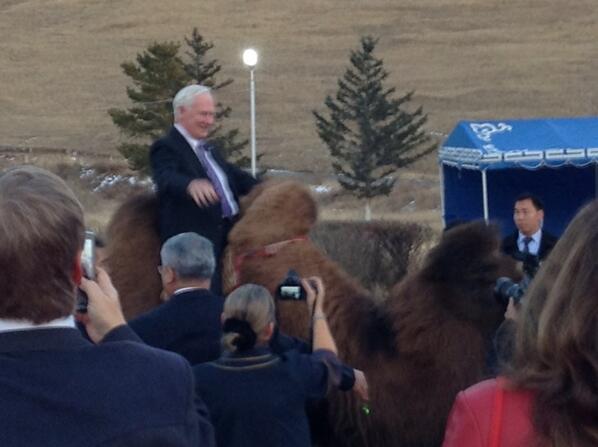
Look Ma, no Hands! The GG on a Camel at Ikh Tenger

Many people want to capture the theatre of a state visit, including members of the delegation and others on the fringes. While the Governor General travels with a photographer and videographer and some of the results of their very professional work is made available, there seem to be moments of great concern over the photo-taking habits of the camera-enabled cell phone, while other moments turn into a bit of a touristy free-for-all. Very few participants could thus resist the camel-riding Governor General at the president’s residence.

This was my second time to visit the presidential palace and the second time to observe some of the living culture that is included in these events in the park behind the residence. Ikh Tenger is situated south of downtown Ulaanbaatar and the entrance to a fairly pristine valley, and serves as the residence as well as for ceremonial events like the State Dinner.

In the park, living culture is on display in the form of animals, their handlers/riders, and bow-and-arrow as well as horseback acrobatics. There is also a ger set up where the President and whoever the visiting dignitary is, disappear for a bit of ceremony and a chat.

During dinner (very tasty and very elegant porcelain and silverware) there was a brief show of folk music (horse head fiddles, including the base which is always a treat, throat singing, long song, the shoulder twitching dance [apologies, I’m sure there’s a technical term for that, but if you’ve seen it, you know what I mean]). It turned out that it was a great blessing that I was sitting at the “kiddie table” furthest removed from their excellencies, since this was the table closest to the music.

Being close to the music also made me do a double-take on one of the performers. How did I know him? When I was chauffeur to the president and general secretary of the National Olympic Committee of Mongolia during the Vancouver Olympics, Tsagaan Sar was celebrated at a Mongolian lama’s house in Coquitlam (of all places). This musician was performing with the wonderful Tono show that was a collaboration with the Canadian Red Sky troupe. I ended up driving him and a colleague from New Westminster to Coquitlam and they were warming up in the car. Throat singing on “my” Olympic back seat? I thought I died and went to heaven! I didn’t have a chance to speak to him that evening, but met him again on Saturday.

More on the GG’s State Visit

Other posts that discuss the visit

For the Canadian International Council, I wrote about the wider implications of the visit and a ‘Diplomacy of Knowledge’.

Posted in Canada, Education, Foreign Policy, Governor General's Visit 2013 | Tagged | 3 Comments

Visible Manifestations of Social Change in Ulaanbaatar

By Julian Dierkes

It seems to me that social change has accelerated in Mongolia, or at least in Ulaanbaatar, or at least in central Ulaanbaatar in the past two years. I’ve had the food fortune to have visited Mongolia three times in the last half year. Here, I’m listing things and behaviours that are manifestations of such changes. Not terribly deep, but telling, I think.

What has arrived?

  • sadly, Louis Vuitton and KFC
  • Mini, Bentley
  • child seats
  • sidewalks
  • parks [these are closely linked to Bat-Uul’s election win in 2012]
  • farmers’ markets

What has disappeared, or at least nearly?

Note that some of these may be due to seasonal changes, as I hadn’t been in Ulaanbaatar in September before my last winter, really only in summer or winter.

  • stationary 80s-office-phone-looking old-granny cell phone booth
  • for-pay scales
  • free WiFi on Sukhbaatar, er Chinggis Khaan Square
  • Sukhbaatar Square
  • open gullys/missing manholes
  • street kids
  • packs of dogs
  • smoking
  • the sixth-floor souvenir shop at the State Department Store (though perhaps seasonal)

What will appear in the future

  • navigation systems
  • wheelchair accessibility
  • bike lanes
  • city park along the Tuul
  • new airport (apparently)
  • subway (really, I wish they had selected light rail instead)
  • sports cars
  • Harley-Davidson
  • urban renewal and historical restorations embracing district north of government house (National University of Mongolia, German embassy, etc.)
  • road signs in the countryside
  • street names and signs in the city
  • network of cross-country riding trails

What will disappear in the near future

I’m going out on a predictive limb here… 2-3 years is what I mean by “near future”.

  • stray dogs
  • stretched-out hand to signal for a car ride

What will disappear in the medium-term future

I mean around 5 years or so.

  • new (to Mongolia) cars that are right-hand drive
  • the neo-classical Ministry of Foreign Affairs building, with its Stalinist (if that’s an architectural style) spire
  • deels in the city
  • some of the downtown university campuses
  • buildings of 4 floors or less in the urban core.

Please feel free to nominate additions to the list via the comments function!

Posted in Change, Curios, Social Change, Ulaanbaatar | Tagged | 2 Comments

My Governor General’s Medallion

It is a bit embarrassing to toot my own horn in this way, but the Rt Hon David Johnston awarded me a Governor General’s Medallion at the Friends of Canada reception on Oct 26 2013.

October 26, 2013
Ulaanbaatar, Mongolia
Credit: Cpl Mathieu St-Amour, Rideau Hall, OSGG

During the award, the following citation was read by Greg Goldhawk, the terrific Canadian ambassador to Mongolia:

Professor Dierkes is arguably Canada’s pre-eminent Mongolist. Working with his graduate students at UBC’s Institute of Asian Research, he concentrates on Mongolian economic and political issues. He is the co-author of the blog Mongolia Focus, which has a wide following that includes readers from the Mongolian parliament. He served as an observer in the most recent parliamentary and presidential elections, and took part in the World Economic Forum Strategic Dialogue on the Future of Mongolia held this September.

Obviously, I was very pleased and proud. It was especially nice that the citation also mentioned the graduate students with whom I have been collaborating, in some cases for years now, on brining more Mongolia expertise to UBC and offering that expertise to the interested world: NARANZUL B, MENDEE J, BYAMBAJAV D, Brandon Miliate, and most recently, OTGONBAATAR B.

Along with the medallion, I received a very elegant folder that included a letter from the Governor General.

I was also thrilled that the Governor General mentioned that he had been reading this blog in preparation for the trip as he handed me the Medallion.

Posted in Canada, Curios, Governor General's Visit 2013, Research on Mongolia | Tagged | Leave a comment

Governor General’s Speech to the Mongolian Parliament

Clearly, a parliament, a democratically-elected parliament no less, deserves much respect as an institution and in its proceedings. How appropriate then, that a visiting Governor General would address the Mongolian parliament.

As I was not a part of the official Canadian delegation, I had to rely on contacts in Mongolia to procure an invitation to the event, but was certainly delighted to be able to attend.

I learned during this visit that the Governor General’s role is not only limited to a largely symbolic one, but that this limitation extends to his visits abroad as well. I was therefore somewhat disappointed that David Johnston did not announce the bilateral aid program for Mongolia during the visit. This program has existed in stealth mode for some time now with a CIDA officer posted in Mongolia for over a year and even a reference to such a program on the CIDA webpages. As a program, it has yet to be announced officially and thus continues to exist in some kind of limbo where some projects appear to be underway.

So, the bilateral aid program did not make it into the speech to parliament or any other announcements.

The parliamentary session was naturally presided over by Enkhbold Z, chairman of the Ikh Khural, who sits at the centre of the back wall. Seats for the 76 MPs are arranged in a horseshoe formation facing each other and the chairman. President Elbegdorj sat to the right of the chairman and an additional chair was placed ahead of him for the Governor General. Official members of the Canadian delegation were sitting in a line behind MPs to the right of the chairman while another row of chairs was behind the MPs to the left of the chairman where Mongolian officials, such as H.E. Zalaa-Uul, the current ambassador to Canada, were seated.

The Rt Hon David Johnston addressing the Ikh Khural

The incoming ambassador to Canada, R Altangerel, was quite involved in this event as in other events, since his current position is as chief of protocol at the Ministry of Foreign Affairs in Mongolia.

David Johnston crossed the floor (literally, not metaphorically) to his chair together with Enkhbold.

After Enkhbold formally opened the session, everyone stood as the Mongolian anthem was played. The Governor General was then invited to deliver his speech. As always, the text for the speech was carried and then placed for him on the lectern by a military attendant who provides a mobile aura of political theatre for the Governor General everywhere.

I was able to observe the proceedings together with Canadian officials and members of the delegation and members of the foreign diplomatic corps from the balcony.

The speech was attended by over 50 of the 76 members. It only lasted 12 minutes or so, in part because David Johnston may be one of the fastest talkers in the history of his office.

The speech quite naturally focused on the 40th anniversary of diplomatic relations between Canada and Mongolia and discussed a number of similarities and common interests between the two countries. While there was no explicit mention of a bilateral CIDA program, the rational for and focus of such a program was summarized in the following paragraphs,

We are working together for improvements in public service management, better policing practice, legal and judicial reform, and enhanced local government capacity.

We are also working to develop the administrative and legislative strengths of this critical institution, the State Great Khural.

Canada is partnering with Mongolia in these endeavours because we believe that building strong, transparent and efficient judicial, public service and legislative institutions is both the “smart” thing to do and the “right” thing to do.

Given that there has been some sustained Canadian involvement in training the Mongolian military for peacekeeping missions, this aspect of the relationship also received specific mention.

The full text of the speech can be accessed on the Governor General’s website.

For an overview of the main themes of the state visit, see my piece for the Canadian International Council.

Posted in Canada, Governor General's Visit 2013 | Tagged | Leave a comment

Foreign Policy Roundup #9: October 13-27, 2013

The last two weeks of Mongolian foreign policy news are marked with 2 important state visits: The Mongolian PM’s official visit to China; The Canadian Governor-General’s first visit to Ulaanbaatar. See below for the highlights of these visits and more.


Neighbors

Mongolian and Russian representatives from the countries’ respective Ministries of Infrastructure and Transportation met in Ulaanbaatar to discuss rail connections and Mongolia’s reliance on the jointly-owned railway for the transport of goods ranging from oil and piping to building materials.

PM Altankhuyag traveled to China. During this official visit he met not only with Beijing officials, but also with representatives from China’s southwestern provinces, participating in the 14th Western China International Fair. During the forum, Altankhuyag remarked that Mongolia is a country full of business opportunities, not solely in the mining sector. The visit concluded with the signing of a strategic partnership between Mongolia and China. Of particular interest, the agreement noted that Mongolia’s Sukhbaatar Aimag led the push for increased cooperation with China’s Liaoning province.

Mongolia’s newly appointed ambassador to the Russian Federation, Sh. Altangerel presented his credentials to Russian President Vladimir Putin.

During L. Bold’s attendance at the World Economic Forum in Moscow, negotiations between the Eurasian Development Bank and the Mongolian government were reopened. At the same time, consultations were reopened between Mongolia and Rusneft, a Russian oil conglomerate.


Asia Pacific

Mongolia and North Korea are marking the 65th anniversary of the establishment of diplomatic relations. The Guardian recently released a story on the economic benefits of Mongolia’s continued good relations with North Korea.

Consultations were held between the Vietnamese and Mongolian Ministries of Foreign Affairs.

North America

Canadian Governor-General David Johnston made an official visit to Mongolia, during which he addressed the Mongolian Parliament. Following the address, he paid his respects to the Chinngis Khaan statue outside of the Government Palace and signed the official guest book of the Mongolian state. This year marks 40 years of Canadian-Mongolian relations and the first visit by a Canadian Governor-General. During the visit a number of agreements on cooperation in medicine, construction, infrastructure, and agriculture were discussed and signed. During a press conference, President Elbegdorj remarked that this visit marked a new page in Canadian-Mongolian bilateral relations; Governor-General Johnston similarly remarked that relations between the two countries would soon be strengthened across a number of sectors. To see a video released by the Canadian government, click here. During the visit, Dr. Julian Dierkes was awarded the Governor-General’s Medallion. See Dr. Dierkes’ report on the outcome of the visit, here.


Europe

Great Britain’s Minister of Foreign and Commonwealth Affairs, William Hague, visited Ulaanbaatar on the invitation of Minister L Bold. The two exchanged views for how Mongolia and Britain might cooperate more fully, with particular emphasis on the mining sector.

The Polish President visited Mongolia on invitation of President Ts. Elbegdorj. They held negotiations, followed by more formal meetings with PM N. Altankhuyag and Director of Parliament Z. Enkhbold. The visit concluded with the signing of a MoU signed by Mongolian Minister of Mining, D. Gankhuyag, and the Polish Deputy Economics Minister on technological cooperation in the mining sector, and a meeting of the Poland-Mongolia Business Council.

The French Foreign Minister made a two-day trip to Mongolia on the invitation of L. Bold. During the visit new visa regulations that would allow diplomatic passport holders 90-days of visa-free entry were announce.

A seminar was held in Mongolia’s embassy in Belgium regarding the emerging EU-Mongolian Partnership.

Middle East

L. Bold received the Turkish Ambassador to discussed cooperation in trade, education, and defense.

Mongolian citizens can now travel visa free to Turkey for 30 days and to Brunei for 14 days. The same applies for Turkish and Brunei citizens traveling to Mongolia.

Multilateral

October 27, 2013 marks the 53rd anniversary of Mongolia’s admission into the United Nations.


For previous postings of the Foreign Policy Roundup in 2013 CLICK HERE.

Posted in 2013, Foreign Policy Roundup, Mongolia and ... | Tagged | Leave a comment

Results of Canadian State Visit to Mongolia

Obviously, state visits have symbolic purposes and motivations, but they are also the occasion for announcements in a bilateral relationship. I tried to guess at what the intentions for the state visit to Mongolia by Governor General David Johnston were ahead of the visit.

Visa-Free Travel for Canadians

I was clearly right on the most concrete outcome that was announced during the visit, namely 30-day visa free travel to Mongolia for Canadians as of January 2014. This announcement was very much in line with Mongolia’s recent initiatives to extend this visa-free travel privilege to a number of partner nations. As the citizen of a privileged nation (in my case, Germany) who enjoys visa-free travel to many countries of the world, it’s important to remember what a privilege this is. I’m always reminded of this when I interact with Mongolians and learn about their tribulations in planning travel to various countries that do not reciprocate this visa-free travel status.

The announcement was made during the meeting of President Elbegdorj and Governor General Johnston in the morning of the first day of the State Visit.

Other news and concrete steps have been sparse. In his speeches (to the Mongolian parliament and at a state dinner) the Governor General has referred to similarities between Canada and Mongolia frequently, has emphasized people-to-people contacts, and has pointed to Canadian investments as well as past support for Mongolia (like the curriculum for democracy that was pursued during Mongolia’s chairmanship of the Community of Democracies).

Education in the Canada-Mongolia Relationship

It is noticeable, but perhaps not surprising given the Governor General’s academic background, that education has been of central concern in a number of the meetings. Especially when it is lumped together with “people-to-people” bilateral relations, this emphasis was not only reflected in the Governor General’s speeches, but in his schedule as well which included a roundtable discussion focused on education. The Mongolian participants in this discussion included representatives from all the public universities and Ms Oyungerel, Minister of Culture and Tourism. Ms Oyungerel also expressed her surprise and delight at the inclusion of a special session on education in the schedule.

At this meeting, I noted as an aside, that we had organized a somewhat similar discussion of education for the visit of then-President Bagabandi in 2004, pointing to a nice symmetry in the concerns with education. It was this visit by the Mongolian president that provided some of the impetus for the pursuit of Mongolia expertise at UBC and I very much hope that the roundtable in Ulaanbaatar may have a similar impact.

Mongolian participants in the roundtable gave an overview over their institutions (representatives from universities) as well as over educational policy (from the Ministry of Education). In these remarks as they pertained to higher education, there was a clear focus on the improvement of quality over an expansion of quantity in higher education, a bit of a refrain from Mongolian policy-makers in recent times.

Canadian participants in turn highlighted their interest in Mongolia and potential collaborations in areas such as distance education, the fostering of research capacity, and academic standards.


Posted in Canada, Foreign Policy, Governor General's Visit 2013 | Tagged | 2 Comments

Canadian State Visit

Celebrating 40 Years of Diplomatic Relations between Canada and Mongolia2013 marks the 40th anniversary of diplomatic relations between Canada and Mongolia. Earlier this year, this anniversary was marked by a visit of the chairman of the Ikh Khural, Z Enkhbold, to Canada. Now, it has been announced that the Canadian Governor General, David Johnston, will be visiting Mongolia at the end of October.

This will be a first Canadian state visit and it reciprocates the visit of then-president N Bagabandi to Canada in 2004. Since then numerous officials have visited, including then-prime minister Su Batbold in Fall 2010.

The Governor General of Canada

For readers not familiar with Canada, the governor general formally represents the Queen of Canada (and some other minor places around the world), Elizabeth II. The governor general is appointed by the Queen upon nomination by Canada’s prime minister. The current Governor General has held the position for just over three years. He is the commander-of-chief of Canada and has a number of constitutional rights and duties related to parliament, elections, appointments of officials, and the granting of various honours, most notably perhaps, membership in the Order of Canada. In international relations, the governor general represents Canada on state visits, such as the upcoming trip to Mongolia.

The current Governor General succeeded Michaëlle Jean in October 2010. He is a legal scholar who has taken on a number of university administrative role in addition to his scholarship on securities regulation and corporate law. From 1999 to 2010 he served as the president of the University of Waterloo.

Prior to the upcoming visit to Mongolia, the Governor General will have visited 12 countries on state visits.

Expectations of the State Visit to Mongolia

Likely Canadian Announcement

Despite his constitutional status, the governor general’s role is largely a ceremonial one when it comes to specific policies, including international relations. He thus represents Canada on a state visit and does not typically hold negotiations on behalf of the government of Canada.

Nevertheless, the visit could be expected to be an occasion for announcements of new initiatives by either government. On the Canadian side, the announcement of a bilateral aid program is as long overdue highly likely. This program has been in preparation since 2011, including concrete planning by CIDA for activities, but has not been announced officially. After several rumoured high-profile visits from Canadian officials that fell apart at late stages in the planning, the Governor General’s state visit and his address to the Mongolian parliament will afford the Canadian government a perfect opportunity to make this announcement for maximum impact in Mongolia even though the planned activities may be relatively limited.

Mongolia’s current economic challenges may make this a fortuitous time to announce a program that will likely focus in part on governance questions, especially the role of the public service. This focus will also be highly appropriate a time when Mongolia’s material conditions are improving with economic growth to the extent that human welfare is not as urgent a concern in the country (absent severe winter weather) as it would have been some years ago. A Canadian bilateral program would come at a time when the U.S. engagement is being scaled back and Japanese JICA is preparing to switch the focus of its activities in Mongolia from grant-making to loans.

The Canadian visit will draw attention to educational opportunities for Mongolians in Canada, but also to academic relations between the two countries, a development that I would – obviously and somewhat self-interestedly – welcome very much. Immediately after the governor general’s visit, the Canadian embassy will be hosting an education fair in Ulaanbaatar for the first time and the fair’s visibility in Mongolia will certainly be enhanced by the State Visit.

Possible Mongolian Announcements

As a state visit to Mongolia may also provide the occasion for announcements and initiatives by the Mongolian government, what can be expected in this regard? Note that neither Canadian nor Mongolian officials have hinted at any of these possible announcements, I am merely speculating here.

The most concrete and substantial “next step” in the Canadian-Mongolian relationship would be the conclusion of a Foreign Investment Promotion and Protection Agreement (FIPA). Negotiations for such an investment began in 2009, though there has not been any suggestion that they have progressed to the extent that the conclusion of an agreement is imminent. As the Mongolian side seems to be slow to this particular dance, the State Visit could certainly be an opportunity for concrete steps to jump-start these negotiations once again. On the one hand, current parliamentary debates about its foreign investment law have put this topic on top of the agenda for many Mongolian officials, but a bilateral agreement specifically may not seem as urgent to policy-makers who are grappling with wider challenges. Since the investment community is looking for signals of stability and medium term opportunities, however, steps toward a FIPA could provide such a signal. Any initiative in this regard would merely be an announcement of intentions however.

Recently, Mongolia has lifted visa requirements for a number of countries. I myself thus benefited from the lifting of a visa requirement for Germans as of September, but very recently a similar announcement was made regarding Turkish-Mongolian relations. As Canada has also played an important and, indeed, strategic role in Mongolia’s third neighbour policy, an announcement of a waiver of visa requirements for Canadians seems like a plausible welcoming present during a State Visit. Such an announcement would also recognize that it appears to have become easier for Mongolian nationals to obtain (tourist and other) visa to Canada in recent years, despite the hurdle that such visas are issued in Beijing.

Impact of the State Visit in Canada

Given the limited substantive expectations of the visit, the impact may not be great, particularly since Canadian attention likely will be more focused on the Governor General’s visit to China that occurs just before his trip to Ulaanbaatar and coincides with a flurry of Canadian cabinet members visiting China.

Yet, many visitors to Mongolia in the past have become quite enamored with the country, its vibrant democracy, beautiful nature, and open people. If the same happens to the Governor General (and it has been observed several times that a routing from China to Mongolia often makes foreign officials appreciate the access to and openness of Mongolian officials), he may well become an advocate of sorts for Mongolia in Ottawa. Though he does not seem to be closely involved in policy deliberations of the Conservative government, such advocacy could give Mongolia a bit of a higher profile or perhaps help it regain the profile that it briefly held after Su Batbold’s visit during which a personal relationship between Batbold and Prime Minister Harper seems to have been established.

The Governor General’s return from Mongolia may also roughly coincide with the arrival of a new Mongolian ambassador, the country’s fourth resident ambassador in Ottawa. R Altangerel has been nominated for this position. He has previously served as ambassador to France, as state secretary and chief of the protocol office in the Ministry of Foreign Affairs in Mongolia. Particularly the latter role is a much more central one in the Mongolian MoFA that extends much beyond control over etiquette for meetings between Mongolian and foreign officials and plays much more of a coordinating role.

As the new ambassador is bi-lingual and was reputed to be quite active during his posting in Paris, he may well be able to capitalize on some interest on the part of the Governor General to raise the Mongolian profile in Ottawa in 2014.

Regardless of the specific circumstances and any announcements – surprising or foreseen -, the State Visit will be a marker in Canada-Mongolia relations and will thus certainly also have an impact on Mongolia-related activities at Canadian universities, including the University of British Columbia.

Posted in Canada, International Relations, Mongolia and ... | Tagged | 2 Comments

Foreign Policy Roundup #8: September 30-October 13, 2013

Latest foreign policy news from Mongolia, including Mongolia’s continuing bid to join APEC.

————-


From Last Week

Mongolia established diplomatic relations with Suriname.

L. Bold met with a representative from the UN Office for Least Developed Countries, Landlocked Countries, and Small Island Developing states.


Neighbors

Prime Minister Altankhuyag received the Chinese Ambassador to discuss the Prime Minister’s upcoming trip to China later this month.

Z. Enkhbold called upon the Russian Ambassador to Mongolia. During the meeting an invitation was extended to the head of the Russian Duma to visit Ulaanbaatar.

Mongolia is offering assistance to the Russian Federation following natural disasters in the country’s far eastern provinces.

D. Erdenebat, member of the DP and Parliamentary member met with the Major of Buryatia’s Ulaan-Ude. The focus of the meeting was on business relations, specifically the sell of building materials.

Asia Pacific

Director of the Mongolian Parliament, Z. Enkhbold, greeted the delegation of the South Korean National Assembly as they arrived on an official visit to Ulaanbaatar. Following their arrival, the two parties discussed strengthening their cooperation in the mining and transportation sectors, specifically mentioning Korean investment in the Mongolian railway.

For the first time, Mongolia participated in the APEC Ministerial Meeting. During the proceedings, L. Bold took the opportunity to discuss Mongolia’s relations with Indonesia and ASEAN more generally, and how to strengthen relations in the future. L. Bold also reiterated Mongolia’s objective of being admitted in APEC, something Indonesia has voiced support for. An English language examination of Mongolia’s APEC bid is available here.

President Elbegdorj was invited to Japanese President Shinzo Abe’s residence following a conversation at last week’s UN Forum.

North Korean Leader Kim Jung-un sent a letter to Elbegdorj in recognition of 65 years of diplomatic relations between the two nations.

Europe

The Mongolian Ministry of Foreign Affairs held its annual meeting, for which several ambassadors were recalled and new appointments discussed, specifically those in France, Germany, Canada, and Switzerland. The meeting is at least partially the result of allegations of money laundering on the part of Mongolia’s Ambassador to Germany.

Mongolia participated in the 129th Assembly of the Inter-Parliamentary Union in Geneva.

The fourth meeting of the Mongolian-Hungarian Commission was held in Budapest.

L. Bold met with the representatives of 20 E.U. states, in what has become an annual meeting since 2009 to discuss the Mongolian-E.U. partnership.


Middle East

Z. Enkhbold made an official visit to Turkey and met with the Turkish Prime Minister.


Multinational

L. Bold met with Asia Foundation’s Executive President. This week marks 20 years of cooperation between the Mongolian Government and Asia Foundation.

L. Bold announced plans to attend the World Economic Forum in Moscow from Oct. 18-20.


For previous postings of the Foreign Policy Roundup in 2013 CLICK HERE


Posted in 2013, Foreign Policy Roundup, Mongolia and ... | Tagged | 1 Comment

If not an SWF then what?

At the recent World Economic Forum’s “Strategic Dialogue on the Future of Mongolia” I heard a lot of talk about the need for the Mongolian government to shed its direct involvement in the economy, but also the recommendation to rely on a Sovereign Wealth Fund for investments to spur sectoral diversification. As I argue on the World Economic Forum’s blog, you can’t have both, economic liberalization and an active investment policy that selects winning companies/industries.

Yet, sectoral diversification beyond the mining industry is absolutely essential to Mongolia’s long-term economic and thus also its social and economic development. The case for such diversification is based on the recognition that a) natural resources are finite, and b) market oscillations in commodity prices makes dependence on resources an inherently risky state.

How to Achieve Sectoral Diversification

This is certainly not an area that I specialize in, so what I am offering here are some interested musings.

Clearly, a (neo)liberal world order has restricted the options for an industrial policy that are available to modern states, and it is an industrial policy that is really needed in the case of Mongolia to move beyond mining and its associated industries. In the days of classic developmental states like postwar Japan through the 1980s, states had access to tools such as control over credits, foreign currencies, etc. that allowed them to direct the economy. Some states were good at this (Japan and S Korea stand out as examples) while others imitated such strategies, but were not as successful. One of the main doubts about the success of developmental policies has always been that it assumes that the state and its representatives is able to “pick winners”, that is to pick sectors and firms that will be growing and successful.

Clearly, contemporary China is also pursuing developmental policies through its state-owned enterprises and somehow is able to mask subsidies under this set-up to be immune to WTO interdiction.

However, many observers would agree that the Mongolian state is not ideally situated to engage in an active industrial policy for two reasons: 1. a lack of policy analysis capacity, and 2. a close intertwining of business interests with government, or in more extreme cases, corruption.

What options might remain:

  • invest in basics
  • tax credits?
  • top-up venture fund for crowdfunding

Investments in Education, R&D, Applied Research

In the absence of an active industrial policy that targets particular technologies, sectors, or firms, many states strive to create the pre-conditions for innovation and the emergence of industries.

These preconditions include education and research, as well as the physical infrastructure to enable new industries.

In the Mongolian case this would suggest an increased focus for funding in education and research. The state universities are currently funded (almost?) entirely by tuition, though systems for research funding are under discussion or emerging. Stepping up such efforts now might lead to business opportunities in the long-term, especially when coupled with international best practice on supporting commercialization of research, etc.

Perhaps the role of the Academy of Science could be re-thought in this context. While largely a legacy of the state-socialist era when teaching in higher education and research were separated institutionally into the universities and the Academy and its institutes on a Soviet model, the institutes of the Academy could be re-invented as research institutes that focused specifically on applied research on the model of the German Fraunhofer Institutes.

Investment into applied research on minerals and minerals processing could be combined with similarly-structured efforts in other fields, particularly fields where Mongolia’s territory, location and climatic conditions might offer potential for future growth. Examples could be superconducting electricity transmission that would enable an alternative energy export industry for Mongolia (as partly envisioned by the Desertec Foundation [despite the horrifying terminology of “Greater East Asia”], see also Karl-Friedrich Lenz’ writings on Mongolia). Other examples might seek to capitalize on Mongolia’s cold temperatures as a condition for certain industrial processes.

Investments in Infrastructure

There are entire fields of research that examine the success of innovation incubators, industrial clusters and the like. A thorough search of these literatures would likely yield some lessons for the particular Mongolian context and how to provide the infrastructure that makes the emergence of new industries more likely.

From my point of view, some of the candidates for such industrial sectors that are often mentioned in discussions in Mongolia are highly implausible, though there’s always luck involved in these developments. Implausible scenarios (and thus areas where investment would not seem obvious to me):

  • Ulaanbaatar as a finance centre: Asia already has Hong Kong, Singapore, Tokyo, and whatever centres might emerge from China
  • IT industry: at such a generic level, there’s nothing about Mongolia that makes this more likely and the tiny domestic market and small number of potential entrepreneurs make this unlikely in my mind

Sectors that I find much more plausible:

  • organic agriculture/meat: the world is turning to healthier food and Mongolia is ideally positioned in this regard for super-organic production. This is a sector that definitely requires infrastructure investment
  • tourism: yes, but, this will always be specific niches
  • transport hub: railroads (keeping in mind the dreaded question of gauges), but I even find the airport as a hub between Europe and Asia vaguely plausible, though that requires massive and highly concentrated investment.

I’m certainly open to suggestions/discussions of other sectors or different views on the sectors I’ve mentioned here. I certainly also believe that investment into building research capacity on this question in Mongolia should be a priority NOW and not just in the medium or long term

Infrastructure investment could also come in areas where such investment aims to create commercial resources rather than bricks-and-mortar facilities. Stephen Kreppel has thus been involved in a national brand strategy for Mongolia that would ideally offer a Mongolian branding that would benefit any industry or sectors, as difficult as such unified messaging might be to achieve.

Tax Credits

A classic in the arsenal of policies that is acceptable under WTO rules, but Mongolian taxes (personal and corporate) are so low already that it’s unclear that there are massive incentives to be found in this area.

Crazier Ideas

With some of the excitement around crowdfunding and crowdsourcing theses days, perhaps these concepts could be adapted for industrial policies. Again, I’m mostly thinking out loud here, but could state investment not come in the form of matching grants to crowdfunded projects? In such a scenario the crowdfunding serves as the mechanism to “pick winners” relying on the distributed intelligence of the crowd rather than bureaucrats and simply super-charges such crowdfunding to enable commercial developments. Obviously, this is a bit faddish at the moment and might not be a permanent economic institutions, but the concept of crowdsourcing decisions about diversification opportunities may be applicable.

Thoughts? Ideas? Go ahead and use the Comment function below!

Posted in Business, Development, Diversification, Economics, Foreign Investment, JD Mining Governance, Sovereign Wealth Fund | Tagged | 5 Comments