Mongolia-Australia Mining Partnership

During FM Lu Bold’s visit to Australia, there has now been an announcement of a grand “Mining Partnership” between Mongolia and Australia to the tune of A$20m over 5 years.

From Julie Bishop, Australian Foreign Minister’s website:

Mongolian Foreign Minister Luvsanvandan Bold and I today announce a five-year, $20 million program to assist the sustainable development of the resources sector in Mongolia.

Like Western Australia, Mongolia’s economy is driven by mining and resources. The Australia-Mongolia Extractives Program will utilise Australian expertise in Mongolia to help ensure the benefits of the mining sector are spread across its entire population.

[…]

Australia is pledging to support the Mongolian Government with financial assistance and expertise that will improve governance in the mining sector, opening their economy up to international investment and development opportunities.

The program will also improve access to technical and vocational education and training in disadvantaged communities in Mongolia so they are better equipped to gain employment in the mining industry.

[…]

1. I’m Jealous

Obviously, this is a very public announcement of commitment to Mongolia by the Australian government and I wish there was a similar commitment from the Canadian side.

From the high point of the Governor General’s visit to Mongolia last Fall, relations currently are in a bit of a funk.

While Australia announces a A$20m program, Canada’s less ambitious bilateral aid program remains in unannounced limbo.

The Canadian government appears to be stalling on accepting the nomination of R Altangerel as new Mongolian ambassador to Ottawa following the departure of T Zalaa-Uul in late 2013. While nothing has been said publicly, one can only guess that there is some kind of a stall in relations.

The only obvious item that could be stalled is a bilateral Foreign Investment Protection Agreement about which little has been heard in years. Whether this is out of a lack of focus on the Mongolian side or actual objections is unclear, but the Canadian ambassador to Mongolia, Greg Goldhawk, is scheduled to be replaced this summer, so if a Mongolian nomination is not accepted by Ottawa, one might imagine that the Mongolian government might similarly stall on a Canadian nomination. That would be a serious and unfortunate stall, obviously.

So that’s why I might be a bit jealous of this Australian announcement.

I hope that this announcement will benefit colleagues in Australia (especially at the ANU’s Mongolian Studies Centre and perhaps at the U of Queensland’s Centre for Social Responsibility in Mining) not least by signalling a certain prominence and thus public attention to Mongolia in Australia.

I also hope that the projects that will be undertaken under this program will involve some colleagues with Mongolia expertise rather than some of the many subject area experts (as opposed to area specialists) who seem to be jetting around the world dispensing their wisdom.

2. Did Someone Leak my EAFQ Piece?

Curiously, the ANU’s Crawford School of Public Policy will be publishing an issue of the East Asia Forum Quarterly later this month which will include some focused discussions of Asia’s “fringe”, including Mongolia.

{Note that my piece was posted on East Asia Forum on March 23}

My own contribution will take a brief look at Mongolian foreign policy, note its success in building political friendships, but urge Mongolian policy-makers to re-focus their efforts on economic relations, particularly in Northeast Asia. If only this issue had appeared before the present announcement, I might wander the earth claiming that my article had an impact. As it will appear after the announcement that trajectory is unlikely.

However, this mining partnership is not what I had in mind in urging a greater economic focus. Yes, this partnership clearly involves a substantial financial commitment to Mongolia and the apparent focus on governance and vocational education implies economic concerns, but it is not a partnership that is focused on trade or the development of bilateral ties per se. Should Australia be successful together with its partners in the pursuit of a comprehensive multilateral free trade agreement around the Pacific (TPP), Mongolian would be frozen out of yet another free trade project raising the spectre of a future when Mongolian will not be able to diversify away from the export of raw materials in part due to a web of trade agreements that excludes it.

Of course, Australia is among the few developed countries that actually have significant investments in Mongolia. These investments are nowhere near the volume of Chinese investments, but they have surpassed Canadian engagement, for example, as Turqoise Hill (by far the largest nominally Canadian investment) has become a mere conduit for strategies pursued by Anglo-Australian Rio Tinto. In this, at least Australia does offer an economic partnership through the private sector that is bolstered by political support as evidenced in the present announcement.

3. What Does This Partnership Mean?

Few details are available at this point. It appears, however, that this is a formalization and re-packaging of Australian aid that has been assumed to be revving up for some time, at least in conversations in Ulaanbaatar. While the announcement is thus quite significant, it appears that it may not be an announcement of anything particularly new.

A focus on governance questions and vocational education is not only very plausible but has been recognized as such by many other aid organizations from the WorldBank to the German-Mongolian Institute for Resources and Technology.

Perhaps, there will be more that’s novel to the programs that are being pursued under this partnership once more details become available, but for now I welcome the news of this very public commitment to Mongolia by Australia and wish the projects to be pursued every success.

I wonder if an Australian embassy to Mongolia (currently, there is a general consulate with bilateral affairs being managed in the Australian embassy in Seoul) can be far behind…

Posted in Australia, Bilateral Aid, Development, Foreign Policy, Governance, Mongolia and ... | Tagged | Leave a comment

Foreign Policy, Mining & Development

I happened to catch a segment of CBC’s “The 180” radio show that included an interview with Erin O’Toole, the Canadian Parliamentary Secretary to the Minister of International Trade. The segment focused on the “marriage” of foreign policy, development aid, and the extractive industry which the government has been arguing for in terms of a strategic advantage in mining (policy) on the one hand, and an integrated foreign policy that coordinates foreign policy goals with development aid.

This discussion comes in the context of this week’s meeting of the Prospectors and Development Association of Canada (PDAC). The PDAC meeting also included a Mongolia Day, of course.

Conservative Government is Engaging!

I was genuinely surprised to hear Mr. O’Toole discuss the connection between foreign policy, aid and mining quite openly with Jim Brown, the program’s host. Why surprised? Because it seems so rare that any members of this government (political or bureaucratic) engages in any discussion in the media that is anything other than a press release.

While I thought that Mr. O’Toole deflected most of the (very important) questions that Mr. Brown raised, I very much appreciated the fact that he engaged in this discussion at all. I voiced this view in a tweet last night.

To my great surprise (and further appreciation), Mr. O’Toole responded this morning.

So now, I’m on the hook, of course. I have previously made the case for the use of social media for engagement by the government with various stakeholders and experts. I surely can’t just complain, but when given this opportunity, I will offer my version of engagement, that is to try to think about Mr. O’Toole’s discussion and the broader policy he was speaking about, in light of my expertise on Mongolia. This is a narrow context that I’m thinking about, but I think that Mongolia is a reasonably good case to examine the linking of foreign policy and development aid with (private) interests of the extractive industry.

Points Discussed in the Interview

The interview can be found through links on the CBC’s The 180 website and via the CBC Audio Player. It begins with brief conversations with Frederico Guzman, a deputy justice in Colombia, and with Jennifer Moore, Latin America Program Coordinator with MiningWatch.

The segment with Mr. O’Toole begins at about 8min into the interview. A transcript of this exchange (which was condensed from a longer conversation) seems like the easiest way to comment on it, so I offer this below. I have made minor edits in good faith for the purpose of ease of understanding and have largely marked these by [square brackets].

I have send an email to The180@cbc.ca in the hopes of getting some guidance whether such a transcript violates any of their rights, but have not received a reply. If I am violating any rights/laws, I apologize and will gladly be educated on that and will respond accordingly immediately.

Jim Brown’s Question1: We’ve heard […] that Canadian mining companies are exacerbating human rights abuses. How do you respond?

Erin O’Toole’s Answer1: Generally there is a lot of confusion about our resource and extractive industry around the world. Industry is in many cases the largest employer in impoverished areas of the [developing] world. Those areas have many challenges from a governance and institution-building capacity [perspective]. There’s often a mixed message from projects [meaning industry?]. I’ve heard from all sides of the[se] debates how much of an impact [these projects] make on employment, on creating a local supplier network in the country, building capacity over time. There are others that say that economic activity in these areas causes disruption. But […] it is our firm belief that [economic activity] actually allows parts of these challenged areas of [developing] countries to actually develop their own local economy. So, there is a lot of different viewpoints on this. We’re trying to work with our Corporate Social Responsibility Office to make sure that – if there are any valid issues – they are addressed.

Q2: I’m sure you’ve heard the concern, the emphasis on economic diplomacy – which has been highlighted by your government recently – makes it hard for Canada to exert the kind of pressure that perhaps should be exerted when it comes to things like human rights concerns. Let me ask you: how can diplomats push for trade and business opportunities for Canadian companies on the one hand, and then on the other hand pressure those companies to respect human rights.

A2: You’ve asked a great question. In a lot of ways our previous approach to foreign policy didn’t recognize the obvious: if there is a Canadian company operating somewhere around the world, bringing positives and some potential issues, we have to recognize that Canada is there, we have a presence, our global brand is there through one of our corporate players. So why would we not orient some of our aid work, and some of our diplomatic work, to not only address some of the issues that might arise, but to try and help develop and lead to longer-term sustainability for the countries those companies are operating in.

Q3: There’s another element to this that people point to: the fact that many of the countries that mining watch is concerned about have very young and often very unstable democracies. Corruption can be a problem, citizens don’t always get the kind of due process that we would expect here in Canada. What’s your government doing to ensure that Canadian companies aren’t exploiting those conditions?

A3: Well, that’s another great question. We work on capacity-building in some of those countries. So, DFATD with the total approach to diplomacy we have now will actually work on capacity-building so there’s countries in South and Latin America, we we’ve actually used some of our aid funding to build local capacity of the country’s judiciary. And that is a much better long-term solution than what was done in the past which was short-term aid delivered and then no capacity built within that country for a sustained prosperity or a sustained institution-building presence. What some of the groups like MiningWatch complain about is that they don’t like that there’s been a change, but they don’t seem to recognize that these changes will actually lead to better governance and better institutions in those countries in the long term.

Q4: The specific concern from Jenn Moore of MiningWatch that she expressed to us was that the government puts all of its lobbying into making rules in countries like Honduras suit Canadian companies without consulting with the affected communities.

A4:  Honduras is a case in point. We have signed a Free Trade Agreement with Honduras. [Honduras] is at a critical turning-point where there is a new government in place with elections that were monitored and fair to try and build a stable democracy in that part of the world. Canada has a choice. We can do what MiningWatch and the NDP want and not trade and engage with these countries, or we can try and trade, help them actually grow their GDP which on a per capita basis is astonishingly low and that leads to social unrest. By focusing our economic diplomacy not just on trading but bringing aid and institution-building to a country like Honduras we’re actually going to increase our direct relationship with them, promote security, and hopefully help them build their own capacity to safeguard everything from human rights to the environment.

My Observations on the Answers Offered

Perhaps it is unfair to expect answers in an interview that directly speak to the questions raised. I’m certain that the few people that may have heard me interviewed in the past could also point to answers that did not directly speak to the questions. Yet, in this interview, Jim Brown raised questions that have been behind some of the reactions to the government’s announcement regarding foreign policy and development, so the fact that Mr. O’Toole was willing to engage in this discussion raised the hope in me that he would address some of these questions directly. I don’t think he did.

Are Mining Companies Exacerbating Human Rights Violations?

On Q1, Mr. O’Toole offered no response on the question of whether mining companies may be exacerbating human rights. Instead, he argued that (private) economic activity is generally a good thing by providing employment and building economic capacity.

This strikes me as broadly true, but it doesn’t answer the question of whether human rights violations are exacerbated by the presence of foreign mining companies.

I don’t have much of a view on this question myself, as human rights concerns are rarely raised about mining activities in Mongolia where the main challenges revolve around environmental concerns, corruption, and strategies to avoid the “resource curse”.

I am a little surprised to see that Mr. O’Toole in this answer seems to suggest that the government of Canada should be involved in sending clearer messages about mining projects. The mixed messages that he refers to would seem to be the responsibility of private interests and investors, not of the government in my mind.

Economic Diplomacy and Canada’s Ability to Speak on Other Issues

I don’t think that Mr. O’Toole provides any answer to the question of “how  diplomats can push for trade and business opportunities for Canadian companies on the one hand, and then on the other hand pressure those companies to respect human rights”. I think this is one of the crucial elements in the shift in foreign/development policy that is being pursued by the government.

Perhaps we’re guilty as analysts of taking the government too much at their own word in a substantive manner, rather than in rhetorical fashion. When the Global Markets Action Plan was released in November 2013 or when Mr. O’Toole speaks of a “total diplomacy” (in A3) my impression was that this implied a primacy of economic concerns (including private Canadian interests) over other areas of diplomacy, presumably including such areas as the promotion of human rights. Maybe this hierarchy of emphasis is less strict than some of the rhetoric implies? Mr. O’Toole seems to suggest as much when he discusses capacity building and judicial reform as a target of development aid, reforms that are aiming at a general benefit to the local population, not an advantage to Canadian investments, I presume.

More specifically, this question did not ask why the government or DFATD would or would not want to developer longer-term sustainability, but whether this would be possible if diplomatic activities were driven primarily by economic interests.

The other part of the answer focuses on the presence of Canada through private investments and the need to recognize that presence. In my mind, that was a strong argument for the establishment of a Canadian embassy in Mongolia when this decision was made. At the time, it seemed like representatives of Canadian investments were arguing for an embassy to help protect their interests and that may have been part of the motivation. From my point of view, however, the presence of Canadian investments necessitated an embassy to safeguard broader public Canadian interests. Not that any Canadian investors in Mongolia were necessarily endangering the value of the Canada brand, but the potential was certainly there. It’s not entirely clear from his answer here whether Mr. O’Toole might share such a view.

Operating in New or Unstable Democracies

I think that the contrast that Mr. O’Toole draws with “what was done in the past which was short-term aid delivered and then no capacity built” is unfair not only to the decision-makers involved in those policies (presumably Mr. O’Toole means Liberal governments of the past here), but also to the professionals engaged in Canadian development work as well as the many academics who have offered contributions to these efforts in the past. To claim that the Conservatives have discovered the secret to long-term capacity building strikes me as a bit more political rhetoric than a substantive point and it doesn’t really address the question about operating in new/unstable democracies.

Excursus on Mongolia

For some, Mongolia is such a context of a new democracy. I tend to see this somewhat differently in that over 20 years of democratic institutions and several national elections that have led to peaceful changes in government more Mongolia out of the “new” category and certainly remove it from the unstable category. That is not to say, of course, that Mongolian democracy doesn’t face challenges. This is a point I’ve written about recently in the context of the Freedom in the World scoring for Mongolia. But there are no legacies of civil war, autocrats, or involvement by the military to contend with in Mongolia.

This doesn’t make the question asked less relevant, but this discussion wasn’t really the context in which Mr. O’Toole might have spoken to the role of foreign policy/development in a context like Mongolia.

In this specific context, I actually happen to agree with some of the logic of the foreign policy that the government is pursuing. Institutional capacity and corruption are areas of major challenges not just to Mongolia’s economic development, but to Mongolia’s democracy as well.

Canadian jurisdictions (the provinces more than the federal government) have wrestled with questions around the community, economic, environmental, and social impact of resource projects for some decades, and have done so in the context of well-established (though never perfect) democratic institutions. This experience is not just an economic comparative advantage to Canadian policy and investments, but is an obvious area for a focus of development work as seems to be recognized by the government as well. Such development work is not built around the straight-forward export of solutions and lessons, but can certainly revolve around a sharing of experiences (including mistakes and dead-ends) and a collaboration with an interpretation of those experiences for a different context like Mongolia.

If such development work contributes to more equitable and environmentally sound, sustainable development, Canadian private investments will be free to compete for investment opportunities and will be in a good position to do so. I don’t think that they will need any direct lobbying from the government to succeed if the rules of the game are well-constructed which is what development work would aim at.

In this context, I have to lament that the bilateral aid program focused on Mongolia appears to be in place de facto, but remains unannounced by the government.

Returning to Interview

Honduras

I claim no expertise on Honduras or Canada’s involvement there.

However, Mr. O’Toole’s response on “focusing economic diplomacy not just on trading but bringing aid and institution-building” reinforces my impression that the portrayal of economic and private investment interests as a driver of foreign policy may be overstated for political rhetorical purposes (the dynamic of which I don’t claim to have any particular insights on), but not in fact as stark as these statements suggest. Mr. O’Toole seems to link development and institution-building to a trade agenda in a more equal relationship that then prioritization of the economic over all else in public announcements seems to suggest.

Bottom Line

I was genuinely surprised by hearing a Conservative parliamentary secretary actually discussing (rather than announcing) policy. The specific shifts in foreign and development policy pursued by the government need (much) more discussion not just to help the public (or at least me) understand this policy better, but also to allow the government to make their case for this shift in a more complete and complex fashion that moves away from press-release-engagement.

It appears that Mr. O’Toole is willing to engage in such a fashion and thus also follow up on Foreign Minister Baird’s announcement of a greater focus on Twiplomacy by the government some weeks ago. One of the aims of Twiplomacy may be the involvement and engagement of a broader spectrum of voices, I’ve tried to offer such a voice here.

Comments are open!

Posted in Bilateral Aid, Canada, Development, Foreign Policy | Tagged | Leave a comment

Foreign Policy Roundup No. 15: Feb. 10-23, 2014

The last two weeks have witnessed a major turning point in South Korean-Mongolian relations as well as some interesting developments in Mongolia’s evolving relationship with New Zealand.


Asia-Pacific (including Oceania)

Minister of Foreign Affairs, L. Bold, made an official trip to South Korea to discuss developments in the two countries’ “Comprehensive Partnership”. During the negotiations, several sticking points in the relationship were discussed, including visa requirements and technological investments. The visit was a recognized success in Mongolian foreign policy, with the establishment of a new South Korean-Mongolian Business Forum and a new commitment to increasing investment.

L. Bold held a dinner for the out-going Vietnamese Ambassador to Mongolia, in recognition of his role in furthering the traditionally friendly relations between these two countries.

A delegation of the Australian Ministry of Foreign Affairs made an official trip to Ulaanbaatar, including the Australian Deputy Secretary of Foreign Affairs and Trade, John Lantry. This visit comes before Minster L. Bold’s up-coming trip to Australia.

Mongolia and New Zealand held their first consultative meeting in Ulaanbaatar to discuss the two countries’ bilateral and multilateral relations, and exchange views on regional issues. The Mongolian Ministry of Foreign Affairs noted that the consultations were especially useful given their similarities as two relatively small countries with small populations and economies based on agricultural production.


Multilateral (UN)

The Mongolian Minister for Popular Development and Social Welfare, S. Erdene, participated in the UN Forum on Social Development in New York. During his presentation to the Forum, he noted Mongolia’s efforts at increasing employment and decreasing cash handout systems through the “Prosperously Employed Mongolian” program.

Mongolian Parliament members M. Batchimeg and N. Nomtoibayar participated in the OSCE meeting in Vienna, Austria.

Mongolia’s Permanent Representation to the UN in Geneva, V. Purevdorj, met with UN High Commisioner for Human Rights, Navanethem Pillai.

The UN announced that the 32rd Small Assembly meeting for the Food and Agriculture Organization in the Asia-Pacific will be hosted by Ulaanbaatar this March.


For previous postings, please CLICK HERE.


Posted in 2014, Foreign Policy Roundup, Mongolia and ... | Tagged | Leave a comment

Здравствуйте!: Why It’s Not about -Stans

By Brandon Miliate

I recently came across and article in The Atlantic, which reported that Kazakhstani President  Nursultan Nazarbayev had suggested that perhaps the suffix –stan was responsible for Kazakhstan’s supposedly low global profile. He mentioned Mongolia, as a country that continues to attract international attention despite its small economy and population. Perhaps a name change would help Kazakhstan develop a stronger international profile, he mused.

There is really only one good Russian response to this: Здравствуйте! (‘hello’ or in this case more like a saracastic ‘good morning’). On the one hand this could just have been a interesting idea that the President was playing around with, which has no serious implications for the future of the country or his perception of its position in world affairs. On the other hand, it could point to some serious misconceptions on Nazarbayev’s part.

Let’s start with the statement that Mongolia has somehow benefited as a result of not being called something like Mongolistan. For every available economic indicator, Kazakhstan greatly outperforms Mongolia. This is, naturally, to be expected. Kazakhstan is a oil exporting state, has a much larger population, and was more developed at the dissolution of the Soviet Union, giving it a stronger starting point. Just looking at FDI, Kazakhstan hosts a huge figure at $111.5 billion, while Mongolia stands at just $4.5 billion! Anecdotally, it is more that clear enough that many more businessmen, students, policy makers, and analysts take a direct interest in Kazakhstan than in Mongolia when it comes to current affairs (naturally, I would suspect that Mongolia can command more than its fair share of historians). While it is beyond the scope of this casual blog post to offer a full comparison, I feel confident in saying that Kazakhstan’s international profile is significantly more pronounced than Mongolia’s.

That said, I would suspect that Nazarbayev was more concerned with a different kind of indicator, namely something more related to soft power. (I detailed Mongolia’s «small power» here). In this case, Mongolia is certainly outperforming Kazakhstan, and it has nothing to do with a little Perso-Turkic suffix. Mongolia is a proven democracy, and has consistently shown its committment to engaging with the international community and improving its own democratic credentials. While Mongolia has eshewed further deepening its relationship with the Russian Federation, Kazakhstan is part of the Eurasian Custom’s Union and CIS, tieing it to the Russian Federation. While Mongolia has sought to further its relationship with the European Union and North America, Kazakhstan remains a difficult partner because of its authoritarian political system and continued abuses of basic civil/human rights. Even with these limitations, Kazakhstan does enjoy good relations with the E.U. and the United States, but the relationship remains limited, largely as a result of Kazakhstan’s own domestic and foreign policy choices. While Mongolia has sought to rise above its own geographical position, Kazakhstan’s leadership continues to avoid a more balanced relationship with the Russian Federation, to the direct detriment of its other foreign policy goals. (In fact, Kazakhstan’s political system is also a key reason for the underdeveloped nature of Kazakhstan-Mongolian relations, outlined here).

At the end of the day, Kazakhstan’s economy is stronger and its economic ties to North America and Europe outperform Mongolia on most indicators. If Kazakhstan has any lessons to learn from Mongolia it is that democratization is not only beneficial as a domestic policy, but also as a lever for diplomatic relations. Democracy matters, names and suffixs don’t. 

Posted in Central Asia, Democracy, Governance, Inner Asia, International Relations, Kazakhstan, Mongolia and ..., Politics | Tagged | 1 Comment

Foreign Policy Roundup #14: January 27-February 9, 2014

The last two weeks have shown Mongolia’s commitment to furthering its relationship with the European Union, and its ability to use past Soviet-era relationships to fulfill that goal.


….


Neighbors

President Elbegdorj arrived in Sochi on February 7, to attend the 2014 Winter Olympics. 

The president of the Mongolian Organization for Peace presented a medal to the Consul-General of the Russian Federation in Darhan-Uul for his role in Mongolian-Russian relations over the past 30 years.


Asia-Pacific 

Upon returning to Ulaanbaatar, Minister L. Bold met with the Korean and Japanese Ambassadors to Mongolia.

Two Mongolian citizens have been transferred from South Korea to Mongolian custody to stand trial under the “Treaty on the Exchange of Criminals” between the two states. 


Europe

Minister of Foreign Affairs, L. Bold, made his first official visit to Latvia, to discuss the expansion of trade relations between the two countries. Before the collapse of the Soviet Union, Mongolian-Latvian relations were stronger, with many Mongolians studying in Riga.

Following his visit to Latvia, Minister L. Bold traveled to Lithuania. With his Lithuanian counterparts, he discussed how Lithuania could be a key country for Mongolia’s evolving partnership with the EU, and that Mongolia could serve as a gateway for Lithuania into the Northeast Asian economy.

After his tour of the Baltics, Minister L. Bold made an official visit to Poland, where he met with the Polish Minister of Foreign Affairs. In recent years, Mongolian-Polish diplomatic and economic relations have expanded rapidly.

The 2014 Mongolian-Hungarian Business Council was held in Veszprém, Hungary to discuss the facilitation of investment, economic, and trade relations.

Mongolia’s newly appointed Ambassador to the Malta, Sh. Odonbaatar, presented his credentials to the Maltese President.


Middle East

The newly appointed Mongolian Ambassador to Lebanon, B. Odonjil presented his credentials to the Lebanese President.


Multilateral

Mongolia’s Permanent Representative to the UN made a speech at the recent small assembly meeting in Geneva, in which he focused on the danger of the spread of nuclear weapons.


For previous Foreign Policy Roundup postings, please CLICK HERE.


Posted in 2014, Foreign Policy Roundup, Mongolia and ... | Tagged | Leave a comment

Subscores: Freedom in the World Report

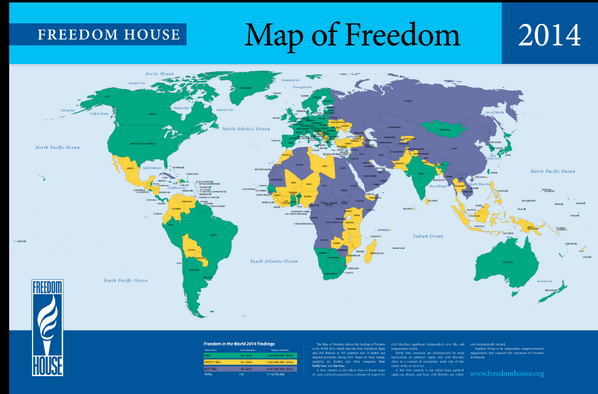
When the 2014 Freedom in the World report was released on January 23, it came with the following map:

At the time I tweeted, “That dot of hopeful green in a see of authoritarian purple is #Mongolia #FIW“. I also quickly added this rating to the Mongolia Scorecard.

Apart from the obvious and embarrassing typo using “see” for “sea”, this tweet generated a lot of re-tweets, but also some reactions. Several Mongolians replied with comments disparaging the state of democracy and freedom in Mongolia.

Most of these comments were very general.

Details on Mongolia’s Subcategory Scores in the Freedom in the World Report

At the time I urged those who find fault with Mongolian democracy to think about this a) in a comparative perspective, but b) also to look at the details of the scoring to see whether they disagreed with any specific aspects.

Comparative Democracies

It’s important to emphasize that few democracies, even those with high ratings in a comparative effort like that run by Freedom House, are perfect by any account of citizens of those democracies or observers. By whatever standard (empirical, philosophical, moral, ethical) one might apply, democracies fall short in functioning as an expression of the political will of the people in all kinds of ways. This is obviously true of Mongolia as well.

Whether it is the declining participation in elections in Mongolia, or the lack of policy options presented by parties, or the amount of corruption in Mongolian politics, there is much than Mongolians might choose to improve about their political system which – like other democracies – remains a work in progress. But this is true of Canada, as it is of Germany or Japan, just to list other democracies that I am most familiar with.

If we look at the more detailed scores for Mongolia that are available from Freedom House, we might look at a category like “Electoral Process”, for example, where Mongolia scores 11 out of 12 points. Examples of other countries with a score of 11 here are: Argentina, Brazil, India, Indonesia, Taiwan, and the U.S. Mongolia’s neighbours receive much lower scores here (as in other categories): Russia: 1, China: 0. The only full score of 12 in Asia is for Japan.

In another subscore where Mongolia’s ranking is much lower, “Rule of Law” (12/16) it is comparable to Ghana, Italy, Slovakia, for example. Asian countries with higher scores include: Japan (15), South Korea (13), Taiwan (14).

Corruption as an area for concern when it comes to democracy and freedom in Mongolia is included under C, “Functioning of Government” where Mongolia is ranked 9/12. This is a ranking that correspond to such countries as Croatia, Jamaica, and Namibia. Asian scores here range from Uzbekistan’s 0 to Japan and South Korea’s 10.

Scoring Freedom in Mongolia

For anyone who disagrees with the rating provided for Mongolia in the Freedom in the World report, I would urge them to turn to the subcategory scores that are provided at http://www.freedomhouse.org/report/freedom-world-aggregate-and-subcategory-scores. The links provided here lead to Excel spreadsheets that provide much more detail on the Mongolian scores than the summary of Political Rights: 1, Civil Liberties: 2 = “Free” does.

In this spreadsheet, the following subcategory scores are recorded for Mongolia: A = 11, B = 16, C = 9, D = 15, E = 11, F = 12, G = 12.

What does this mean? All the categories are explained in the FIW Methodology.

From here, the subcategories take on more meaning.

Political Rights
A = Electoral Process: 11/12
B = Political Pluralism and Participation 16/16
C = Functioning of Government 9/12
Subtotal: 36/40

Civil Liberties
D = Freedom of Expression and Belief 15/16
E = Associational and Organizational Rights 11/12
F = Rule of Law 12/16
G = Personal Autonomy and Individual Rights 12/16
Subtotal: 50/60

Note that for all these scores, Freedom House “assesses the real-world rights and freedoms enjoyed by individuals, rather than governments or government performance per se”. For ratings the question is thus not whether the electoral process is successful in channelling the political will of the people, but whether this process enshrines and guarantees rights within this process.

The individual ratings are based on a series of criteria and questions that is also listed in the FIW Methodology.

As is listed in the FIW Methodology, the cut-off for a Political Rights ranking of 1 is 36 which Mongolia reaches exactly. For Civil Liberties, category 2 is assessed for subtotals for 44-52, so Mongolia’s score of 50 puts it toward the upper end of this range. The relatively low scores that were assessed for Rule of Law and Personal Autonomy and Individual Rights thus keep Mongolia in category 2 for Civil Liberties.

With an average between the Political Rights and Civil Liberties of 1.5, Mongolia falls firmly in the “Free” category.

These scores for 2014 are identical to those for 2013 when Mongolia had made a big jump in the rankings.

That jump was somewhat confirmed by the OSCE election observation mission report which reinforced the generally positive impression of procedures and regulations around national elections, the presidential election for 2013.

Previous Discussion

I had written about the 2013 Freedom in the World report when Mongolia moved up from 2 to 1 in the Political Rights section.

Full disclosure: I have acted as a consultant to Freedom House on the Freedom in the World report for Mongolia.

Posted in Corruption, Democracy, Elections, Governance, Party Politics, Politics | Tagged | 1 Comment

Foreign Policy Roundup #13: January 12-26, 2014

The FPR is back for 2014. Get the highlights of Mongolian foreign policy news from Mongolian-language news sources. Highlights of this week include President Elbegdorj’s trip to Liechtenstein, and Minister L. Bold’s official visit to Urumchi, Xinjiang Uighur Autonomous District.


Neighbors

Minister of Foreign Affairs, L. Bold, traveled to China on the official invitation of the Chinese Minister of Foreign Affairs, Ban Yi. During the visit, L. Bold also made an official visit to Urumchi, the capital of the Xinjiang Uighur Autonomous District to discuss cross border trade and cooperation.

L. Bold was presented with the credentials of the new ambassador to Mongolia from the Russian Federation, Iskandar Kobarovich Azizov. The change in the ambassadorship corresponds with the planning for the celebration of the 75 anniversary of Russian-Mongolian victory over Japan in the Khalkh River battle.

Europe

A delegation of Mongolian parliamentarians made an official visit to France, to meet with their counterparts in the French Senate, the French Minister of Foreign Affairs, and met with Mongolians living, working, and studying in the country.

L. Bold received the outgoing E.U. Ambassador to Mongolia, to congratulate him on his success in promoting E.U.-Mongolian relations and wished him luck in his future endeavors.

Ts. Tuvaan, Minister of Agriculture and Manufacturing traveled to Germany for an exposition on produce and agriculture called “Green Week”.

President Elbegdorj traveled to Liechtenstein, to participate in a meeting of the World Economic Forum. While at the forum, he met behind the scenes with the PM of Japan, and gave a speech on the future of the extractive industry with the president of the Republic of Guinea.


Asia-Pacific

The President of Mongolia held a telephone conversation with Japanese Prime Minister, Abe, to discuss the Japanese-Mongolian strategic partnership and exchange views on regional security.


For last year’s Foreign Policy Roundup postings, please CLICK HERE.


Posted in 2014, Foreign Policy Roundup, Mongolia and ... | Tagged | Leave a comment

In Defence of Twitter Diplomacy

On January 6, David Carment (Carleton Univ, @cdnfp) wrote a comment piece for The Embassy (a Canadian weekly and on-line paper focused on Canada’s international relations) that made a case for “Why Twitter Diplomacy Won’t Lead to Better Foreign Policy“.

As I’ve been very interested in the use of social media for professional purposes, including engagement with stakeholders for foreign policy, I wrote a bit of a rebuttal to this piece.

My rebuttal was published on-line by The Embassy as “In Defence of Twitter Diplomacy” on January 9.

Below is the text of my rebuttal.

David Carment  draws on years of experience in teaching, analyzing and contributing to foreign policy in Canada.  He laments two only loosely related developments: The first is the absence of a foreign policy under the Harper government. He is well-positioned to lament the lack of engagement with academic expertise on the part of the current Canadian political leadership. His comments are timely and deserve wider attention and consideration.

The second development that Carment examines is the putative rise of Twitter diplomacy, or a diplomacy that incorporates social media as an (increasingly central) tool for policy-makers in informing decisions, but also in addressing different stakeholders at home and abroad directly. Here too, Carment decries the absence of engagement between different participants in policy-analysis. While he is right in lamenting the lack of a “conversation” between government policy-makers and experts and their students, it is hardly the technology that is to blame for that.

Advocates of an intensified use of social media as a policy-analysis and policy-making tool point to different aspects: social media as a site for information gathering, for information dissemination, and for engagement. The first two aspects are essentially unidirectional communication and while social media and the information available at our fingertips via the public internet may increase the amount of data available, there may be nothing transformative about that.

It is the engagement where the promise lies and where Carment sees this promise as unfulfilled. In the absence of social media, policy-analysts were limited to deep engagement with a limited number of actors and voices. This is the situation that Carment describes as characterizing his past experience with DFAIT. Particularly given NPSIA’s location in Ottawa and its networks into the federal government I imagine that his portrayal is accurate and was to mutual benefit. Close interactions offered policy-makers efficient and extensive access to deep policy-analysis, and it allowed policy-analysts and academics access to the questions that were occupying policy-makers minds and their students access to learning experiences.

Yet, this approach also had clear limitations. A small number of deep interactions necessarily limit the overall number of interactions.

By contrast, social media hold the promise of offering policy-makers the possibility of hearing many more different perspectives, and tapping into information and analysis that may have been exceedingly difficult and costly to locate in the deep-but-limited-engagement world.

Clearly, the judgment on whether the potential for wider, faster, and more varied engagement will lead to an overall better foreign policy depends on perspective and will have to be reserved for future analyses. From my perspective, there are two aspects that I have experienced (not unlike Carment but in a different context) that do suggest some benefits to a wider engagement.

I am not a foreign policy specialist and I live and work in British Columbia, which removes me from the halls of the Pearson Building in two significant ways.  Yet, I have expertise to contribute to the formulation of Canada’s foreign policy based on my understanding of specific countries, their regional context and their relations with Canada (Japan and Mongolia in my case) and on a particular academic perspective (as a sociologist focused on public policy and institutions). This expertise does not make me an obvious choice for regular interactions with foreign policy-planning experts or strategic thinkers. But when my expertise can be of use, these policy-makers will have a much easier time drawing on this expertise through social media.

By providing expertise in a publicly accessible manner (in my case, primarily through blogs of various formats and tweets that point to these blog contributions, though this accessibility is platform-agnostic and the tools will surely change over coming years) policy-makers have the opportunity to gather information on specific topics more efficiently (thus Carment’s and my DFATD followers on Twitter who are perhaps primarily monitoring rather than engaging), but also to know where to turn when the need for deeper expertise arises.

For me, as a provider of policy-analysis, social media offer the same information-gathering and communication opportunities, but they also lead to deeper, but specific engagement in areas of my specific expertise that would not have occurred in earlier periods.

The same arguments would apply even more to NGOs who address topics of occasional focus for policy-making. Their voices can be heard much more efficiently when policy-makers are able to scan them on an on-going basis and to draw on them directly, ideally engaging in deep conversations at that moment, when the time comes.

Carment is right, of course, that the contributions to improving foreign policy through such wider or more specific engagement presuppose a desire on the part of policy-makers to be informed. I see that desire clearly with DFATD officials and even with individual Conservative policy-makers. On the whole, however, the public impression that the government makes is very much in line with what Carment describes, namely of a lack of interest in subject-matter expertise. The absence of a broader conversation between the government and experts (or the public) thus is also likely to preclude the benefits of an intensified engagement that might come through social media.

Posted in Canada, Foreign Policy, Social Media | Tagged | Leave a comment

Symposium: Mongolian Responses to Globalization

Department for Mongolian and Tibetan Studies
Rheinische Friedrich-Wilhelms-Universität Bonn

January 15-17, 2014

Organizer: Ines Stolpe

The event is designed as a workshop in order to foster lively discussions on issues and topics concerning contemporary Mongolia – including their historical backgrounds. Our primary goal is a productive exchange of ideas. We will focus on: processes of social, economic, political and cultural change within shifting global contexts and horizons, new orientations (partially caused by foreign/new influences), changing normative ideas (including new ideals, neo-traditional tendencies), as well as processes of ‘mongolisation’. As framework we will use the multiple and entangled relations between pre-socialist, socialist and post socialist notions of globalisation.

Symposium Website

Posted in Conferences, Research on Mongolia | Leave a comment

My Sources on Developments in Mongolia

I am sometimes asked how I keep up with developments in Mongolia from afar. I take that question as a compliment on the quality of the analysis we provide.

Social Media

Twitter has become an invaluable tool for keeping up with Mongolia, especially because many Mongolian politicians and commentators are not only active on social media, but are less guarded in their comments than politicians in Canada, for example. I thus follow a number of prominent individuals and try to scan their tweets regularly. When a specific term/policy comes up repeatedly, I try to find out what this discussion is about to understand what role it might play.

My “Secret Weapon”: B Erdenegarid

But, there are sources beyond social media, of course. One of my “secret weapons” is B Erdenegarid. Mr. Erdenegarid provides a daily summary of articles in the Mongolian press to subscribers in German. His meticulousness and good selection of articles and coverage make this invaluable for knowing what topics and views are showing up in the Mongolian print media.

I can’t recommend his press summary more highly. Mr. Erdenegarid can be reached at berdenegarid@gmail.com for subscription inquiries.

Because I rely on his work, I have been meaning to interview him for some time.

Baatar Erdenegarid has been involved in Mongolian trade relations and especially in its relationship with the Germanies since his student days at the Hochschule für Ökonomie (Berlin-Karlshorst) in the early 1960s. Following the completion of his studies (Diplom-Volkswirt Fachrichtung Außenhandel) he held several positions in the Mongolian state’s export business, Mongolexport from 1965 to 1988, eventually rising to deputy chairman (Stellvertretender Vorsitzender). From 1988-1992 he served as the economic counselor at the Mongolian embassy in Belgrade. Since 1992, Mr. Erdenegarid advises numerous private enterprises in Mongolia and abroad focusing on investments and projects in different industries.

Below are his responses to some questions we exchanged by email.

Interview with Erdenegarid

You have been observing Mongolian-German relations for 50 years. Can you divide this period into specific periods.  Surely, 1990 was the most significant watershed, but were there other significant divides?

The German Democratic Republic (East Germany) and Mongolia initiated diplomatic relations on April 13 1950. Even though the Soviet Union supported Mongolia economically, it also pursued highly egoistical policies. Just across the Soviet-Mongolian border six large slaughterhouses were built. The Mongolian government started construction of a meat processing facility in Ulaanbaatar with East German financial and technical help in the middle of the 1950s. This slaughterhouse started operations in 1961. With Bulgarian support a further slaughterhouse was build in Darkhan as well as one in Choibalsan supported by Hungarian aid.

These facilities drastically reduced the export of cattle. Instead of live animals, Mongolia was now able to export meat products and to retain skins, pelts, and innards for further processing. This lead to the construction of a leather industry in the 1960s and 70s. Mongolia thus became a significant exporter of leather, and of leather and sheepskin clothing.

A large carpet factory was set up at the same time and carpets became an export item instead of sheep’s wool. Further carpet factories were set up later in Erdenet and Choibalsan. The gold deposit at Boroo was discovered by German geologists. Gold was produced here and the proceeds were split between Mongolia and the GDR.

From Spring 1965 on Mongolian furs were sold for hard currency in Leipzig and at international fur auctions. This hard currency was desperately needed for the Mongolian economy.

The Federal Republic of Germany took over the GDR embassy and some of the employees. Humboldt University offered Mongolian Studies and continues to do so. This provided Germany with a sufficient number of experts with good knowledge of the Mongolian language and milieu.

Around 30,000 Mongolians were educated at universities, technical and professional schools in East Germany. German was the second-most spoken foreign language after Russian in Mongolia.

As a specialist on Mongolia’s trade you have a good sense of developments of this business over the past ten years. What are particularly interesting developments?

Export opportunities have not been explored to their possible extent. Objective reasons for this are geographic isolation and the relative proximity of the giant Chinese market that sucks everything up.

The extraction of Mongolian natural resources has been financed in past years by aggressive foreign FDI and will be so in the future. With the exception of the economic crisis year of 2009, FDI into Mongolia and the percentage of GDP these represent have been increasing steadily on an annual basis.

The foreign investment law has recently been revised and this might spur more investment again.

At the end of the first half of 2013, overall foreign investments to Mongolia added up to US$17.8 billion.

What role could sea-buckthorn play in Mongolia’s exports?

The Mongolian government is currently pursuing a national program for sea-buckthorn cultivation. Sea-buckthorn products will be exported in significant quantities in coming years.

For your coverage of Mongolia media, you follow the press very closely. Here are a couple of questions about Mongolian print media.
What do you see as a particular strength of the Mongolian press?

There are several newspapers, TV stations, and press agencies that are owned by journalists.

By contrast, where are the press’ weaknesses?

Some mass media are owned by politicians and wealthy businessmen who abuse these outlets to attempt to influence public opinion.

What about the state of economic reporting?

Reporting of economic and business is sufficient.

How good is reporting about developments abroad?

Many Mongolians are fluent in foreign languages and can thus obtain information directly. Bloomberg TV is now reporting whole day and night in Mongolian and English about economic developments around the world.

Many TV stations are now clearly identified with a specific politician/political party. Has this tendency increased among print media as well?

Citizens can elect what to read, listen to and watch. Most mass media have a steady readership.

Do you ever get an itch to write as a journalist yourself when you spend so much time in translating others’ writing?

I follow the maxim: cobbler stay with your lasts. [German proverb to mean that one should do what one knows best how to do.]

What will be the most interesting development in Mongolia in 2014.

I am optimistic about the short-term future. Experts are expecting foreign investments of around US$25billion in the coming 5 years. This is quite significant relative to the US$18billion that have been invested so far. The prioritization of manufacturing and processing industries would be very important.

Posted in Media and Press, Research on Mongolia, Social Media | Tagged | Leave a comment

Export peacekeeping training to Central and East Asia

This op-ed is first appeared in The Embassy, Canada’s foreign policy newsweekly (12/19/2013)

Canada, a co-creator of United Nations peacekeeping, has a substantial comparative advantage in transferring peacekeeping knowledge to Central and East Asian countries, including former communist states, as it has done for generations of peacekeepers from Africa, Latin America, and Central and Eastern Europe.

The transfer of peacekeeping knowledge is a unique Canadian addition to the Canada-United States Asia-Pacific Defense Policy Cooperation Framework that both countries’ defence ministers signed in November.

Although the operational map of the Department of National Defence has not changed much since the end of the Cold War, formerly socialist Mongolia, unexpectedly, has appeared on the DND map. Canadian military assistance there has been repeatedly highlighted by political leaders of both nations, most recently by Governor General David Johnston during his state visit to Ulaanbaatar in October.

In March 2001, DND hosted four Mongolian delegates. Presentations at the Pearson Centre and the Peace Support Training Centre in Kingston, Ont. opened the eyes of Mongolian officials to peacekeeping.

It was knowledge offered at just the right moment when the Mongolian military was trying to explain its vision to political leaders and the public.

In 2003, Mongolian artillery trainers were stationed at the Canadian-run Camp Julien just outside Kabul. Here, the Mongolian military became familiar with the rules of engagement, organization, structure, equipment and even culture of Canadian forces serving in Afghanistan.

From 2006 on, Mongolian military personnel officially began participating in Canada’s foreign military help initiative, the Military Training Assistance Program. It was recently renamed Military Training & Cooperation.

Since 2006, almost 100 Mongolian military members have participated in peacekeeping training courses, including those of the Pearson Centre, and other professional and language courses.

The foreign military help program provides an excellent environment for Mongolian military personnel to learn the complexity of contemporary peace support operations, and a venue for understanding Canadian culture and civil-military relations.

Mongolian forces now offer their unique experiences of coalition operations in Iraq, Afghanistan and Kosovo as well as UN peacekeeping operations in Africa. The Canadian model and experience are more applicable than the US model for states like Mongolia.

Diplomacy of knowledge

This help has prompted Mongolian political and military leaders in encounters at regional events (like the Shangri-La Dialogue, and the Chiefs of Defense Conference) to request more slots in the Canadian military co-operation program, to organize a workshop on peacekeeping strategy and plans, and to invite Canadian forces to attend the annual Mongolian-hosted peacekeeping exercise Khaan Quest.

With support from the US and other NATO members, especially Germany and Canada, Mongolia is now one of the largest contributors for UN peacekeeping operations from Central and East Asia (with 1,200 to 1,500 deployments per year) and operates the only peacekeeping training centre with annual multinational and bilateral exercises. Canada has played an important role to help Mongolia overcome challenges in embarking on this new peacekeeping journey.

Governor General and Commander-in-Chief David Johnston has used the term “diplomacy of knowledge,” which he says is “our ability and willingness to work together and share our learning across disciplines and borders.” Even DND’s limited engagements with Mongolia have proven Canada’s ability to transfer knowledge to a newly found friend in Asia.

The Canadian defence attaché office in Beijing has administrated Canadian military training assistance for Mongolia and participation in multilateral exercises. The results were visible and applauded by the Mongolian military. And they didn’t even require Canada to set up new defence attaché posts. The Canadian experience with the Mongolian military could be extended to other states in the region like Cambodia, China, Laos and Vietnam, some of which have communist-style political and defence structures but are open to new ideas.

Despite the increasing peacekeeping contribution of the People’s Republic of China and Cambodia, both are encountering numerous challenges, including training (from individuals to contingents), organizing logistics of deployments, sustainment, and redeployment, dealing with international and host nations’ laws and culture, and educating politicians, military personnel and the public.

Vietnam has declared its intention to participate in peacekeeping operations starting in 2014. Laos is attending all US-hosted events toward peacekeeping, while North Korea is not objecting to any UN peacekeeping operations. All Central Asian states, especially Kazakhstan, Kyrgyzstan and Tajikistan, are inclined to participate in peacekeeping operations.

Canada seems to be in a better position to disseminate its peacekeeping knowledge in Central and East Asia, because its contender, Australia, appears to be focused on Southeast Asia.

The peacekeeping knowledge transfer would enable countries like Mongolia to become active members of the international community and open more constructive political channels for Canada with these prospective friends. While Canada would not do the UN peacekeeping, Canada would help others become peacekeepers, not troublemakers.

The well-targeted, efficient peacekeeping knowledge of the Canadian Armed Forces will contribute to changing the mindsets of Asian military personnel and help them internalize the norms of professionalism, multilateralism, and most importantly help them become contributors to the global peacekeeping endeavour.

Posted in Canada, Central Asia, Military, Mongolia and ..., UN | Tagged | Leave a comment

Visas, Medicine, Education: Feeling Chinese Soft Power in Mongolia

China has been gradually increasing its soft power in neighbouring Mongolia, from offers of visa-free travel to access to its medical facilities, and most recently, growing educational opportunities in China for Mongolians. These policies have gone far in diminishing deep-seated anti-Chinese sentiment among Mongolians, feelings hardened during the era of Sino-Soviet tensions between 1960 and 1986, even as they have contributed to growing Chinese influence over its neighbor.

The travel patterns of Mongolians have changed dramatically since the Sino-Soviet and Sino-Mongolia rapprochements of the late 1980s, following which the Soviet Union imposed visa requirements on Mongolians (which have persisted under the Russian government), while China offered Mongolians 30-day visa-free travel.  In comparison to 5  -7 days train ride and about 7 hours flight to Moscow, Beijing is approached by train within 12 hours and by air in 2 hours.

In addition to shorter travel hours, visa-free travel arrangements have benefitted Mongolians in a number of tangible ways, including allowing Mongolians to access foreign embassies not represented in Ulaanbaatar and facilitating the import of scarce goods from China.  Like the Chinese traders currently shuttling goods to Pyongyang, Mongolian shuttle traders operating in China have helped meet consumer needs in Ulaanbaatar and even operated along the trans-Siberian routes up to Poland during the economic hardships of 1990s.

Another effective use of Chinese soft power has been the preferential access granted Mongolians to Chinese medical facilities.  As the public health system continues to struggle in Mongolia, Chinese medical facilities have become very beneficial for those Mongolians with urgent medical needs.  Because of cost, distance, visa hurdles, and linguistic challenges, very few Mongolians can seek medical services in South Korea, Japan, Thailand, and the United States, making Chinese medical facilities very attractive.

Chinese educational assistance to Mongolia is also on the rise.  During the Mongolian Prime Minister’s visit to Beijing this October, China promised to increase annual scholarship numbers for Mongolians from 400 to 1000 over the next five years.  Despite historical anti-Chinese sentiments among Mongolians, Chinese schools are becoming the choice of many young Mongolians. As such, the number of Chinese private schools in Ulaanbaatar is also on the rise.  With China’s imminent rise as an economic powerhouse and its proximity to Mongolia, education may become the most effective form of Chinese soft power in the coming years.

On one hand, Chinese visa exemption policies, access to its medical facilities, and educational assistance are contributing to mutual understanding and good neighbourly relations between Mongolia and China, but on the other, Mongolians may find themselves increasingly dependent on Chinese infrastructure and lured into a China-centred orbit. However, Mongolia is still being considered politically and culturally less welcoming environment for Chinese investment, businesses, labor (esp., construction workers), and travellers.

A shorter version was published as the Asia Pacific Memo (#256) on December 13, 2013.

Posted in Asia Pacific Memo, China, International Relations, Publications | Tagged | 1 Comment

Subscribing to Mongolia Focus Updates

We’ve posted over 250 updates to this blog in the past 2 1/2 years. Any volunteers out there to edit a compilation? 😉

You’ve asked frequently about notifications for new posts recently. All along, I’ve tweeted about new posts @jdierkes and will continue to do so.

We’ve now created some new mechanisms for you to receive notifications:

I hope these are useful to our readers, please let us know if there are other notification services that we should add.

Posted in Research on Mongolia, Social Media | Tagged | Leave a comment

Foreign Policy Roundup #12: November 25-December 8, 2013

Highlights for the last two weeks include the 17th meeting of the Russia-Mongolian Joint Governmental Commission, meetings with the Japanese Ministry of Defense, and new relations with Rwanda and Micronesia.


Neighbors

The Russia-Mongolia Joint Governmental Commission met for the 17th time to discuss cooperation in trade, transportation, science and technology, as well as joint ventures such as the Erdenet cooper mine. They also discussed regional and border issues.


Asia-Pacific

Political Secretary of the Mongolian Ministry of Defense, Z. Boldbaatar, traveled to Japan to meet with his counterpart in the Japanese Defense Ministry. Following the meeting, they announced a new initiatitve to increase cooperation in military engineering and hospitals.

Dr. Julian Dierkes published a very informative chart comparing Mongolia and Myanmar. Following which, Brandon Miliate released an article on the potential for Mongolia-Myanmar relations in The Diplomat.

Mongolia attended the Asia Cooperation Dialogue held in Bahrain.

Diplomatic relations between Mongolia and the Federated States of Micronesia were established.

President Elbegdorj continued his tour of Southeast Asia, meeting with the PM of Singapore, before departing for Hong Kong. In Hong Kong, he attended the Hong Kong-Mongolian Business Forum.


Central Asia, South Asia, and the Middle East

PM Altankhuyag met with the outgoing Indian Ambassador to Mongolia, thanking the ambassador for his work in furthering Indian-Mongolian relations. Following this meeting, he received the incoming Turkish Ambassador to the country. 

Mongolia’s newly assigned ambassador to Uzbekistan, B. Batkhishig, presented his credentials to the Uzbekistani Minister for Foreign Affairs.

Europe

Mongolia’s new ambassador to Ireland, N. Tulga, presented his credentials to the Irish President.

L. Bold attended the OSCE Ministerial Council in Kiev, Ukraine.


Latin America

The Mongolian Embassy in Brazil opened last week.


Africa

Mongolia established diplomatic relations with Rwanda.


Multilateral

Minister of Foreign Affairs, L. Bold, attended the NATO ISAF meeting.


For previous postings of the Foreign Policy Roundup in 2013 CLICK HERE


Posted in 2013, Foreign Policy Roundup, Mongolia and ... | Tagged | Leave a comment

Results from the Corruption Perception Index 2013

On Dec 3, Transparency International released its annual Corruption Perception Index.

Previous Posts

Last year, I wrote two blog posts that specifically focused on the CPI score for Mongolia:

Last weekend, I wrote a post that looked ahead to the release of the 2013 CPI.

2013

In 2013, Mongolia’s score came in as 38. That puts Mongolia at 83rd least corrupt among the 177 countries that are included in the CPI.

Elements in the CPI

Some hours after the initial release of the CPI, TI also provided the complete data set of component scores on its website.

For the 2013 CPI, the following sources are listed as sources:

  • Bertelsmann Foundation Transformation Index 2014
  • Economist Intelligence Unit Country Risk Ratings (no date)
  • Global Insight Country Risk Ratings (n.d.)
  • Political Risk Services International Country Risk Guide (n.d.)
  • World Bank – Country Policy and Institutional Assessment 2012
  • World Economic Forum Executive Opinion Survey (EOS) 2013
  • World Justice Project Rule of Law Index 2013

Here is a summary of the CPI scoring for Mongolia:

Rank Score Surveys Used S.E. Lower 90% CI Upper 90% CI Min Score Max Score
2012 94 36 7 2.6 32 40 26 47
2013 83 38 7 2.2 34 42 31 47

Here are the individual component scores on a normalized scale out of 100 as calculated by TI:

BTI ICRG WB WEF WJP EIU GI
2012 32 31 47 26 37 38 42
2013 40 31 47 32 33 38 42

The WEF’s Executive Opinion Survey contributed by far the lowest score to the overall CPI in 2012. This score has moved up significantly to 32 this year. Given that this score reflects an annual opinion survey, movement in the score seems plausible and may well reflect some of the perceptions of corruption that I discussed previously. Likewise the Bertelsmann Transformation Index has moved up significantly to 40. These two increases are somewhat balanced by the drop in the score from the World Justice Project. Though even if the WJP score had remained the same, the overall score would not have changed, so the 2-point increase for the score is driven by the rise in the BTI and WEF scores.

Countries with an Identical Score to Mongolia

Burkina Faso, El Salvador, Jamaica, Liberia, Peru, Trinidad and Tobago, Zambia

Scores for Select Post-State Socialist Countries

Estonia (68), Poland (60), Armenia (36), Vietnam (31), Russia (28), Tajikistan (22), Uzbekistan (17)

Select Scores in Mongolia’s Neighbourhood

Singapore (86), Japan (74), Taiwan (61), S Korea (55), China (40), Indonesia (32), Kazakhstan (26), Kyrgyzstan (24), Myanmar (21)

The average score for the Asia Pacific region (TI includes Mongolia in this region, though I have simply picked countries in some geographic proximity to Mongolia for the listing above) is 43. While below the average, Mongolia comes in above the median score for the region (36).


Posted in Corruption, Governance, Media and Press, Policy, Social Issues | Tagged | Leave a comment