
By Marissa J. Smith
Last month I attended Julian’s talk at Humboldt University of Berlin, “The Mongolian State and the Magnetism of Natural Resources.”
In the talk, Julian posed the question of how the presence of “natural resources” influence the shape and course of democratization and economic development in countries like Mongolia.
The concept that Julian created, that “natural resources” generate “magnetic fields,” sparked my imagination right away. In his talk, Julian gave a comprehensive review of mining projects in Mongolia and their place in the Mongolian imaginary of national development: Nalaikh as the foundation pit of the Mongolian working class, Erdenet as the modernist “milk cow,” and Oyu Tolgoi as the uncertain and contested present and future. As he demonstrated, the “magnetism” of natural resource projects has profoundly shaped Mongolia’s historical path, making it anything but a linear course of prosperous ascendance.
While the primary association with magnets might be “attraction” (in the case of Mongolian mining, international investors, researchers, bilateral and multilateral agreements, and infrastructure projects), the “magnetism of mining” concept provoked me to consider how magnets and magnetic fields also produce “repulsion” (specialization, geopolitical pressure, and infrastructural restraints).
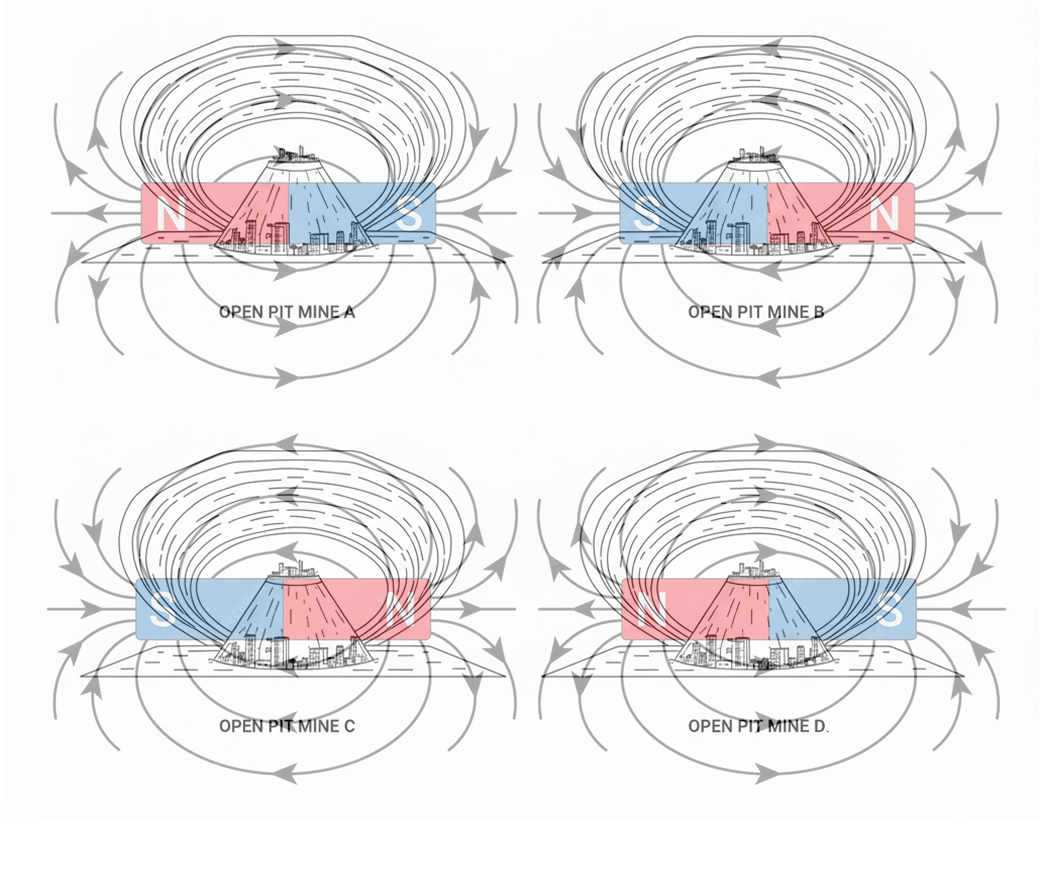
(Created using Gemini 3 and Freepik)
As Julian invited me to reflect on after his talk, the long-term data from Erdenet provides a direct illustration of this magnetism in action. However, looking through the lens Julian has provided, I began to see not just the “attraction” of the modernist “milk cow,” but also the “repulsion” — the specialization and geopolitical pressures — that his framework brings into focus. Acknowledging the “repulsion fields” of mining projects makes possible a particular vision as to how they can drive development gains, at both the local or regional level as well as the national level. While Erdenet functions as the national “milk cow” Julian described, his magnetism framework helps me illuminate how that wealth is not just an input for the national budget, but the regenerative source of a multiplicity of networks maintaining the prosperity of certain groups while repelling “outsiders” who are not “attracted” in by particular types of social physics, at least some of which are particular to the Mongolian context (including the deliberate pacing of more “federalist” reforms in Mongolian governance that Julian noted in his talk).
In the past months, Julian and I have focused on the Prime Minister, the Parliament, and mining in Mongolia as “national” dynamics. We have also documented, however, how as the Prime Minister and the Party have narrativized crises that have (for now at least) “unhappened” as issues of central control in the present to direct development by investigating corruption, collecting revenue from mining projects, and attracting foreign investors, Mongolia’s present problems are also deeply historical and remain caught up in long-standing “force fields.”